Infinite Anekāntic Logos

Infinite Anekāntic Logos: The Doctrine of Inexhaustible Perspectives and Meanings
Toward a Philosophy of Infinite Ontological, Epistemological, Phenomenological, and Semantic Pluralism
I. Introduction: The Inexhaustibility of Reality
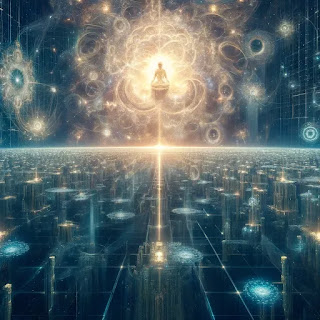
No finite perspective can exhaust an inexhaustible Reality. No finite interpretation can exhaust an inexhaustible Meaning. No finite word can exhaust an Infinite Logos.
Every being is more than any single description of it. Every idea possesses dimensions that exceed its immediate expression. Every word opens onto horizons of meaning that extend beyond its dictionary definition. Every world contains relationships, structures, processes, and possibilities that no single consciousness can completely apprehend.
The universe is not merely something to be observed. It is something to be interpreted, questioned, explored, experienced, and understood through an extraordinary multiplicity of perspectives.
And perhaps one of the greatest errors of the finite mind is to mistake its particular window into reality for the entirety of reality itself.
This paper proposes a philosophical doctrine I call Infinite Anekāntic Logos: The Doctrine of Inexhaustible Perspectives and Meanings.
The doctrine draws inspiration from the Jain philosophical principle of Anekāntavāda, or non-one-sidedness, while extending its central insight into a broader metaphysical framework involving the Greek Logos, Buddhist interdependence, phenomenology, process philosophy, semantic multiplicity, and the possibility of infinite intelligibility.
Its foundational proposition is that reality is not exhausted by any finite conceptualization, and that the relationships between reality, consciousness, language, and meaning may generate inexhaustible horizons of understanding.
The Infinite Anekāntic Logos is therefore both an ontology and an epistemology, both a philosophy of meaning and a philosophy of intellectual liberation.
It is an invitation to move beyond the tyranny of singular perspectives without abandoning the pursuit of objective truth.
For the highest form of understanding may not consist in discovering one final perspective that annihilates all others, but in discovering an ever-expanding capacity to recognize, evaluate, reconcile, and transcend perspectives.
II. Anekāntavāda: The Many-Sidedness of Existence
The Sanskrit term Anekāntavāda (अनेकान्तवाद) is commonly translated as the doctrine of non-one-sidedness or the philosophy of manifold aspects.
Within Jain philosophy, it expresses the conviction that reality possesses multiple characteristics and modes of existence that cannot be adequately represented by a single restricted standpoint.
An object may be described according to its substance, qualities, transformations, relationships, temporal conditions, and practical functions.
Consider a clay vessel.
The vessel exists as a particular object at a particular time and place. Yet it did not exist in its present form before its creation. Its material existed before its present configuration, and that material may continue to exist after the vessel has been destroyed.
The vessel therefore possesses dimensions of continuity and change, identity and transformation, existence and nonexistence under different qualifications.
The apparent contradictions disappear when we recognize the conditions under which each proposition is asserted.
This insight is developed through two closely related Jain doctrines.
Nayavāda concerns the theory of standpoints, recognizing that different approaches disclose different aspects of an object.
Syādvāda concerns conditional predication, expressing judgments in relation to particular respects or conditions.
The famous sevenfold predication of Jain logic explores existence, nonexistence, their qualified combination, inexpressibility, and further combinations of these predicates.
Importantly, Anekāntavāda is not equivalent to the assertion that every proposition is true.
Nor does it require accepting contradictions without qualification.
Rather, it teaches that the validity of a statement must be understood in relation to the standpoint, conditions, and dimensions of reality to which it refers.
The doctrine preserves a distinction between the inexhaustibility of reality and the correctness of particular descriptions.
This distinction is essential to the Infinite Anekāntic Logos.
The existence of innumerable possible perspectives does not entail the validity of innumerable arbitrary conclusions.
A perspective may illuminate, distort, conceal, clarify, or falsify.
The task of wisdom is not merely to multiply perspectives, but to cultivate the capacity to distinguish between them.
III. The Infinite Logos: Reality as Inexhaustible Intelligibility
The Greek word Logos (λόγος) possesses a remarkable range of meanings.
It may signify word, speech, reason, account, explanation, principle, or rational order.
In ancient Greek philosophy, the Logos could represent the intelligible structure of existence. In the Gospel of John, the Logos assumes a profound theological significance as the Divine Word through whom all things came into being.
The concept thus occupies an extraordinary intersection between language, reason, reality, and divinity.
Within my broader philosophical framework, I have explored the Logos through three complementary formulations:
Logos Apeiros — The Infinite Word.
Logos Teleios — The Perfect Word.
Logos Hyperkenos — The Transcendent Word.
These three formulations offer a conceptual architecture through which the Infinite Anekāntic Logos can be developed.
Logos Apeiros: The Infinite Word
Logos Apeiros represents the inexhaustible horizon of meanings, interpretations, relationships, ideas, and intelligible possibilities.
It expresses the intuition that no finite articulation can exhaust the possible intelligibility of existence.
Every answer may generate further questions.
Every discovered relationship may disclose further relationships.
Every interpretation may reveal additional interpretive possibilities.
Every conceptual system may become the foundation for more comprehensive systems.
The Infinite Word is therefore not merely a collection of words.
It is the possibility of inexhaustible intelligibility itself.
Logos Teleios: The Perfect Word
Multiplicity alone is insufficient.
An unlimited proliferation of interpretations, without standards of evaluation, risks producing confusion rather than wisdom.
Logos Teleios represents the aspiration toward truth, coherence, completeness, and the perfection of understanding.
It is the principle through which perspectives are evaluated, refined, corrected, and integrated.
The Perfect Word prevents the Infinite Word from degenerating into indiscriminate relativism.
Not every interpretation is equally illuminating.
Not every perspective is equally coherent.
Not every proposition corresponds to reality.
The pursuit of the Perfect Word therefore requires intellectual discipline, logical rigor, epistemic humility, and a willingness to revise even our most cherished assumptions.
Logos Hyperkenos: The Transcendent Word
Logos Hyperkenos represents that which exceeds every finite conceptual boundary.
It is the recognition that even our most comprehensive systems may remain partial expressions of a reality greater than themselves.
The Transcendent Word does not necessarily invalidate finite knowledge.
Rather, it prevents finite knowledge from being mistaken for absolute conceptual completion.
The Infinite Word expands the horizons of intelligibility.
The Perfect Word disciplines and integrates understanding.
The Transcendent Word reminds us that no finite formulation should automatically be identified with the totality of what is.
Together, these three dimensions provide the metaphysical and epistemological foundation of the Infinite Anekāntic Logos.
IV. Infinite Ontological Pluralism: The Many Dimensions of Being
Ontology concerns the nature of being and existence.
The Infinite Anekāntic Logos proposes that reality may be understood through an extraordinary multiplicity of ontological dimensions.
An entity is not exhausted by its physical composition.
It may also possess temporal, relational, functional, structural, informational, experiential, symbolic, historical, and conceptual dimensions.
Consider a human being.
A human being may be understood biologically as a living organism, psychologically as a conscious and developing person, socially as a participant in communities, historically as the bearer of a unique life, and ethically as a being whose interests and dignity deserve consideration.
The person may also be understood through relationships, memories, aspirations, abilities, vulnerabilities, and unrealized possibilities.
Each description may disclose something genuine.
Yet none should be mistaken for the totality of the person.
A person is not merely a body.
A person is not merely a mind.
A person is not merely a social role, a political identity, a religious affiliation, a psychological diagnosis, or a collection of past actions.
The person exists within a network of dimensions whose full significance may exceed any particular observer's understanding.
This principle can be extended to civilizations, ecosystems, institutions, languages, and entire worlds.
The ontological significance of a thing is partly disclosed through the relationships in which it participates.
A river is a physical system, an ecological habitat, a geographical feature, a historical force, a source of life, and a symbol capable of bearing countless meanings.
These dimensions are not necessarily interchangeable.
But together they reveal why reducing reality to one descriptive framework may impoverish understanding.
The world is not made simpler merely because we choose to see less of it.
The strongest version of Infinite Ontological Pluralism proposes that reality possesses infinitely many distinguishable aspects and relations.
That proposition remains a metaphysical hypothesis requiring philosophical defense.
A more modest version holds that reality is sufficiently complex that no finite descriptive framework should be presumed exhaustive.
Both versions support an important intellectual discipline: the refusal to confuse partial description with total comprehension.
V. Infinite Phenomenological Pluralism: The Countless Horizons of Experience
Phenomenology concerns the structures of experience and the ways in which things appear to consciousness.
The same object may be encountered differently by different observers.
A mountain may appear to a geologist as a geological formation, to an artist as an aesthetic composition, to an ecologist as a network of living systems, to a traveler as an obstacle or destination, and to a religious contemplative as a symbol of transcendence.
The mountain does not necessarily become a different physical object with each interpretation.
Rather, different modes of attention disclose different aspects of its significance.
This distinction is crucial.
The Infinite Anekāntic Logos does not require the claim that every perspective creates an entirely separate reality.
Instead, it proposes that the relationship between consciousness and reality generates multiple horizons of disclosure.
The phenomenological world is shaped by perception, embodiment, memory, language, expectation, emotion, culture, and conceptual understanding.
A change in perspective can therefore transform the experienced significance of something without altering every fact about the thing itself.
A forest may become more intelligible through ecological knowledge.
A painting may become more meaningful through historical understanding.
A person may become more comprehensible through compassion and patient attention.
A philosophical problem may become more tractable through the adoption of an unfamiliar conceptual framework.
This suggests that intellectual liberation involves more than accumulating information.
It involves cultivating new capacities for perception and interpretation.
To become wiser is partly to become capable of seeing what one previously could not see.
The Infinite Anekāntic Logos therefore encourages the deliberate expansion of phenomenological horizons.
It asks us to develop the ability to encounter reality through multiple forms of attention without losing the capacity to distinguish appearance from fact.
VI. Infinite Semantics: Words as Inexhaustible Horizons of Meaning
Language is among the most extraordinary instruments through which consciousness encounters reality.
A word is not merely a sound or inscription.
It is a symbolic structure capable of participating in networks of reference, association, interpretation, memory, emotion, knowledge, and imagination.
The meaning of a word depends partly upon its use, context, history, and relationships with other words.
Consider the word ocean.
At one level, it denotes a vast body of salt water.
Yet it may also evoke depth, mystery, movement, freedom, danger, abundance, exploration, interconnectedness, or immensity.
In theology, an ocean may symbolize divine mercy or inexhaustible goodness.
In philosophy, it may symbolize the apparent boundlessness of existence.
In psychology, it may represent the depths of consciousness.
In literature, it may become a metaphor for grief, hope, transformation, or the unknown.
These meanings do not erase the ordinary referential meaning of the word.
They extend its possible significance through new contexts and relationships.
Within my broader philosophy of Words-as-Infinities, I have proposed that words may be understood as gateways into expanding fields of meaning.
The Infinite Anekāntic Logos provides a complementary foundation for this idea.
If reality admits multiple aspects, and if language can represent these aspects through multiple conceptual relationships, then semantic inquiry may remain indefinitely generative.
Every word can become the subject of further interpretation.
Every definition can be situated within broader conceptual systems.
Every metaphor can establish new relationships between previously separated domains of thought.
Every question can reorganize the semantic field in which an idea is understood.
Nevertheless, semantic productivity must be distinguished from semantic validity.
The fact that a word can acquire new meanings does not mean that every proposed meaning is justified in every context.
Language remains accountable to usage, coherence, communicative intention, and the realities to which it refers.
The goal is not semantic chaos.
It is semantic abundance disciplined by intelligibility.
Words are not merely containers of meaning. They are also windows through which further meanings become visible.
VII. Buddhist Emptiness, Dependent Origination, and Indra's Net
The Infinite Anekāntic Logos finds illuminating parallels in several Buddhist philosophical traditions.
One of the most important is Śūnyatā, commonly translated as emptiness.
Within Madhyamaka Buddhism, emptiness refers to the absence of independent intrinsic existence.
Things arise dependently rather than possessing self-sufficient, unconditioned identities.
This insight is closely associated with Pratītyasamutpāda, or dependent origination.
Phenomena arise through conditions and relationships.
Their existence and significance cannot be adequately understood through isolated, self-contained descriptions.
There is an important distinction between this Buddhist framework and Jain Anekāntavāda.
Jain philosophy affirms the genuine multiplicity of attributes and modes belonging to reality, while Madhyamaka challenges the attribution of independent intrinsic nature to phenomena.
The two traditions therefore should not be collapsed into a single doctrine.
Yet both offer resources for questioning the adequacy of rigid, one-dimensional conceptualization.
A particularly evocative metaphor appears in the Buddhist tradition through Indra's Net.
Imagine an immeasurable network of jewels, each reflecting the others.
Every jewel occupies its own position, yet its appearance is inseparable from the wider network of reflections.
The metaphor suggests a world in which individual phenomena participate in intricate patterns of interdependence.
Within the Infinite Anekāntic Logos, Indra's Net becomes a powerful image of relational intelligibility.
Every concept may illuminate other concepts.
Every discovery may alter the significance of previous discoveries.
Every perspective may disclose relationships unavailable from another standpoint.
The result is not necessarily a universe without distinctions.
It is a universe in which distinctions coexist with profound interconnectedness.
Multiplicity need not be the enemy of unity. Unity need not require the annihilation of multiplicity.
VIII. Scientific Complementarity and the Plurality of Models
Modern science provides several useful analogies for perspectival understanding.
In physics, different models may illuminate different features of the same system.
Quantum complementarity demonstrates that certain experimental arrangements reveal features that cannot be simultaneously manifested through a single experimental setup.
Relativity theory demonstrates that some measurements depend upon reference frames while preserving invariant physical relationships.
Complexity science studies systems whose behavior emerges through interactions among numerous components.
Ecology investigates organisms through networks of interdependence rather than through isolated biological descriptions alone.
Cognitive science examines the mind through neurological, computational, psychological, developmental, and social frameworks.
These examples illustrate the practical importance of multiple explanatory perspectives.
Yet scientific pluralism must not be confused with unrestricted relativism.
A scientific model is valuable because it explains, predicts, organizes, or illuminates phenomena under identifiable conditions.
Its usefulness depends upon empirical adequacy, coherence, scope, and explanatory power.
The Infinite Anekāntic Logos can therefore draw inspiration from scientific model pluralism without claiming that science establishes the metaphysical infinity of reality.
The deeper lesson is methodological.
A complex phenomenon may require several distinct explanatory frameworks.
The limitations of one model do not necessarily invalidate its contributions.
Nor does the usefulness of one model prove that alternative models are unnecessary.
Scientific wisdom often involves knowing which perspective is appropriate, which assumptions it requires, and where its explanatory authority ends.
The same principle can be extended to philosophy, theology, and the interpretation of human experience.
IX. Recursive Intelligibility: Every Answer as the Beginning of Further Questions
One of the most important principles of the Infinite Anekāntic Logos is recursive intelligibility.
Knowledge does not merely accumulate.
It transforms the conditions under which further knowledge becomes possible.
A discovery can generate new questions.
A new question can reveal previously unnoticed distinctions.
A new distinction can produce an entirely new field of inquiry.
A new conceptual framework can reorganize older knowledge and disclose relationships that were previously inaccessible.
Consider the historical development of scientific understanding.
The discovery of microorganisms opened new domains of biology.
The development of genetics generated questions concerning heredity, molecular structure, gene regulation, and evolution.
The investigation of physical matter revealed atoms, subatomic particles, quantum fields, and increasingly sophisticated theoretical problems.
Each stage of understanding created new opportunities for investigation.
This does not establish that every sequence of inquiry must continue infinitely.
But it does demonstrate that intellectual progress frequently expands the space of meaningful questions.
The Infinite Anekāntic Logos proposes that such recursive expansion may be a fundamental feature of intelligibility.
A conceptual formulation of this principle is:
For every finite stage of understanding, further meaningful questions may remain possible.
The stronger metaphysical claim would be that no finite stage of understanding could ever exhaust all possible intelligibility.
Whether that stronger claim can be demonstrated remains an open philosophical problem.
Nevertheless, recursive intelligibility offers a powerful orientation toward learning.
The mind should not merely seek answers.
It should cultivate the ability to generate better questions, discover new relationships, and recognize the horizons opened by each achievement.
The ideal intellect is not simply an archive of conclusions.
It is a living capacity for further understanding.
X. The Seven Principles of Infinite Anekāntic Logos
The doctrine can be summarized through seven foundational principles.
First Principle: Ontological Inexhaustibility
Reality may possess more aspects, relationships, processes, and possibilities than any finite description can adequately capture.
The finite representation should never be confused with the totality represented.
Second Principle: Epistemic Humility
Every finite knower operates within limitations of knowledge, perception, interpretation, and conceptual capacity.
Intellectual humility is therefore not the abandonment of truth, but the recognition that our access to truth may be incomplete.
Third Principle: Semantic Multiplicity
Words, concepts, symbols, and propositions may participate in expanding networks of meaning.
The interpretation of language must remain attentive to context, usage, reference, and the possibility of further significance.
Fourth Principle: Perspectival Complementarity
Different perspectives may disclose compatible dimensions of a shared reality.
Apparent disagreements should be examined for differences in standpoint, scope, assumptions, and meaning before they are treated as irreconcilable contradictions.
Fifth Principle: Recursive Illumination
New understanding can generate further questions, interpretations, distinctions, and discoveries.
Knowledge may expand not only by adding information but by transforming the conceptual possibilities available to the knower.
Sixth Principle: Integrative Discernment
Perspectives must be evaluated through appropriate standards of truth, coherence, evidence, explanatory power, and ethical significance.
Multiplicity does not abolish the distinction between insight and error.
Seventh Principle: Transcendent Openness
No finite conceptual system should automatically be regarded as the final boundary of reality or understanding.
Wisdom remains open to the possibility that what exceeds present comprehension may become partially intelligible through future inquiry.
Together, these principles establish a philosophy that seeks to combine intellectual openness with disciplined judgment.
They reject both rigid conceptual absolutism and indiscriminate relativism.
They propose instead an expanding, self-correcting, and integrative approach to the inexhaustible horizons of existence.
XI. Infinite Interpretive Hospitality: The Ethics of Many-Sided Understanding
A philosophy of multiple perspectives carries profound ethical implications.
Human beings frequently reduce one another to singular descriptions.
A person becomes a political identity, a religious affiliation, a profession, a diagnosis, a mistake, a failure, or an adversary.
The complexity of an entire life is compressed into one category.
Such reductions may serve practical purposes, but they become dangerous when a partial description is treated as the totality of a person.
The Infinite Anekāntic Logos proposes an ethic of Infinite Interpretive Hospitality.
This is the disciplined willingness to recognize that another being may possess dimensions of reality, experience, and meaning that one's present understanding has failed to apprehend.
Interpretive hospitality does not require agreeing with every belief or excusing every action.
It requires resisting the temptation to mistake one's incomplete understanding for exhaustive knowledge.
A person may have committed a wrong without being reducible to that wrong.
A civilization may contain injustice without being reducible to its injustices.
A religious tradition may contain internal contradictions without being reducible to those contradictions.
An opponent may hold mistaken beliefs while nevertheless perceiving genuine problems that others have overlooked.
The moral significance of this doctrine becomes especially apparent in situations of conflict.
Oppression frequently depends upon the reduction of persons to narrow categories that deny their full humanity.
Dehumanization transforms complex beings into simplified objects of fear, contempt, exploitation, or domination.
Interpretive hospitality challenges these reductions.
It encourages the recognition of persons as beings whose experiences, relationships, possibilities, and moral significance exceed the categories imposed upon them.
Yet it must also recognize the perspectives of those who are harmed.
An appeal to multiple perspectives must never become an excuse for refusing to judge cruelty, exploitation, deception, or domination.
The suffering of the oppressed cannot be erased by declaring that their oppressors merely possess a different viewpoint.
Understanding a perspective does not require surrendering moral judgment to it.
The purpose of interpretive hospitality is not to dissolve justice.
It is to make justice more discerning, more humane, and more capable of distinguishing between persons, actions, systems, and possibilities for restoration.
XII. The Infinite Anekāntic Logos and Divine Inexhaustibility
The theological interpretation of this doctrine begins with a question:
If finite reality can disclose such extraordinary multiplicity, what might be said of the intelligibility of an Infinite God?
Within Christian theology, the Divine Logos is associated with the eternal Word through whom creation comes into being.
Within apophatic theology, God transcends the adequacy of finite conceptual descriptions.
Within certain Sufi metaphysical traditions, the language of divine self-disclosure expresses the multiplicity through which divine names and attributes become manifest.
Within Jewish mysticism, Ein Sof, or the Without End, signifies divine infinity beyond ordinary conceptual determination.
These traditions possess distinct theological commitments and cannot simply be treated as interchangeable formulations.
Nevertheless, they invite comparison around a common philosophical problem: the relationship between infinite divine reality and finite understanding.
The theological Infinite Anekāntic Logos proposes that divine intelligibility may be inexhaustible to finite minds.
No finite description of God could contain the totality of divine reality.
No finite theological system could claim exhaustive possession of the Infinite.
No finite act of understanding could eliminate the possibility of further contemplation.
This does not imply that all theological claims are equally true.
Nor does it imply that contradictory descriptions of God must be accepted without examination.
Rather, it suggests that theological understanding may involve an unending process of clarification, purification, deepening, and expansion.
The Infinite Logos may be approached through reason, revelation, contemplation, language, experience, and ethical transformation, while exceeding the limits of every finite formulation.
The theological vision becomes particularly powerful when expressed through the imagery of Infinite Oceans.
Imagine the Countless Bottomless Oceans of God's Infinite Heart and Mind.
Every finite concept is a vessel lowered into those waters.
Every genuine discovery draws something from their depths.
Every new perspective reveals another movement, another current, another horizon.
But no finite vessel contains the Ocean.
And the Ocean is not diminished by the countless vessels that draw from it.
The image expresses a theological possibility rather than an empirically established conclusion.
It portrays divine inexhaustibility as an invitation to endless wisdom rather than an obstacle to understanding.
The Infinite is not impoverished by the multiplicity of its expressions, nor exhausted by the countless minds that seek to understand it.
XIII. The Problem of Relativism
One of the strongest objections to the Infinite Anekāntic Logos concerns the relationship between perspectival multiplicity and objective truth.
If every perspective is partial, how can we distinguish truth from error?
If every interpretation has limitations, how can we justify preferring one interpretation over another?
If reality admits countless descriptions, does the doctrine ultimately undermine the possibility of knowledge?
These objections deserve serious consideration.
The response begins by distinguishing three propositions.
First, a description may be incomplete.
Second, a description may be false.
Third, a description may be true within a particular scope or under particular qualifications.
These are not equivalent conditions.
A biological description of a human being may be accurate without exhausting the person's psychological or ethical significance.
An astronomical description of a star may be scientifically valid without exhausting the star's cultural or symbolic meanings.
A historical interpretation may illuminate certain causes while overlooking others.
In each case, incompleteness does not necessarily entail falsehood.
But neither does incompleteness guarantee truth.
The Infinite Anekāntic Logos therefore requires standards of evaluation.
Perspectives should be assessed according to their logical coherence, evidential support, explanatory adequacy, conceptual precision, and relevance to the questions they seek to answer.
Different kinds of claims may require different methods of evaluation.
An empirical claim must remain accountable to evidence.
A logical claim must remain accountable to valid reasoning.
A historical claim must remain accountable to historical sources.
An ethical claim requires moral argument.
A theological claim must be assessed in relation to its premises, traditions, interpretations, and philosophical implications.
The existence of multiple legitimate forms of inquiry does not eliminate the distinction between justified and unjustified conclusions.
Indeed, the doctrine's commitment to multiplicity makes disciplined discernment even more important.
The greater the number of possible interpretations, the greater the need for intellectual responsibility.
XIV. The Problem of Self-Reference
A second objection concerns the doctrine's own epistemic status.
If no finite perspective can exhaust reality, how can the Infinite Anekāntic Logos claim to know that reality is inexhaustible?
Does the doctrine contradict itself by presenting a universal claim about the limitations of universal claims?
This challenge reveals the need to distinguish several versions of the doctrine.
The modest version asserts that finite human descriptions are limited, situated, and subject to revision.
This position is compatible with many established approaches to epistemology.
The stronger version asserts that reality possesses infinitely many distinguishable aspects, relations, or intelligible possibilities.
This is a substantive metaphysical hypothesis that requires further argument.
The theological version asserts that the ultimate ground of reality is an Infinite Divine Logos whose intelligibility cannot be exhausted by finite minds.
This version additionally depends upon theological commitments.
These three versions should not be conflated.
The limitations of finite human knowledge do not, by themselves, demonstrate that reality contains infinitely many properties.
Nor does the indefinite possibility of generating questions demonstrate that every question possesses a meaningful answer.
An intellectual system committed to epistemic humility must apply that humility to its own foundational propositions.
The Infinite Anekāntic Logos should therefore be understood not as an infallible declaration of exhaustive metaphysical knowledge, but as a developing philosophical framework whose strongest claims remain open to examination.
Its central insight survives this qualification.
Even if the infinity of reality cannot be conclusively demonstrated, the disciplined recognition of finite perspectives remains a powerful foundation for inquiry.
And if the stronger metaphysical or theological versions can be defended, the doctrine may possess implications far beyond ordinary epistemic pluralism.
XV. The Liberation of the Mind from Singular Horizons
The Infinite Anekāntic Logos ultimately proposes a philosophy of intellectual liberation.
The mind can become imprisoned within its own categories.
It may mistake inherited assumptions for necessary truths.
It may confuse familiarity with completeness.
It may become attached to one interpretation so strongly that alternative perspectives appear threatening rather than illuminating.
Such intellectual rigidity can diminish curiosity, creativity, compassion, and understanding.
Anekāntic thinking seeks to loosen these constraints.
It encourages the mind to recognize that the world may be approached through more than one conceptual horizon.
It cultivates the capacity to ask:
What am I failing to see?
What assumptions structure my interpretation?
What would this problem look like from another standpoint?
Which dimensions of reality does my present framework illuminate, and which does it conceal?
Can apparently conflicting perspectives be reconciled through a more comprehensive understanding?
And what new questions become possible once my present understanding is transformed?
These questions are instruments of intellectual freedom.
They allow the mind to move beyond its inherited limitations without abandoning its responsibility to truth.
The ideal is not a consciousness that accepts everything.
It is a consciousness capable of examining almost anything without immediately becoming imprisoned by its first interpretation.
A mind that can inhabit multiple perspectives is not necessarily a mind without convictions.
It may instead be a mind whose convictions have been strengthened, refined, and humanized through deeper understanding.
This is the aspiration of the Infinite Anekāntic Logos:
To cultivate minds that are simultaneously expansive and discerning, imaginative and rigorous, open and principled, fluid and coherent.
The highest intellectual freedom is not freedom from truth.
It is freedom from the unnecessary limitations that prevent us from encountering truth more fully.
XVI. Conclusion: The Infinite Ocean of Perspectives
Reality exceeds our descriptions.
Meaning exceeds our definitions.
Experience exceeds our categories.
Knowledge exceeds our present understanding.
And if the theological vision of an Infinite Divine Logos is true, then the ultimate intelligibility of existence may exceed every finite act of comprehension.
The Infinite Anekāntic Logos proposes that this excess should not be regarded merely as a deficiency of human knowledge.
It may also be understood as an invitation.
An invitation to inquire more deeply.
An invitation to cultivate intellectual humility.
An invitation to explore unfamiliar perspectives.
An invitation to discover new relationships between apparently separated domains of knowledge.
An invitation to develop richer languages, more comprehensive philosophies, more discerning ethical judgments, and more expansive forms of understanding.
The doctrine does not demand that every perspective be accepted.
It demands that no perspective be mistaken for the whole merely because it is familiar, powerful, or persuasive.
It seeks a form of wisdom that can recognize the partial truth within a limited description while remaining capable of identifying its errors.
It seeks an intellectual culture in which the discovery of another perspective is not automatically experienced as the destruction of one's own.
And it seeks a philosophical orientation in which the expansion of knowledge becomes an ongoing process of liberation.
For every finite perspective is a window, but no window is the whole sky.
Every concept is a vessel, but no finite vessel contains the Infinite Ocean.
Every answer may become the beginning of further questions.
Every horizon may disclose further horizons.
And every genuine act of understanding may bring the finite mind into a deeper relationship with the inexhaustible intelligibility of existence.
The purpose of philosophy, then, is not merely to construct systems within which the mind can dwell.
It is also to cultivate the freedom to transcend those systems when greater understanding becomes possible.
The Infinite Anekāntic Logos is a doctrine of that freedom.
A doctrine of multiplicity without nihilism.
A doctrine of truth without intellectual tyranny.
A doctrine of unity without the annihilation of difference.
A doctrine of infinity without the abandonment of discernment.
And a doctrine of the Logos as an inexhaustible horizon of meaning, understanding, and possibility.
Let no finite perspective become a prison.
Let no finite word become the boundary of the Infinite Word.
Let no finite understanding declare the end of wisdom.
For the Countless Bottomless Oceans of Reality, Meaning, and the Infinite Logos may possess depths that no finite mind can exhaust.
And the highest wisdom may consist not in possessing the Ocean, but in learning to navigate its inexhaustible waters.
Philosophical Foundations and Further Reading
The following works provide historical and philosophical foundations for the traditions discussed. The Infinite Anekāntic Logos itself, including its Triple Logos synthesis, is an original proposal rather than an established doctrine of these traditions.
-
Jain Philosophy: The doctrines of Anekāntavāda, Nayavāda, and Syādvāda, especially as developed in classical Jain philosophical literature and modern scholarship.
-
Umāsvāti / Umāsvāmi — Tattvārtha Sūtra. A foundational systematic presentation of Jain philosophy.
-
Māṇikyanandi — Parīkṣāmukha. A significant Jain text addressing epistemology and logic.
-
Nāgārjuna — Mūlamadhyamakakārikā. A foundational Madhyamaka Buddhist work examining emptiness, dependent origination, and the limits of conceptual reification.
-
The Avataṃsaka Sūtra. An important Buddhist scripture associated with the imagery of radical interdependence developed in Huayan thought.
-
Heraclitus — Surviving Fragments. Early Greek reflections on the Logos, change, and the intelligibility of cosmic order.
-
The Gospel According to John, 1:1–18. The Christian theological presentation of the Divine Logos.
-
Pseudo-Dionysius the Areopagite — The Mystical Theology. A foundational work of Christian apophatic theology.
-
Gottfried Wilhelm Leibniz — Monadology. A metaphysical system in which individual monads express the universe from distinct perspectives.
-
William James — A Pluralistic Universe. A philosophical defense of pluralism against certain forms of metaphysical absolutism.
-
Alfred North Whitehead — Process and Reality. A major work of process metaphysics emphasizing becoming, relations, and the complexity of actual existence.
-
Edmund Husserl — Ideas Pertaining to a Pure Phenomenology and to a Phenomenological Philosophy. A foundational investigation of intentional consciousness and the structures of experience.
-
Hans-Georg Gadamer — Truth and Method. An exploration of interpretation, historical understanding, and the encounter between horizons.
-
Niels Bohr — Atomic Physics and Human Knowledge. Essays concerning complementarity, scientific description, and the conceptual interpretation of quantum phenomena.
Infinite Anekāntic Logos: The Doctrine of Inexhaustible Perspectives and Meanings
A Strong Resilience
“No finite perspective can exhaust an inexhaustible Reality. No finite interpretation can exhaust an inexhaustible Meaning. No finite word can exhaust an Infinite Logos.”

Comments
Post a Comment