Holy Epektasis and The Unreachable God

📖
Holy Epektasis and the Unreachable God
Introduction
Why Eternity Must Be an Eternal and Exponential Approach Toward the Infinite God
A Simple Question
What will eternity be like?
For many people, heaven is imagined as:
- A place of peace
- A place without suffering
- A place of reunion
- A place of rest
All of these are beautiful ideas.
But they raise a deeper question:
If eternity never ends, what keeps it from becoming repetitive?
If heaven is perfect, what keeps it from becoming static?
If God is infinite, how could a finite soul ever “finish” knowing Him?
This book proposes a bold but ancient answer:
Eternity is not static perfection.
It is eternal growth.
The Core Idea: Epektasis
The word epektasis comes from the Greek language and means “stretching forward” or “pressing onward.”
It appears in the New Testament (Philippians 3:13) when Paul describes pressing forward toward Christ.
Later Christian thinkers — especially Gregory of Nyssa — developed this into a profound idea:
Even in heaven, the soul continues moving deeper into God.
Not because it lacks something.
But because God is infinite.
If God is infinite love, infinite beauty, infinite wisdom — then no finite being could ever exhaust Him.
Therefore, eternal life must be an eternal approach.
Not because heaven is incomplete.
But because God is inexhaustible.
The Big Claim of This Book
This book argues:
- God is infinite in being, goodness, and love.
- The human soul is finite but capable of growth without limit.
- Eternal life is not static arrival but endless participation.
- The soul approaches God forever without ever exhausting Him.
- This eternal approach is not frustrating — it is joyful.
- The closer the soul comes to God, the more it expands.
- Eternity is an infinite and exponential “Yes” to divine love.
This view preserves two truths at once:
- God remains transcendent and beyond containment.
- The soul enjoys real, deep, and ever-increasing communion.
God is unreachable in essence —
yet infinitely intimate in participation.
Why This Matters
This is not just a theory about heaven.
It reshapes how we understand:
- Growth
- Curiosity
- Identity
- Worship
- Joy
- Purpose
If eternity is endless deepening into infinite love, then:
- There is no ceiling on your becoming.
- There is no final boredom.
- There is no point at which wonder ends.
- There is no fear of stagnation.
The future is infinite — not in duration only — but in depth.
Accessible Framework
Throughout this book, we will use:
- Simple metaphors (like horizons and gravity)
- Clear philosophical reasoning
- Classical Christian theology
- Mathematical analogies (like asymptotes)
- Practical reflections on joy and growth
You do not need advanced theological training.
You do not need a background in philosophy.
All you need is willingness to consider this possibility:
What if eternity is infinite adventure into infinite love?
The Structure of the Book
This book unfolds in three movements:
Movement I – The Foundation of Eternal Growth
We establish the theological and philosophical basis for eternal growth.
Movement II – Asymptotic Theosis
We explain how infinite approach can coexist with perfect blessedness.
Movement III – God as a Holy Black Hole
We explore metaphorically how infinite love draws the soul ever inward — without collapse, without loss, without fear.
The journey moves from clarity to depth.
From argument to vision.
The Invitation
This book does not end with a closed system.
It ends with an open horizon.
If God is truly infinite, then the greatest joy possible is not containment — but endless approach.
Not arrival — but eternal deepening.
Not stagnation — but expansion.
Not fear — but Yes.
And that Yes, once spoken, never stops growing.
📖
Holy Epektasis and the Unreachable God
Movement I
The Foundation of Eternal Growth
Chapter 1
The Crisis of a Static Heaven
For centuries, popular imagination has pictured Heaven as arrival.
Arrival implies completion. Completion implies finality. Finality implies the cessation of movement. The blessed soul, in this view, reaches God, receives eternal satisfaction, and remains forever in a perfected, changeless state. There is peace, there is joy, there is security — but there is no further ascent.
This image is comforting. It promises rest after struggle. It promises resolution after tension. It promises the end of becoming.
But it also conceals a philosophical difficulty.
If God is infinite — not merely very large, not merely maximally powerful, but ontologically infinite — then God possesses inexhaustible depth. His beauty is without limit. His wisdom cannot be circumscribed. His goodness cannot be measured. His being cannot be mapped.
A finite mind cannot exhaust infinite content.
If it could, one of two things would follow:
- God would not be infinite.
- The creature would cease to be creature.
Neither option is acceptable within classical Christian theology.
Therefore, if Heaven consists of truly encountering an infinite God, then encounter cannot imply exhaustion. Vision cannot imply containment. Participation cannot imply completion.
A static Heaven becomes philosophically incoherent.
Infinity and the Structure of Desire
Human longing provides an unexpected clue.
Every finite good eventually reveals its limits. Achievement satisfies briefly. Knowledge expands but also exposes further mystery. Love deepens and simultaneously reveals unexplored depths in the beloved.
This pattern is not accidental. It reveals something about the structure of consciousness.
The mind is not merely a container that fills and stops. It is an expandable horizon. When it encounters greater depth, it stretches.
If the object of that encounter is infinite, stretching cannot end.
Now consider the Beatific Vision — the direct vision of God promised in Christian theology. If this vision were to grant complete comprehension, then divine infinity would be reduced to finite containment. But if it does not grant comprehension — if it grants true vision without exhaustive knowledge — then the experience of God must contain infinite interior movement.
The soul would not stand before God as a finished spectator. It would participate in an endless unveiling.
The Difference Between Rest and Stagnation
Objection arises immediately: Does eternal movement imply dissatisfaction? Does growth imply lack? Would not constant ascent mean perpetual incompletion?
This depends on how one defines rest.
Rest is not the absence of motion. Rest is the absence of frustration.
A river can move without turbulence. A mind can expand without anxiety. A lover can discover new depths in the beloved without dissatisfaction in what is already known.
If God is perfect fullness, then participation in Him does not involve deficiency. It involves depth.
Eternal life, then, need not be static to be restful.
It can be dynamic without being chaotic. It can be ascending without being restless. It can be unfinished without being incomplete.
This is the first crack in the image of static eternity.
The Problem of a Finished Infinity
Imagine, for a moment, that a soul fully comprehends God. There is nothing left to discover. Nothing left to deepen. Nothing left to approach.
What would eternity consist of?
Repetition.
Maintenance.
A fixed state of awareness.
But repetition implies limitation. Maintenance implies containment. A fixed state implies boundary.
Infinity cannot be fixed in a finite container.
Thus, if God is truly infinite, eternal life must involve eternal deepening.
Not because God changes. But because finite participants can expand without limit.
A Hint from Early Christian Thought
The concept of eternal ascent was not invented in modern imagination. It appears in the theology of , who argued that the soul’s movement toward God continues eternally because God’s depth is inexhaustible.
Gregory did not suggest deficiency in God. Nor did he suggest that the soul remains frustrated. Rather, he proposed that divine infinity ensures unending growth.
This concept — epektasis — will anchor the entire project of this book.
But before we build upon it, we must understand the stakes.
If eternity is static, then infinity collapses into containment.
If eternity is dynamic, then transcendence remains intact.
The question is not merely speculative.
It concerns the very nature of joy.
The Ache for an Infinite Future
There is something in the human spirit that resists ceilings.
Not merely pride. Not merely ambition.
But a quiet intuition:
If God is infinite, then there must always be more.
More beauty. More understanding. More communion. More radiance.
A static Heaven feels small because infinity feels large.
The soul aches not merely for peace, but for endless depth.
If this intuition is correct, then eternal life is not arrival at a point.
It is entry into an infinite horizon.
And horizons are approached — never exhausted.
📖
Holy Epektasis and the Unreachable God
Chapter 2
The Infinite, Perfect, and Transcendent God
If eternal ascent is to be more than emotional intuition, it must be grounded in the nature of God Himself. The structure of eternity flows from the structure of the Divine.
We cannot begin with the soul.
We must begin with God.
I. The Meaning of Divine Infinity
When theology declares that God is infinite, it does not mean merely that God is very large or immeasurably powerful. It means that God is without boundary in being.
To be finite is to possess limits — spatial limits, temporal limits, conceptual limits, or ontological limits. To be infinite is not merely to extend beyond a particular limit, but to lack limiting boundary altogether.
God does not occupy a region of reality.
God is not one being among others.
God is Being itself — uncaused, unbounded, underived.
In classical Christian thought, God is not located within the universe. The universe is located within the creative act of God. Divine infinity is not spatial extension; it is the inexhaustibility of pure actuality.
This is why theologians such as described God as actus purus — pure act — containing no unrealized potential. God does not grow, change, or improve. He is fullness.
But fullness, if truly infinite, cannot be conceptually circumscribed.
One may know God truly.
One may never know God exhaustively.
II. Divine Simplicity and Inexhaustible Depth
Divine simplicity often appears at first to threaten the idea of eternal ascent. If God is simple — not composed of parts — how can there be depth to explore? How can there be “more” in that which is indivisible?
The answer lies in distinguishing composition from plenitude.
A thing composed of parts can be analyzed and exhausted. Once the parts are known, the whole is known.
But that which is simple in the divine sense is not partless because it is empty. It is partless because it is fullness without fragmentation.
God does not possess goodness as a quality distinct from His being.
God is goodness.
God does not possess wisdom as an attribute added to His essence.
God is wisdom.
God does not have love as an emotional state.
God is love.
Divine simplicity means that the attributes we distinguish are unified in an infinite plenitude beyond our conceptual divisions.
This means the depth of God is not the depth of complexity in parts.
It is the depth of infinite actuality.
And infinite actuality cannot be exhausted by a finite intellect.
Thus simplicity does not eliminate depth.
It guarantees inexhaustibility.
III. Immutability and Eternal Movement
Another objection arises: If God is immutable — unchanging — how can there be movement toward Him? Does not ascent imply change in the object?
Here we must be precise.
God does not change.
But our participation in God can deepen.
The sun does not increase in brightness because a traveler walks toward it. The traveler’s experience of the sun intensifies without the sun undergoing alteration.
Divine immutability secures the stability of eternal ascent. Because God is unchanging fullness, the horizon toward which the soul moves is not unstable. It is not shifting. It is not evolving.
It is inexhaustible.
Movement in eternity is not God becoming more.
It is the creature participating more deeply in what already infinitely is.
This distinction preserves both transcendence and dynamism.
IV. Transcendence and the Ontological Gap
If eternal ascent is real, it must not collapse the distinction between Creator and creature.
God is not a larger version of us.
He is not an advanced intelligence within the same ontological category.
He is the uncaused ground of all being.
To approach Him infinitely is not to become identical to Him in essence. It is to participate in Him without erasing creaturehood.
The Eastern tradition carefully preserves this distinction through the essence–energies framework, articulated most fully by . While God’s essence remains inaccessible, His energies — His real self-communication — are participable.
This framework provides a metaphysical grammar for epektasis.
One may truly partake.
One may never exhaust.
The ontological gap remains infinite.
Yet communion is real.
V. The Structure of the Infinite Horizon
Consider again the image of a horizon.
A horizon is not an illusion. It is real. It is the boundary of sight at a given vantage point. As one advances, the horizon advances.
The horizon does not retreat because it is false.
It retreats because perspective expands.
If God is infinite being, then every level of participation reveals further depth. The soul does not move because God is distant. The soul moves because God is inexhaustible.
The infinite horizon is not a frustration.
It is a promise.
Every revelation opens further revelation.
Every union deepens into further union.
Every act of comprehension reveals greater mystery.
This is not ignorance.
It is reverent infinity.
VI. The Perfection That Never Becomes Static
Divine perfection does not imply stagnation.
Perfection, in God, means fullness without defect. But fullness without defect is not equivalent to closure for the participant.
The ocean may be perfectly full without shores expanding. But a finite vessel lowered into it can be enlarged without limit.
If the vessel is infinitely expandable, then participation is infinite.
Here lies the foundation of holy epektasis:
- God is infinite fullness.
- The creature is finite but capable of enlargement.
- Enlargement does not imply deficiency.
- Enlargement implies participation.
Eternal life, then, is not static preservation.
It is unending enlargement within immutable plenitude.
VII. The Beauty of the Unreachable God
To call God unreachable is not to deny intimacy.
It is to affirm transcendence.
The unreachable God is not distant in affection. He is unreachable in exhaustion.
You may draw infinitely near. You may never contain.
You may know truly. You may never comprehend totally.
You may love fully. You may never conclude.
This is not tragic.
It is magnificent.
If God were reachable in exhaustion, eternity would collapse into containment.
Because He is unreachable, eternity opens infinitely.
Chapter 2 establishes the metaphysical ground.
We now have:
- Divine infinity
- Divine simplicity
- Divine immutability
- Divine transcendence
- Participatory enlargement
These are not speculative embellishments.
They are classical theology.
And they point directly toward eternal ascent.
📖
Holy Epektasis and the Unreachable God
Chapter 3
The Unreachable God and the Light of Unknowing
If God is infinite, simple, immutable, and transcendent, then a profound consequence follows:
God cannot be comprehended.
This is not a failure of intellect.
It is the logical result of infinity.
A finite mind cannot exhaust infinite being.
And here we arrive at one of the most misunderstood dimensions of Christian theology: apophaticism — the way of unknowing.
I. The Necessity of Negative Theology
Throughout the early centuries of Christianity, theologians recognized a paradox.
To speak of God is necessary.
To define God is impossible.
When we say God is good, we do not mean “good” in the limited, creaturely sense. When we say God is wise, we do not mean wisdom as measured in human cognition. When we say God exists, we do not mean existence as one being among others.
Every positive statement about God must be purified of creaturely limitation.
Thus emerged the apophatic tradition, articulated most powerfully by . Dionysius insisted that after affirming what can be said of God, one must deny it in its limited form.
God is good — but beyond goodness.
God is being — but beyond being.
God is light — but beyond light.
This is not contradiction. It is transcendence.
Apophatic theology does not strip God of attributes. It protects Him from conceptual confinement.
II. The Cloud of Unknowing
In later Christian mysticism, particularly in the anonymous medieval work The Cloud of Unknowing, the idea deepens: God is not grasped by thought but approached by love.
The mind ascends until it reaches its limit. Beyond that limit lies not absence, but excess.
The “cloud” is not darkness of ignorance. It is the brightness of overwhelming light.
This paradox — darkness caused by excessive radiance — becomes central to understanding holy epektasis.
If God is infinite light, then the intellect does not reach a final clarity and stop. It continually adjusts, expands, and reorients as greater brilliance unfolds.
The more one sees, the more one realizes the depth of what remains unseen.
This realization does not produce despair.
It produces wonder.
III. Why Comprehension Would Be Catastrophic
Let us imagine, for a moment, the opposite scenario.
Suppose the finite intellect could completely comprehend God. Suppose there were a final boundary, a definable totality, a conceptual map that contained divine being.
What would follow?
First, God would be reduced to an object.
Second, transcendence would collapse.
Third, eternity would end in intellectual stasis.
A comprehended infinity is not infinity.
It is containment disguised as grandeur.
The unreachable God safeguards divine infinity and eternal dynamism simultaneously.
We approach endlessly because He exceeds endlessly.
IV. The Paradox of Intimacy and Inaccessibility
The language of “unreachable” can sound distant or cold. But apophatic theology does not imply relational separation.
It distinguishes between exhaustion and intimacy.
A child may know his father truly without comprehending the full depth of his father’s mind. A lover may know her beloved deeply without exhausting the beloved’s interiority.
Knowledge does not require exhaustion.
In fact, love thrives on inexhaustibility.
If a person were fully exhausted conceptually, mystery would vanish. And with mystery, much of reverence would vanish as well.
The unreachable God is not inaccessible in affection.
He is inexhaustible in being.
V. The Infinite Horizon of Thought
Consider the structure of human inquiry.
Every time a boundary of understanding is reached, further questions emerge. Scientific discovery does not close mystery; it expands it. Philosophical insight does not eliminate depth; it reveals additional layers.
Finite realities already display this horizon effect.
How much more would infinite being?
If even the created cosmos — vast, expanding, and mathematically intricate — continues to unfold in mystery, then the Creator of such a cosmos must exceed it infinitely.
To stand before infinite being is not to reach a wall.
It is to encounter a horizon that retreats not because it is distant, but because depth increases with approach.
VI. Reverent Ignorance as Fuel for Ascent
Apophatic theology, properly understood, does not paralyze thought. It energizes it.
It humbles the intellect without humiliating it.
It tells the mind:
You may truly know.
You may never finish knowing.
This is not defeat.
It is eternal invitation.
If God were fully definable, ascent would terminate.
Because He exceeds definition, ascent becomes infinite.
Thus negative theology becomes the engine of holy epektasis.
The unreachable God is not a barrier.
He is an infinite invitation.
VII. The Radiance Beyond the Event Horizon of Thought
Here we approach a metaphor that will later mature in this work: the idea of divine gravity.
In astrophysics, the event horizon of a black hole marks a boundary beyond which light cannot escape. It represents a limit of observation.
Apophatic theology suggests something analogous — not a boundary of annihilation, but a boundary of intellectual limitation.
The mind approaches God.
Conceptual light stretches.
Language strains.
And then thought recognizes its boundary.
But beyond that boundary is not emptiness.
It is radiance too intense for containment.
This is not destructive.
It is transformative.
The soul does not fall into darkness.
It descends into brilliance.
VIII. The Beauty of the Endless
The unreachable God preserves the endlessness of eternity.
If He could be circumscribed, eternity would shrink.
Because He exceeds all circumscription, eternity expands.
You may forever approach.
You may forever deepen.
You may forever discover.
And there will always be more.
Not because God is withholding.
But because God is infinite.
📖
Holy Epektasis and the Unreachable God
Chapter 4
Gregory of Nyssa and the Doctrine of Epektasis
If the vision of eternal ascent were merely modern imagination, it would carry little theological weight. But it is not a novelty. It appears in the early Church, articulated with remarkable boldness by Gregory of Nyssa in the fourth century.
Gregory did not invent infinity.
He took it seriously.
And in doing so, he proposed one of the most daring ideas in Christian theology: that even in eternity, the soul never stops stretching forward into God.
I. The Scriptural Seed
Gregory’s doctrine of epektasis arises from a meditation on Philippians 3:13–14, where the Apostle Paul writes of “straining forward” toward what lies ahead.
The Greek term ἐπέκτασις implies extension, stretching, pressing beyond.
For most readers, Paul’s language describes the Christian life in time — the ongoing pursuit of holiness before death.
Gregory, however, perceived something deeper.
If God is infinite, then the movement of “straining forward” cannot cease in eternity. The soul’s forward movement toward God is not a temporary condition. It is the eternal structure of communion.
Eternal life, for Gregory, is not static possession.
It is unending participation.
II. Moses and the Infinite Ascent
Gregory’s treatise The Life of Moses offers his most poetic articulation of this idea. Moses ascends Mount Sinai to encounter God. But each encounter does not conclude revelation. It deepens it.
First comes light.
Then cloud.
Then darkness — not the darkness of absence, but the darkness of excess.
God is encountered, yet remains beyond.
Moses draws near, yet continues ascending.
Gregory interprets this not as failure, but as the very nature of divine communion.
To see God truly is to realize that more remains.
And this realization does not produce despair.
It produces further desire.
III. Desire Without Frustration
This is where Gregory’s brilliance becomes evident.
Ordinarily, desire implies lack. We desire what we do not possess. When possession occurs, desire ceases.
But Gregory suggests a different structure of desire in relation to the infinite God.
In temporal life, desire is often mixed with deficiency. In eternity, desire becomes pure expansion.
The soul participates in God fully at every moment. Yet because God is infinite, each participation opens further depth.
Desire is not born of absence.
It is born of abundance.
One does not seek God because He is withheld.
One seeks because He is inexhaustible.
This is the first articulation of what we are calling holy epektasis.
IV. Perfection as Endless Growth
Perhaps Gregory’s most radical move is redefining perfection.
In many systems of thought, perfection implies completion. To be perfect is to have reached final state.
Gregory reframes perfection as endless growth in the good.
If the good is infinite — and God is the infinite Good — then perfection cannot mean static finality. It must mean dynamic participation.
To stop growing would imply encountering a limit in the good.
But there is no limit.
Thus, in eternity, growth does not signal imperfection.
It signals infinite horizon.
V. Safeguarding Divine Transcendence
It is important to recognize what Gregory does not do.
He does not collapse the distinction between Creator and creature.
He does not suggest absorption into divine essence.
He does not imply that the soul becomes God by nature.
Rather, he insists that participation in God is real yet always creaturely.
The ascent is infinite precisely because the ontological distinction remains.
If the creature were absorbed, movement would cease.
Because distinction endures, communion deepens forever.
Gregory’s doctrine is not mystical dissolution.
It is relational ascent.
VI. The Psychological Genius of Epektasis
There is something psychologically profound in Gregory’s insight.
Human beings often fear finality. We fear boredom more than labor. We fear stagnation more than struggle.
A static eternity can feel small — even if filled with pleasure.
But an eternal ascent into infinite beauty removes this fear.
There is no ceiling.
No final plateau.
No last discovery.
This does not diminish rest.
It transforms rest into stability within motion.
One rests in God while moving infinitely within Him.
VII. Why Gregory Matters for This Project
Holy epektasis is not speculative novelty.
It is rooted in early Christian reflection on divine infinity.
Gregory recognized that infinity and static eternity are incompatible.
If God is infinite, communion must be infinite.
If communion is infinite, ascent must be eternal.
This historical grounding protects the concept from modern exaggeration.
We are not inventing something strange.
We are developing something ancient.
VIII. From Gregory to the Present
Gregory’s insight, however, was never fully systematized into a mathematical or metaphysical framework.
He articulated the vision poetically and theologically.
What this book seeks to do is extend that vision carefully:
- To integrate classical divine attributes.
- To clarify the metaphysics of participation.
- To model eternal ascent using the concept of asymptotic approach.
- To introduce, cautiously, the metaphor of divine gravitational depth.
But none of this stands without Gregory’s original recognition:
God is infinite.
Therefore, eternal life must be unending movement into infinite Good.
📖
Holy Epektasis and the Unreachable God
Chapter 5
The Desire That Cannot Be Exhausted
If holy epektasis is true, it will not merely harmonize with divine attributes and patristic theology. It will resonate with the structure of the human soul.
For theology that contradicts the deep grammar of desire rarely endures. But theology that illuminates it often reveals something already present, already felt.
There is within the human being a peculiar phenomenon: desire that refuses final satisfaction.
I. The Strange Elasticity of Human Longing
Consider the pattern of achievement.
A student works for years toward mastery. A scholar pursues knowledge. An artist refines craft. A lover seeks union. A leader seeks accomplishment. In each case, the anticipated fulfillment promises rest.
Yet upon attainment, something curious occurs.
Satisfaction arrives — but it does not conclude longing.
The mind stretches again.
The horizon expands.
The desire returns, not because the good was false, but because the good was finite.
This elasticity of longing is not mere greed. It is not simple ambition. It is structural.
The human soul does not terminate at finite goods.
It expands.
II. Augustine and the Restless Heart
This intuition is famously expressed by , who wrote: “Our heart is restless until it rests in You.”
Often this statement is interpreted as implying that once God is attained, rest replaces movement.
But rest, in Augustine’s deeper metaphysical framework, is not stagnation. It is stability in the highest good.
If God is infinite, then resting in God does not mean exhausting God.
It means finding an inexhaustible source.
Rest in infinity does not eliminate motion.
It transforms it.
III. Finite Goods as Echoes of Infinite Depth
Every finite good participates, in some limited way, in divine goodness.
Beauty reflects divine beauty.
Truth reflects divine truth.
Love reflects divine love.
When we encounter these goods, we taste something real. But the taste points beyond itself.
A beautiful landscape moves the heart — but the heart senses that beauty exceeds what is seen.
A profound idea illuminates the mind — but the mind senses that understanding is deeper than one argument.
Romantic love overwhelms — yet lovers often testify that the depth of the beloved continues unfolding long after initial union.
Finite goods do not silence longing.
They refine it.
They function as echoes of an infinite original.
If the original is infinite, then the echo can never be exhausted.
IV. The Difference Between Addiction and Transcendence
It is necessary here to distinguish unhealthy craving from transcendental desire.
Addiction seeks repetition because the finite good cannot deliver lasting depth. The addict returns to the same object, hoping for intensity that cannot ultimately be sustained.
Transcendental desire, by contrast, seeks infinite depth because it intuits that the ultimate object is inexhaustible.
Addiction circles.
Epektasis ascends.
The difference lies in the nature of the object.
If God were finite, eternal pursuit would become repetition.
If God is infinite, eternal pursuit becomes expansion.
V. Why Final Satisfaction Would Paradoxically Diminish Desire
Imagine that in eternity the soul encounters God and fully comprehends Him. There is no further mystery. No deeper layer. No new unfolding.
What becomes of desire?
It ceases.
But if desire ceases entirely, then dynamism ceases. And if dynamism ceases, then eternity becomes static possession.
The human structure of longing suggests something different.
We are not built for termination.
We are built for deepening.
This does not imply dissatisfaction in heaven. It implies endless intensification of fulfillment.
Desire purified of lack becomes propulsion toward infinite fullness.
VI. The Paradox of Fulfilled Yet Expanding Joy
There is a form of joy that contains expansion within it.
Consider intellectual discovery. A scientist uncovers a new law of nature. The discovery satisfies — but it also opens deeper questions. The joy of discovery includes anticipation of further depth.
Or consider love within a long marriage. Union is real. Intimacy is genuine. Yet over decades, the beloved becomes more known and more mysterious simultaneously.
Joy does not require finality.
Joy thrives in inexhaustibility.
Thus in eternal communion with God, joy would not flatten into repetition.
It would expand into ever-greater delight.
VII. The Soul as an Expanding Vessel
If God is infinite and the soul is finite, how can participation be endless?
Because the soul is not a fixed container.
The soul is capable of enlargement.
Gregory of Nyssa understood this intuitively: the capacity of the creature increases as it participates more deeply in divine goodness.
The vessel grows.
The horizon widens.
The intellect expands.
The will strengthens.
The heart deepens.
And because God remains infinite, this enlargement never reaches final boundary.
The soul is not infinite by nature.
It is infinitely expandable by grace.
VIII. The Ache as Prophecy
There is something prophetic in the human refusal to accept ceilings.
Even in this life, we are disturbed by finality. We want further exploration, further knowledge, further beauty.
This ache can distort into ambition or pride. But purified, it may reflect something truer:
We were made for infinite depth.
If that is the case, then holy epektasis is not fantasy.
It is fulfillment of the deepest structure of longing.
Eternal life would not eliminate desire.
It would transfigure it.
📖
Holy Epektasis and the Unreachable God
Chapter 6
Knowledge That Expands Forever
Christian theology has long promised something staggering: the Beatific Vision — the direct vision of God “face to face.”
If taken superficially, this promise appears to threaten the entire structure of holy epektasis. For if God is seen directly, what remains to pursue? If the vision is immediate, what remains to deepen?
Does not direct sight imply completion?
To answer this, we must examine what “seeing” God actually means.
I. What Is the Beatific Vision?
The doctrine is articulated most rigorously by . For Aquinas, the blessed soul in heaven sees God not through created images, but through a direct participation granted by divine light.
This vision is not imagination. It is not symbolic representation. It is immediate intellectual participation in God as He is.
But Aquinas is careful.
The intellect truly sees God.
The intellect does not comprehend God exhaustively.
He distinguishes between:
- Vision (true knowledge of the divine essence)
- Comprehension (total containment of the divine essence)
The first is promised. The second is impossible.
For the finite intellect cannot contain infinite being.
II. Vision Without Exhaustion
To see is not to contain.
Consider the difference between gazing at the ocean and containing the ocean. One may truly see the ocean. One does not exhaust its depth.
Now intensify the analogy infinitely.
The Beatific Vision grants direct contact with infinite being. But infinite being cannot be circumscribed by finite cognition.
Thus vision introduces depth.
It does not terminate it.
This distinction is critical.
If vision equaled comprehension, eternity would flatten.
If vision equals participatory encounter, eternity expands.
III. Infinite Object, Finite Knower
The structure of knowledge depends on both object and knower.
If the object is finite, the knower may eventually exhaust it.
If the object is infinite, exhaustion is impossible.
God is not infinite in size. He is infinite in ontological depth. There is no final boundary at which divine being is “fully mapped.”
Thus, even direct intellectual participation cannot terminate mystery.
Mystery in this sense does not imply ignorance.
It implies inexhaustibility.
IV. The Dynamic of Intellectual Ascent
We already observe something similar in finite inquiry.
In mathematics, deeper understanding does not eliminate complexity — it reveals deeper structures.
In physics, discovery of fundamental laws does not conclude exploration — it opens further questions.
In philosophy, clarity often generates more profound mystery.
If finite reality behaves this way, how much more would infinite reality?
The Beatific Vision would not reduce divine depth to static clarity.
It would reveal an infinite interiority that continues unfolding.
The intellect would not chase God from a distance.
It would descend ever more deeply into radiance.
V. The Intensification of Light
Let us refine the metaphor.
Imagine light increasing in intensity without limit.
At first, the eye adjusts and sees more clearly.
As brightness intensifies further, the eye must strengthen to endure it.
Now imagine an eye capable of infinite strengthening.
At no point does light become darkness.
But at every point, greater capacity reveals greater brilliance.
The soul in the Beatific Vision is not blinded by excess.
It is strengthened by grace.
And because divine light is infinite, strengthening never ceases.
Thus knowledge expands forever.
VI. Motion Without Temporal Change
One might object: does eternal expansion imply time in heaven?
Not necessarily.
Temporal succession is not the only form of movement.
There is also intensity without sequence — deepening without decay, participation without chronological progression.
Philosophers speak of “aeviternity” — a mode of existence beyond temporal flux yet not identical to divine eternity.
In such a state, growth need not imply temporal deficiency.
It may involve ontological intensification — ever deeper participation in immutable fullness.
Eternal ascent does not require clocks.
It requires inexhaustibility.
VII. Comprehension as the True Impossibility
Aquinas makes a decisive claim: only God comprehends God.
To comprehend is to know fully, without remainder.
If a creature comprehended God, the creature would equal God in intellect.
This is metaphysically impossible.
Thus, eternal non-comprehension is not failure.
It is necessary to preserve transcendence.
And if non-comprehension remains eternally, then movement remains eternally.
The soul truly sees. The soul never finishes seeing.
VIII. Joy in Infinite Unfolding
What would it feel like to behold infinite being without exhaustion?
It would not feel like chasing something receding.
It would feel like discovering inexhaustible depth.
Joy would not plateau.
Wonder would not terminate.
Intellectual delight would not flatten into repetition.
Each participation would be complete in itself — and yet open onto further radiance.
The joy would not be in reaching the bottom.
The joy would be in discovering that there is no bottom.
We now have a crucial development:
- The Beatific Vision does not contradict holy epektasis.
- It requires it.
Vision without comprehension preserves infinite ascent.
The intellect is fulfilled without being finished.
The horizon is entered without being exhausted.
📖
Holy Epektasis and the Unreachable God
Chapter 7
Love as Infinite Motion
If knowledge in eternity expands without exhaustion, what of love?
For Christianity does not promise merely intellectual vision. It promises communion — union of will, delight, and affection with God.
And here the question becomes even more urgent.
If God is infinite love, can love ever become static?
I. Love Is Not Possession
Love is often confused with possession.
To possess something fully is to have secured it. To love someone truly, however, is not to contain them, but to enter into living relation.
Possession ends movement.
Love deepens it.
In human relationships, love does not terminate upon union. If anything, true union begins the discovery of depth.
A shallow relationship can be exhausted quickly. A deep relationship becomes more mysterious the longer it endures.
The beloved does not become smaller with time.
The beloved becomes larger.
II. God as Infinite Love
Scripture does not merely say God loves.
It says God is love.
If God’s very being is love, and if God is infinite being, then love itself is infinite depth.
To encounter infinite love is not to encounter a finite emotional state. It is to enter inexhaustible relational richness.
Thus, if the soul is united to infinite love, then love must expand eternally.
Static love would imply limited depth.
Infinite love implies infinite interiority.
III. The Difference Between Fulfillment and Finality
One might worry that infinite motion in love implies dissatisfaction. But we must distinguish fulfillment from finality.
Fulfillment means real communion, real joy, real union.
Finality means nothing further can unfold.
In finite relationships, love can become stagnant when novelty disappears or when depth is limited.
But infinite love cannot stagnate because it has no boundary.
Thus, in communion with God:
- Love is fulfilled at every moment.
- Yet love deepens endlessly.
There is no lack.
There is no boredom.
There is only expansion.
IV. The Intensification of Desire
Desire in earthly life often arises from absence.
In eternity, desire may arise from abundance.
When the soul encounters divine beauty, it does not crave because beauty is withheld.
It craves because beauty is inexhaustible.
This is not the hunger of deficiency.
It is the hunger of glory.
The soul tastes.
The soul delights.
The soul perceives further depth.
And love moves forward — not anxiously, but joyfully.
V. The Infinite Reciprocity of Love
Christian theology holds that God is not solitary but triune — Father, Son, and Holy Spirit in eternal relational fullness.
The life of God is already dynamic communion.
When the creature participates in divine life, it does not enter static isolation.
It enters living relationship.
Relationship implies exchange.
Exchange implies depth.
Depth implies movement.
If divine love is eternally dynamic within the Trinity, then participation in that love cannot be inert.
It must reflect that dynamism.
VI. Motion Without Anxiety
There is a form of motion driven by insecurity — fear of loss, fear of abandonment, fear of insufficiency.
That form of motion does not belong to eternity.
Holy epektasis is not anxious pursuit.
It is serene ascent.
The soul is secure.
The soul is held.
The soul is loved completely.
And precisely because security is absolute, love can deepen infinitely without fear.
There is no risk of falling away from infinite love once fully united.
There is only descent into greater radiance.
VII. Love and Infinite Identity
One might ask: if love deepens forever, does the self dissolve?
No.
In fact, the opposite occurs.
In healthy love, identity strengthens.
The more deeply one loves, the more one becomes oneself.
If God is infinite source of identity, then union with Him perfects individuality rather than erasing it.
Thus eternal ascent in love does not produce absorption.
It produces intensification of personhood.
The more deeply the soul loves God, the more fully the soul becomes itself.
VIII. The Beauty of Endless Communion
Imagine eternal communion not as a frozen embrace, but as living exchange.
Every act of love reveals further depth.
Every recognition of divine beauty awakens further delight.
Every participation strengthens capacity.
There is no ceiling.
No repetition.
No flattening.
Just infinite relational depth.
Love becomes movement not because it lacks, but because it cannot exhaust.
We now have both pillars of participation:
- Knowledge expands without exhaustion.
- Love deepens without termination.
Holy epektasis is not merely intellectual.
It is relational.
It is existential.
It is personal.
The soul moves toward God not as abstract principle, but as living communion.
📖
Holy Epektasis and the Unreachable God
Chapter 8
Participation Without Collapse
Every vision of eternal ascent faces a danger.
If the soul approaches God infinitely, does it eventually become God?
If love deepens without limit, does identity dissolve?
If participation intensifies forever, does the Creator–creature distinction erode?
Unless this tension is handled carefully, holy epektasis collapses into either pantheism or mystical absorption. And either collapse would destroy the very structure that makes eternal ascent possible.
The infinite approach must never become ontological collapse.
I. The Creator–Creature Distinction
Classical Christian theology insists upon an unbridgeable ontological distinction between God and creation.
God is uncreated being.
Creation is contingent being.
God exists necessarily.
Creation exists by participation.
This distinction is not merely quantitative. It is categorical.
God is not a being among beings. He is the ground of all being.
Therefore, no matter how deeply a creature participates in God, it never becomes uncreated.
To erase this distinction would dissolve transcendence. And without transcendence, infinity would shrink into immanence.
Epektasis depends upon distinction.
Without distinction, movement ends.
II. The Essence–Energies Framework
The Eastern Christian tradition provides a crucial safeguard through the theology articulated most fully by .
Palamas distinguished between:
- God’s essence (what God is in Himself, utterly inaccessible)
- God’s energies (God’s real self-communication, truly participable)
This distinction is not a division within God. It is a way of preserving both transcendence and real communion.
The creature never participates in the divine essence.
The creature truly participates in divine life through divine energies.
Thus, communion is real.
Absorption is impossible.
The ontological gap remains infinite.
And because it remains infinite, approach remains infinite.
III. Why Collapse Would End Ascent
Consider what would happen if the creature became identical to God in essence.
Movement would cease.
If the soul attained infinite being itself, there would be no further depth to enter. Infinity cannot approach itself.
The paradox is this:
Eternal ascent requires eternal distinction.
If the creature were absorbed, epektasis would terminate.
Thus the preservation of creaturehood is not a limitation of glory.
It is the condition of infinite glory.
IV. Union Without Confusion
The early Church was careful in its language about Christ — affirming union of divine and human natures “without confusion, without change, without division, without separation.”
Something analogous applies here.
The union between God and the soul in eternity must be:
- Without confusion (identities remain distinct)
- Without separation (communion is real)
- Without collapse (essence remains inaccessible)
Intimacy does not require identity.
Love does not require absorption.
Participation does not require equivalence.
V. The Expanding Vessel, Not the Expanding Essence
When we speak of the soul enlarging eternally, we must be precise.
God does not expand.
The soul expands in capacity.
The ocean does not increase when the vessel grows. The vessel simply holds more.
Likewise, divine infinity remains infinite. The creature’s capacity to receive increases.
This enlargement is by grace, not by nature.
The creature never becomes infinite by essence.
It becomes infinitely capable of participation by divine generosity.
VI. The Beauty of Eternal Otherness
There is something profoundly beautiful in eternal otherness.
If God were fully identical with the self, love would collapse into self-regard.
But because God remains transcendent, love remains directed outward.
Worship remains meaningful.
Wonder remains alive.
The infinite God stands forever beyond exhaustion, forever inviting approach, forever preserving reverent distance even in deepest intimacy.
This distance is not alienation.
It is holy difference.
VII. Why Pantheism Destroys Infinity
Pantheistic systems often collapse God and world into one substance. But such systems inadvertently eliminate transcendence.
If everything is God, then nothing approaches God.
If everything is identical with divine essence, then depth becomes flattened into immanence.
Infinity without distinction becomes indistinguishable from totality.
But Christian theology insists that God is both immanent and transcendent.
He is closer to the soul than the soul is to itself.
Yet He remains infinitely beyond comprehension.
This tension preserves the possibility of infinite ascent.
VIII. The Unreachable and the Near
We now see how paradox holds the structure together:
God is unreachable in essence. God is intimately near in participation.
God is infinite in transcendence. God is present in communion.
The soul approaches infinitely. The soul never collapses into divinity.
This is not compromise.
It is the architecture of holy epektasis.
📖
Holy Epektasis and the Unreachable God
Chapter 9
Why Completion Would Be Catastrophic
There is a word that sounds comforting but may conceal danger: completion.
Completion promises rest.
Completion promises finality.
Completion promises no more struggle.
But if applied incautiously to eternity, completion may shrink what should remain infinite.
The question before us is direct:
What would happen if the soul truly “arrived” at God in a final, exhaustive sense?
I. The Seduction of Final Arrival
Human life is structured around goals.
We pursue education to complete it.
We work to finish tasks.
We labor to arrive at stability.
Completion feels like relief.
But this pattern emerges in a finite world. Goals here are bounded because objects here are bounded.
When we project this psychology onto eternity, we assume heaven must culminate in final arrival — a state beyond which nothing remains to pursue.
Yet if God is infinite, such arrival becomes metaphysically incoherent.
Completion presupposes limit.
Infinity denies limit.
II. The Collapse of Wonder
Imagine a soul that fully comprehends God.
There is nothing left unknown. Nothing left mysterious. Nothing left to discover.
What becomes of wonder?
Wonder depends upon depth exceeding perception.
If depth is exhausted, wonder evaporates.
Eternity without wonder would not be torment — but it would be flattened.
The human spirit is animated by discovery. Even in temporal life, the joy of knowing includes the thrill of further unveiling.
To eliminate mystery is to reduce vitality.
The unreachable God preserves wonder eternally.
III. The End of Motion
If the soul reaches final completion, motion ceases.
Not motion in space. But motion of depth.
No further intensification. No further participation. No further ascent.
Existence becomes static maintenance of attained fullness.
But static maintenance is characteristic of finite containment.
Infinite being cannot be maintained by finite intellect in fixed stasis.
It can only be entered more deeply.
If movement ceases, infinity becomes conceptually enclosed.
That enclosure would contradict divine transcendence.
IV. Completion as Implicit Limitation
To say “I have fully arrived” is to imply that the object of arrival is fully containable.
If the soul could reach a final state in relation to God, then divine depth would have boundary.
But divine infinity entails boundlessness.
Thus final completion implies limitation in God.
This is not a minor issue.
It strikes at the core of classical theism.
Holy epektasis protects divine infinity by refusing to imagine a final boundary of participation.
V. The Difference Between Stability and Stagnation
We must distinguish carefully.
Eternal ascent does not mean instability.
The soul is secure. The soul is glorified. The soul is perfected in holiness.
But perfection in holiness does not require termination of depth.
A flame can burn steadily while growing brighter.
A mind can remain stable while deepening in understanding.
A relationship can be secure while expanding in intimacy.
Stagnation is the absence of growth.
Stability is growth without chaos.
Eternity must be stable — but not stagnant.
VI. The Psychological Horror of Endless Repetition
Even if repetition were pleasant, endless repetition would eventually feel small.
Music repeated infinitely without variation would lose its vitality.
Conversation without new insight would become thin.
Experience without novelty would flatten.
Finite goods can only sustain repetition because they are limited.
Infinite good must sustain infinite unfolding.
Otherwise heaven risks becoming eternal familiarity without depth.
Holy epektasis rejects this reduction.
It affirms eternal newness without instability.
VII. The Catastrophe of a Finished Infinity
The phrase “finished infinity” is self-contradictory.
Infinity, by definition, cannot be finished.
To finish infinity is to reduce it to the finite.
If the creature ever reached the final boundary of participation, infinity would have boundary.
Thus completion in the sense of total arrival would not glorify God.
It would shrink Him.
The catastrophe would not be emotional dissatisfaction.
It would be metaphysical contraction.
VIII. The Greater Glory of Endless Ascent
Now invert the scenario.
Instead of final containment, imagine eternal deepening.
Every moment contains fullness. Every moment reveals greater depth. Every participation strengthens capacity. Every union intensifies delight.
There is no deficiency. There is no fear. There is no plateau.
The horizon expands because the participant expands.
God remains infinite. The soul grows without limit in participation.
This vision does not diminish rest.
It magnifies glory.
Completion is replaced not by chaos, but by infinite unfolding.
IX. The Joy of the Unfinished
There is a paradox here.
The unfinished, in this context, is not incomplete.
It is inexhaustible.
The soul is complete in holiness. Complete in communion. Complete in security.
But not complete in exhaustion of God.
Thus the joy of eternity lies not in saying, “I have arrived at the end.”
It lies in saying, “There is no end.”
This is not anxiety.
It is infinite future.
We have now made a decisive turn.
Static heaven shrinks infinity.
Completion implies containment.
Containment contradicts transcendence.
Therefore eternal ascent is not romantic embellishment.
It is logical necessity if God is infinite.
📖
Holy Epektasis and the Unreachable God
Chapter 10
The Ontological Gap
At the heart of holy epektasis lies a tension that must never collapse:
God is infinitely near.
God is infinitely beyond.
The soul is invited into real communion.
The soul never crosses the boundary into divine essence.
This boundary — this infinite distinction between Creator and creature — is not a wall. It is the engine of eternal ascent.
We call it the ontological gap.
I. The Difference Between Degree and Kind
Many philosophical systems imagine transcendence as difference of degree.
God is more powerful. More intelligent. More vast.
But still fundamentally within the same category of being.
Classical Christian theology rejects this.
God is not “more being.”
God is the source of being.
Creation exists contingently — dependent, derived, sustained.
God exists necessarily — uncaused, underived, self-existent.
This is not quantitative difference.
It is qualitative difference.
To cross this gap ontologically would require a creature to become uncreated — a metaphysical impossibility.
Thus the distinction is absolute.
And precisely because it is absolute, approach never collapses into equivalence.
II. Participation Without Equivalence
Participation means sharing without identity.
A mirror participates in light without becoming the sun.
A flame participates in fire without becoming the source of combustion.
Likewise, the soul participates in divine life without becoming uncreated being.
This participation is real, not symbolic.
But it never becomes equivalence.
Equivalence would annihilate distinction.
And annihilating distinction would end movement.
For movement presupposes difference.
III. Why the Gap Is Necessary for Infinity
Consider a thought experiment.
If the soul could eventually cross the ontological gap — if it could become divine by nature — then infinite ascent would have endpoint.
At that point, no further difference would remain to traverse.
The horizon would disappear.
But because the ontological gap is infinite, it cannot be crossed.
And because it cannot be crossed, approach remains infinite.
The very impossibility of ontological fusion guarantees endless depth.
The gap is not a frustration.
It is an infinite invitation.
IV. The Beauty of Creaturehood
Modern spirituality often treats transcendence as escape from creaturehood — a dissolving of self into universal being.
But classical theology affirms the goodness of creaturehood.
To be creature is not to be defective.
It is to be dependent in love.
Dependence is not weakness when the source is infinite goodness.
If the creature were to cease being creature, love would collapse into self-identity.
Communion would disappear.
Worship would lose meaning.
Thus creaturehood is not something to transcend.
It is something to glorify.
And in glorified creaturehood, infinite participation becomes possible.
V. Infinite Distance, Infinite Intimacy
The paradox intensifies.
God is infinitely distant in essence.
God is intimately present in grace.
The ontological gap does not imply spatial distance. God is not far away in location. He is infinitely near as sustaining cause.
The gap refers not to geography but to mode of being.
God is Being itself. The creature is being by participation.
This infinite difference coexists with intimate presence.
Thus the soul may draw infinitely near without collapsing difference.
Infinite proximity does not erase infinite distinction.
VI. The Asymmetry of Being
The ontological gap is not symmetrical.
The creature depends on God absolutely.
God does not depend on the creature.
This asymmetry safeguards humility within eternal ascent.
The soul never ascends by its own nature.
It ascends by grace.
Every increase in participation remains gift.
Infinite ascent is not self-expansion into divinity.
It is infinite reception of divine generosity.
This asymmetry prevents pride and preserves worship.
VII. The Horizon That Cannot Be Crossed
A horizon is not a wall.
It is a limit of perspective.
As one advances, the horizon advances.
But the horizon does not vanish.
The ontological gap functions similarly.
It is not an obstruction.
It is the structural condition of infinite depth.
If the gap were closed, eternity would flatten.
Because the gap remains, eternity expands.
VIII. The Unreachable God Revisited
Now we see why the phrase “unreachable God” is not despairing.
God is unreachable in essence.
But He is infinitely approachable in communion.
The gap cannot be crossed. But it can be approached without limit.
Approach without crossing. Union without collapse. Participation without equivalence.
This is the architecture of holy epektasis.
IX. The Engine of Eternal Ascent
Put simply:
If God were reachable in essence, eternity would terminate. If God were unreachable entirely, communion would be impossible.
But because God is reachable in participation and unreachable in essence, ascent becomes infinite.
The ontological gap is not an obstacle to glory.
It is the engine of glory.
📖
Holy Epektasis and the Unreachable God
Chapter 11
The Eternal Horizon
We have spoken of infinity.
We have spoken of longing.
We have spoken of vision, love, transcendence, and distinction.
Now we gather these threads into a single image:
The horizon.
A horizon is not a boundary of reality. It is a boundary of perception.
When one walks toward it, it does not vanish. It unfolds.
It recedes not because it retreats, but because perspective expands.
The horizon is real — and inexhaustible.
So too is God.
I. The Horizon as Structure, Not Illusion
One might object: is not the horizon an illusion? Is it not merely the limit of sight, not a real thing?
But the horizon is not false. It reveals something true: that perception is finite while space extends beyond it.
Similarly, divine transcendence reveals that comprehension is finite while divine being extends infinitely beyond it.
The horizon does not mock the traveler.
It invites the traveler.
If the traveler stops walking, the horizon remains where it is.
If the traveler advances, the horizon opens further.
The horizon’s retreat is the sign of depth, not deception.
II. Infinity as Infinite Horizon
When we say God is infinite, we mean that no final conceptual boundary contains Him.
The mind approaches.
The mind expands.
The mind encounters ever greater depth.
But there is no final enclosure.
The horizon of divine being is not a line to be crossed.
It is an inexhaustible field to be entered.
In eternity, the soul does not reach the end of God.
It reaches God endlessly.
III. Fulfillment Within Approach
The horizon metaphor clarifies something essential:
Approach does not negate presence.
When standing at the ocean’s edge, one is truly at the ocean — even if the ocean extends beyond sight.
Likewise, in eternal communion, the soul truly possesses God — yet never exhausts Him.
Possession here does not mean containment.
It means participation.
One stands in the infinite while discovering that it extends infinitely beyond.
IV. The Mathematics of the Horizon
We now move toward a crucial development.
In mathematics, there exists the concept of an asymptote — a line that a curve approaches indefinitely but never fully touches.
The curve grows ever closer.
Distance shrinks toward zero.
Yet the line is never crossed.
This model does not imply frustration.
It implies structure.
The asymptote defines the shape of the curve.
Without the asymptote, the curve loses orientation.
Without divine transcendence, eternal ascent loses structure.
God is not a point to be reached and surpassed.
God is the infinite reference that shapes eternal participation.
V. The Horizon and Joy
The fear that eternal approach implies dissatisfaction arises from misunderstanding.
If the horizon were always distant, one might despair.
But imagine a horizon that is always present — always near — yet always unfolding further depth.
Each step is fulfilled.
Each step reveals more.
The joy lies not in closing the horizon.
It lies in entering it endlessly.
In such a structure, eternity is not a frozen achievement.
It is infinite adventure.
VI. The Stability of the Infinite
One might ask: if the horizon constantly expands, is there no stability?
But stability is not the absence of depth.
The ground beneath the traveler remains firm even as the horizon unfolds.
In eternity, God remains immutable fullness.
The soul remains secure in divine love.
The unfolding does not destabilize.
It magnifies.
Thus the eternal horizon is not chaos.
It is ordered infinity.
VII. The Infinite Future
Human beings are creatures of future orientation.
We dread endings not because we fear rest, but because we fear smallness.
A final boundary feels suffocating.
An infinite future feels expansive.
If God is infinite horizon, then eternity is not the cessation of future.
It is the transfiguration of future into endless depth.
There is always more.
More beauty. More knowledge. More love. More radiance.
Not because what has been received is insufficient.
But because what is given is inexhaustible.
VIII. The Edge of Movement I
We have now established the foundation:
- God is infinite and simple.
- God is unreachable in essence.
- The soul longs for infinite depth.
- Knowledge and love expand without exhaustion.
- The Creator–creature distinction remains.
- The ontological gap fuels ascent.
- Eternity is structured as horizon, not endpoint.
The stage is set.
Now we must move from metaphor to model.
Movement II will introduce a rigorous framework for what we have been intuiting.
We will explore:
- Theosis in its theological tradition.
- The mathematical concept of asymptotic approach.
- Exponential intensification of participation.
- Identity without collapse.
- Infinite motion without deficiency.
We move from horizon to equation.
From poetry to structure.
From vision to model.
📖
Holy Epektasis and the Unreachable God
Movement II
Asymptotic Theosis
Chapter 12
What Is Theosis?
Before we can speak of asymptotes or exponential participation, we must understand the doctrine at the heart of Christian divinization: theosis.
The term may sound foreign in Western ears, yet the idea is ancient and deeply rooted in Scripture.
It is nothing less than the claim that human beings are called to participate in the life of God.
But what does that mean?
And what does it not mean?
I. The Scriptural Foundation
The most explicit biblical expression of theosis appears in 2 Peter 1:4:
“That you may become partakers of the divine nature.”
The language is daring.
Partakers — not observers.
Participants — not spectators.
Yet Scripture is equally clear that God alone is uncreated, eternal, self-existent.
Thus the text must be understood carefully.
To partake in the divine nature does not mean becoming divine by essence.
It means participating in divine life by grace.
The distinction between nature and participation is decisive.
II. Early Christian Articulation
Theosis was articulated most clearly in the Eastern Christian tradition. Church Fathers such as expressed it memorably:
“God became man so that man might become god.”
Taken superficially, this statement appears blasphemous.
Taken correctly, it is profoundly Christological.
The Son assumes human nature.
Human nature is united to divine life in Christ.
Through union with Christ, human beings are elevated — not into divine essence — but into participation in divine life.
Divinization is relational and participatory.
It is not ontological equivalence.
III. Theosis and Holiness
Theosis is not abstract metaphysics.
It is sanctification intensified.
To become godlike is to become:
- Holy as God is holy.
- Loving as God is loving.
- Radiant with divine life.
It is moral, relational, existential transformation.
The soul becomes increasingly conformed to Christ.
Not absorbed.
Not annihilated.
Transfigured.
In Western theology, this language appears under the concept of grace and glorification. Though the terminology differs, the substance remains: humanity is elevated beyond natural capacity by divine participation.
IV. The Limits of Theosis
Theosis must be guarded against distortion.
It does not mean:
- Becoming another god.
- Merging into divine substance.
- Losing personal identity.
- Acquiring omnipotence or omniscience.
The Creator–creature distinction remains absolute.
Only God is God by nature.
The creature becomes godlike by grace.
This is the grammar of participation.
Without it, the doctrine collapses into pantheism or self-deification.
V. Theosis and Infinite Capacity
Here we approach the turning point.
If theosis is participation in divine life, and if divine life is infinite, then participation must be capable of infinite deepening.
A finite nature can be elevated.
But if divine goodness is inexhaustible, then conformity to that goodness has no final boundary.
Holiness may reach perfection in kind.
But participation in infinite goodness cannot reach exhaustion.
Thus theosis is not static elevation.
It is dynamic transfiguration.
VI. Theosis and the Beatific Vision
We have already seen that the Beatific Vision does not entail comprehension.
Theosis explains why.
To see God is to participate in His life.
But participation is not containment.
The intellect is illuminated. The will is purified. The soul is glorified.
Yet divine essence remains inexhaustible.
Thus theosis is not a final state that eliminates ascent.
It is the condition that makes eternal ascent possible.
VII. Theosis as Infinite Approach
Now we may state the emerging thesis clearly:
If God is infinite, and theosis is participation in God, then theosis must be infinitely extensible.
This does not imply deficiency in heaven.
It implies inexhaustible depth.
The soul becomes fully glorified — yet continues to deepen.
Perfected — yet endlessly expanding.
Fulfilled — yet infinitely enriched.
Theosis, properly understood, is not the termination of becoming.
It is the sanctified form of eternal becoming.
VIII. The Threshold of Asymptotic Theology
We have now defined theosis.
In the next chapter, we will introduce a conceptual model that clarifies its structure: the asymptote.
This model does not reduce theology to mathematics.
It uses mathematics to illuminate what theology already affirms:
Infinite approach without ontological collapse.
Participation without exhaustion.
Union without equivalence.
The curve and the line.
The soul and God.
Movement toward infinite horizon.
📖
Holy Epektasis and the Unreachable God
Chapter 13
Essence and Energies: The Architecture of Participation
The doctrine of theosis demands precision.
If we are to speak of infinite participation in God, we must answer a decisive question:
What exactly is being participated in?
If the creature participates in God’s essence, then the Creator–creature distinction collapses.
If the creature participates in nothing real, then communion becomes symbolic fiction.
Thus the Church developed a metaphysical grammar to safeguard both transcendence and real union.
That grammar is known as the distinction between essence and energies.
I. The Problem of Divine Accessibility
God is simple.
God is infinite.
God is uncreated.
If divine essence is identical with divine being — as classical theology insists — then how can a finite creature truly participate in that which is infinite and uncreated?
If divine essence were directly shared, the creature would become uncreated.
But this is metaphysically impossible.
Thus we require a distinction that preserves:
- Divine simplicity.
- Divine transcendence.
- Real communion.
- Eternal distinction.
The distinction must not divide God into parts.
It must clarify modes of participation.
II. Gregory Palamas and the Clarification
The most explicit articulation of this distinction comes from in the fourteenth century.
Palamas argued that:
- God’s essence (ousia) is utterly inaccessible.
- God’s energies (energeiai) are His real, uncreated self-communication.
The energies are not created effects.
They are not symbolic representations.
They are God truly present and active.
When the soul participates in divine life, it participates in these uncreated energies — not in the divine essence.
Thus the soul is united to God truly, yet without ontological fusion.
III. Unity Without Division
The distinction between essence and energies does not imply composition within God.
God is not divided into parts.
Rather, the distinction refers to:
- What God is in Himself (essence).
- How God gives Himself (energies).
The sun is not divided when its light radiates. The light is not separate from the sun’s reality, yet the sun’s core remains inaccessible.
The analogy is imperfect — as all analogies are — but helpful.
The creature does not enter the core of divine essence.
It stands in the radiance of divine life.
And that radiance is truly God.
IV. Why This Distinction Enables Infinite Ascent
Now we see why this framework is indispensable to holy epektasis.
If divine essence were accessible, the creature would eventually exhaust participation — or collapse into identity.
If divine life were only symbolic, communion would lack substance.
But because divine energies are real, uncreated, and infinite — while divine essence remains transcendent — participation becomes both real and inexhaustible.
The soul truly participates.
The soul never reaches the end.
The ontological gap remains infinite.
And because it remains infinite, approach remains infinite.
V. Participation as Radiant Contact
Participation is not conceptual awareness alone.
It is existential contact.
The soul becomes luminous with divine life.
The will becomes aligned with divine goodness.
The intellect becomes illuminated by divine light.
The entire being is transfigured.
Yet divine essence remains beyond comprehension.
Thus participation intensifies forever without collapsing into equivalence.
The radiance deepens.
The core remains transcendent.
VI. The Infinite Energies of an Infinite God
If God is infinite, then His self-communication is inexhaustible.
Divine energies are not a finite output.
They are infinite expression of infinite being.
Thus participation cannot plateau.
There is no final measure of divine radiance that the creature can absorb.
Capacity may expand indefinitely.
Grace may deepen eternally.
Communion may intensify without limit.
This is not because God changes.
It is because God is infinite fullness.
VII. Avoiding Misunderstanding
This distinction must not be misunderstood as introducing layers within God.
God does not possess a hidden part and an accessible part.
God is simple.
The distinction lies in relation — not in composition.
From our perspective, divine essence is inaccessible.
Divine energies are participable.
From God’s perspective, there is no division.
This asymmetry preserves transcendence while allowing communion.
VIII. The Bridge to Asymptotic Theosis
We are now ready to introduce the mathematical analogy.
In asymptotic geometry, a curve may approach a line infinitely without crossing it.
The line remains distinct.
The curve approaches without merging.
Distance decreases without collapsing into identity.
So too:
The soul approaches divine life infinitely through participation in divine energies.
Divine essence remains infinitely transcendent.
The distance of ontological difference never becomes zero.
Yet communion becomes infinitely intimate.
This is not metaphor alone.
It is structural analogy.
Theosis has asymptotic form.
IX. The Stability of Infinite Participation
The essence–energies framework secures the stability of eternal ascent.
God remains immutable.
The soul remains creature.
Participation remains real.
Difference remains infinite.
Approach remains endless.
Without this structure, holy epektasis would either dissolve into pantheism or shrink into finite completion.
With it, eternal expansion becomes coherent.
📖
Holy Epektasis and the Unreachable God
Chapter 14
The Asymptote
The time has come to introduce a model.
Not to reduce theology to mathematics.
But to use mathematics as analogy — precise, restrained, illuminating.
The concept is simple.
An asymptote is a line that a curve approaches indefinitely but never reaches.
The distance between them decreases without becoming zero.
The approach is real. The convergence is measurable. The crossing never occurs.
This structure provides a remarkable analogy for holy epektasis.
I. What Is an Asymptote?
In analytic geometry, consider the function:
y = 1/x
As x increases toward infinity, y approaches zero.
The curve draws ever nearer to the x-axis.
The gap becomes smaller and smaller.
Yet the curve never touches the axis.
The axis defines the shape of the curve.
Without the asymptote, the curve would not have its form.
The asymptote is not an obstacle.
It is orientation.
II. Translating the Model Theologically
Now consider:
God = Infinite Being
The Soul = Finite Participant
Participation = Growth in divine likeness
The soul moves toward infinite participation.
Distance decreases.
Union intensifies.
Knowledge deepens.
Love expands.
Yet the ontological distinction between Creator and creature remains.
The soul does not cross into divine essence.
The distance of metaphysical difference never becomes zero.
The approach is real.
The collapse never occurs.
III. Why This Model Matters
The asymptotic model solves several tensions simultaneously.
- It preserves transcendence.
- It preserves real approach.
- It preserves infinite dynamism.
- It avoids pantheistic fusion.
- It avoids static containment.
The soul grows infinitely close in participation. God remains infinitely beyond in essence.
Distance shrinks. Difference remains.
This is holy asymptosis.
IV. Infinite Approach Without Frustration
One might object: is not asymptotic approach eternally incomplete?
In mathematics, incompletion implies limit.
But in theology, incompletion does not imply lack.
In asymptotic growth, each step may be complete in itself while still open to further approach.
The curve is never deficient because it does not touch the axis.
Its movement defines its fullness.
Likewise, in eternal communion:
Each participation is full. Each moment is glorified. Each act of love is complete.
Yet infinite depth remains.
Incompletion here is not failure.
It is structure.
V. The Ontological Distance Never Reaches Zero
Let us be precise.
In the asymptotic model, the distance between curve and line approaches zero but never equals zero.
In holy epektasis:
The relational distance approaches maximal intimacy. The ontological distance never disappears.
God remains uncreated. The soul remains created.
God remains infinite. The soul remains participant.
This is not dualism.
It is ordered distinction.
VI. Exponential Intensification
Now we refine the model.
Consider exponential functions — curves that increase rapidly over time.
If participation in divine life intensifies not linearly but exponentially, then eternity does not merely extend duration.
It magnifies depth.
The soul’s capacity grows.
Growth accelerates.
Union intensifies.
Yet divine infinity remains infinitely beyond.
The asymptote remains.
The curve steepens.
The approach becomes more intimate without collapsing distinction.
This is not static heaven.
It is accelerating glory.
VII. The Asymptote as Infinite Reference
The asymptote does not retreat.
It remains fixed.
The curve moves.
Likewise, God does not evolve to accommodate ascent.
God remains immutable fullness.
The soul expands.
The model protects divine immutability while allowing eternal dynamism.
God is not becoming.
The soul is participating.
VIII. The Beauty of Structural Infinity
The asymptotic model reveals something profound:
Infinite approach is not chaotic.
It has form.
It has orientation.
It has direction.
The curve does not wander randomly.
It is drawn toward a defining reference.
Holy epektasis is not mystical drift.
It is structured convergence toward infinite good.
IX. The Emotional Impact of the Model
There is something strangely comforting about asymptotic approach.
It means:
You will never exhaust God. You will never become bored. You will never plateau. You will never collapse into sameness.
There will always be more.
Not because something is withheld.
But because infinity cannot be contained.
The asymptote guarantees eternal future.
X. The Mathematical Grammar of Worship
Worship itself has asymptotic form.
The more one knows God, the more one recognizes His depth.
The more one loves God, the more one perceives infinite beauty.
The closer one draws, the greater the radiance.
The asymptote becomes not a limit, but a holy reference — defining direction, shaping growth, preserving reverence.
This is not cold abstraction.
It is geometry in service of glory.
📖
Holy Epektasis and the Unreachable God
Chapter 15
Exponential Growth in Eternity
An asymptote gives us structure.
But structure alone does not yet capture the radiance of eternal participation.
We must ask:
If participation in God is asymptotic, what is the character of its growth?
Is it slow and linear — steady but modest?
Or is it exponential — accelerating, intensifying, magnifying without limit?
To answer this, we must rethink what eternity means.
I. Eternity Is Not Endless Time
When we hear “eternity,” we often imagine infinite duration — time stretching forward without termination.
But classical theology distinguishes between temporal succession and eternal participation.
God does not exist in time.
The soul in glorified state does not merely experience endless chronological extension.
Rather, it participates in a mode of existence beyond decay, beyond loss, beyond temporal limitation.
Thus eternal growth need not mean slow, incremental change.
It may mean intensification without decay.
Depth without entropy.
Participation without diminishing return.
II. The Difference Between Linear and Exponential Growth
Linear growth adds steadily.
Exponential growth multiplies.
In linear increase, capacity rises predictably.
In exponential increase, growth accelerates dramatically.
If participation in divine life were merely linear, eternity might feel like slow extension.
But if participation is exponential, then every increase in capacity amplifies the ability to receive further increase.
The vessel not only grows.
It grows in its capacity to grow.
This is glory intensifying itself.
III. Grace as Amplifier
Theology speaks of grace as elevating nature.
But what if grace not only elevates but amplifies?
In temporal life, spiritual growth can feel gradual and uneven.
But in glorified state, impediments vanish.
Sin no longer distorts. Ignorance no longer clouds. Weakness no longer limits.
The soul, fully healed, becomes perfectly receptive.
Each act of participation increases capacity.
Increased capacity allows deeper participation.
Deeper participation further expands capacity.
This feedback loop resembles exponential ascent.
Not frantic acceleration.
But luminous intensification.
IV. Why Exponential Participation Preserves Joy
One fear regarding eternal ascent is monotony.
But monotony arises from flatness.
Exponential growth prevents flatness.
Imagine joy that does not merely continue, but deepens.
Imagine love that does not merely endure, but expands in richness.
Imagine knowledge that does not merely accumulate facts, but unfolds into new dimensions of understanding.
Each increase generates greater capacity for further increase.
Joy compounds.
Love compounds.
Illumination compounds.
This is not repetition.
It is radiant escalation.
V. The Infinite Depth of Divine Being
Why must growth be exponential?
Because the object of participation is infinite.
If God were merely vast, growth might eventually slow as limits were approached.
But because God is infinite plenitude, there is no boundary at which growth must taper.
The asymptote remains infinitely beyond.
Thus the curve may steepen endlessly without ever crossing the line.
Exponential participation does not threaten transcendence.
It magnifies it.
VI. No Ceiling, No Saturation
Finite goods saturate.
After a point, further increase adds little.
But infinite good cannot saturate finite capacity because capacity itself is infinitely expandable by grace.
There is no final threshold beyond which the soul says:
“I have absorbed all that can be absorbed.”
Such a statement would imply finite depth in God.
But infinite being ensures inexhaustible radiance.
Thus there is no ceiling.
Only horizon.
VII. Eternal Freshness
Perhaps the greatest promise of exponential participation is eternal freshness.
In temporal experience, novelty fades.
Familiarity dulls intensity.
But if divine beauty is infinite, familiarity reveals new layers rather than diminishing wonder.
Each encounter discloses further intricacy.
Each recognition reveals deeper brilliance.
The familiar becomes ever more profound.
The known becomes ever more luminous.
Exponential growth ensures that eternity never becomes stale.
VIII. The Strengthening of Identity
As participation intensifies, identity does not weaken.
It strengthens.
The more deeply the soul participates in divine life, the more fully it becomes itself.
Exponential growth in God does not erase personality.
It perfects it.
Individuality becomes more radiant, more defined, more vibrant.
Infinite participation does not flatten difference.
It glorifies uniqueness.
IX. Stability Within Acceleration
Exponential growth may sound unstable.
But this is not chaotic acceleration.
It is ordered intensification within immutable fullness.
God does not change.
The soul does not wobble.
Participation deepens in serenity.
The curve steepens without turbulence.
This is acceleration without anxiety.
Intensity without fear.
X. The Shape of Eternal Glory
If we combine asymptotic structure with exponential intensification, we arrive at a powerful model:
The soul approaches infinite divine life. The approach accelerates. Capacity compounds. Distance shrinks. Essence remains transcendent.
The curve rises steeply toward the infinite horizon.
But the line remains infinitely beyond.
This is not tragic incompletion.
It is structured ecstasy.
📖
Holy Epektasis and the Unreachable God
Chapter 16
Infinite Depth, Finite Vessel
We have spoken of asymptotic approach and exponential participation. But a serious philosophical question remains:
How can a finite creature participate infinitely in God without becoming infinite by nature?
If the soul remains finite, does it not eventually reach its limit?
To answer this, we must distinguish between being finite and being finitely bounded.
I. What It Means to Be Finite
To be finite means to have derived existence — to be contingent, limited, and dependent.
The soul does not possess infinite being in itself. It does not exist necessarily. It does not generate its own essence.
Thus the soul cannot become infinite in ontological status.
It remains creature.
But finitude in essence does not require fixed limitation in capacity.
A vessel may be finite in structure yet capable of expansion.
The difference between nature and capacity is decisive.
II. Capacity as Expandable
In temporal life, human capacity appears limited.
We grow physically to a point and stop. We learn intellectually to a point and slow. We mature emotionally within bounds.
But these limits are tied to temporal, biological, and psychological constraints.
In glorified existence, those constraints vanish.
The soul is no longer bound by entropy, decay, or cognitive distortion.
Capacity becomes receptive without resistance.
Thus the vessel is finite in nature but not fixed in capacity.
It can be enlarged by grace indefinitely.
III. Enlargement Without Essence Change
One might worry: does enlargement imply transformation into something else?
Yes — but not into uncreated being.
The soul is transfigured, not ontologically reclassified.
A child becomes an adult without ceasing to be human.
A mind grows in knowledge without becoming a different species.
Likewise, the glorified soul increases in participation without ceasing to be creature.
Its nature remains creaturely.
Its capacity becomes ever more radiant.
IV. Infinite Depth Requires Infinite Receptivity
If God’s being is infinite depth, then participation must involve infinite receptivity.
Receptivity does not require infinite essence.
It requires openness to infinite gift.
Think of an endlessly deep well into which water flows without limit.
The well may expand in its depth without becoming the source of water itself.
Likewise, the soul may deepen infinitely without becoming the source of divine being.
Grace does not erase finitude.
It perfects receptivity.
V. The Expanding Vessel Analogy
Consider again the analogy of the vessel in the ocean.
The vessel is finite.
It cannot become the ocean.
But if the vessel is made of living material capable of infinite expansion, then it can hold ever greater participation without limit.
The ocean remains ocean.
The vessel remains vessel.
The distinction persists.
Yet participation grows.
The analogy is imperfect, but it clarifies structure.
Infinite participation does not require infinite essence.
It requires infinite expansion of capacity.
VI. Theological Precedent for Infinite Enlargement
Gregory of Nyssa already intuited this structure.
The soul’s desire grows as it participates more deeply in divine goodness.
Participation increases capacity.
Capacity enables further participation.
The process does not terminate because divine goodness has no boundary.
The soul is not infinite by nature.
It becomes infinitely capacitated by grace.
This preserves transcendence while allowing eternal growth.
VII. The Avoidance of Saturation
Finite systems saturate when capacity is filled.
But if capacity expands proportionally to reception, saturation never occurs.
In mathematical terms, this resembles an open system whose boundary recedes as input increases.
The soul receives divine light. The soul expands. Expanded capacity receives more. Expansion continues.
Because divine light is infinite, expansion never terminates.
Because the soul remains creature, it never becomes the source.
The system remains asymmetrical.
VIII. Identity Deepens Rather Than Dissolves
Infinite enlargement does not blur individuality.
In fact, greater participation in divine life reveals the true form of the person.
Sin distorts identity.
Grace clarifies it.
As capacity expands, the soul becomes more distinctly itself.
Infinite participation intensifies uniqueness.
Thus eternal growth does not produce uniformity.
It produces radiant differentiation.
IX. The Beauty of Endless Expansion
There is something profoundly beautiful in the idea that capacity itself is without final boundary.
You will never reach the end of what you can become in God.
Not because you are incomplete.
But because divine depth is inexhaustible.
The soul’s finitude ensures humility.
The soul’s expandability ensures infinite future.
This is the paradox:
Finite in nature. Infinite in participatory capacity.
X. The Shape of Eternal Becoming
We may now articulate the structure more precisely:
The soul remains finite in ontological essence. The soul becomes infinitely expandable in receptive capacity. Participation intensifies exponentially. Divine essence remains transcendent. Asymptotic approach persists eternally.
This is not contradiction.
It is ordered infinity.
The finite vessel deepens without end because the infinite ocean cannot be exhausted.
📖
Holy Epektasis and the Unreachable God
Chapter 17
Identity Without Collapse
There is a subtle fear that often arises when speaking of union with God:
If participation becomes infinite, does the self disappear?
Does eternal ascent dissolve individuality into a vast impersonal radiance?
Is the final destiny absorption rather than communion?
This fear is not trivial. Many spiritual systems indeed propose dissolution — the extinguishing of individuality in ultimate reality.
Holy epektasis proposes the opposite.
Infinite participation does not erase identity.
It perfects it.
I. The Error of Equating Union with Absorption
Absorption is not the same as union.
Absorption eliminates distinction.
Union preserves it.
When two metals melt into one indistinguishable substance, distinction vanishes.
But when two persons enter into deep love, distinction intensifies.
Love does not erase the beloved.
It reveals the beloved.
Likewise, communion with God is relational, not absorptive.
The soul does not disappear into divine essence.
It becomes luminous in divine life.
II. The Trinity as the Model of Personal Distinction
Christian theology affirms that God Himself is not solitary being, but triune communion — Father, Son, and Holy Spirit.
Within the divine life there is unity without confusion and distinction without division.
If participation in God draws the soul into divine communion, it does not draw the soul into impersonal uniformity.
It draws the soul into personal relation.
The structure of ultimate reality is relational, not monistic.
Thus theosis does not dissolve personality.
It situates personality within eternal love.
III. The Strengthening of Selfhood Through Participation
In temporal life, sin fragments identity.
Desire becomes disordered. Fear distorts perception. Selfishness shrinks perspective.
Grace restores coherence.
As the soul participates more deeply in divine goodness, it becomes more fully itself.
The false self — constructed from insecurity and distortion — falls away.
The true self — grounded in divine intention — emerges.
Infinite participation does not flatten uniqueness.
It perfects it.
IV. The Infinite Differentiation of Glory
If divine goodness is infinite, then expressions of participation in that goodness are infinitely diverse.
No two saints reflect divine glory identically.
Each reflects the infinite through a unique lens.
As participation intensifies eternally, differentiation deepens.
Personhood does not converge into sameness.
It becomes more distinct, more radiant, more expressive.
Infinite depth produces infinite variation.
V. The Fear of Losing the Self
The fear of collapse arises when infinity is conceived as undifferentiated totality.
But divine infinity is not blank abstraction.
It is infinite plenitude — infinite richness of being.
To enter infinite richness is not to disappear.
It is to be drawn into inexhaustible relational depth.
The self does not drown.
It expands.
VI. Love as the Guardian of Identity
In human love, the beloved is not consumed.
The beloved is cherished.
The more deeply one loves, the more one recognizes the irreducible uniqueness of the other.
If divine love is perfect, it does not absorb the creature into anonymity.
It calls the creature by name.
Eternal ascent into love therefore intensifies relational distinctiveness.
Identity becomes more vibrant the closer it approaches infinite goodness.
VII. The Paradox of Infinite Nearness
Asymptotic approach means the soul draws infinitely near to God.
But nearness does not mean indistinguishability.
Two stars may draw near in gravitational relationship without becoming the same star.
Likewise, the soul may draw infinitely near without ceasing to be creature.
Infinite nearness coexists with infinite distinction.
The paradox is not contradiction.
It is relational depth.
VIII. The Joy of Becoming Fully Yourself
What if the ultimate destiny of the soul is not to become less personal, but more personal than ever before?
What if eternity is the unfolding of one’s truest identity in infinite communion with divine life?
This would mean:
- Your intellect deepens uniquely.
- Your love expands uniquely.
- Your capacities blossom uniquely.
Infinite participation does not produce uniform saints.
It produces infinitely distinct reflections of divine glory.
The self is not erased.
It is transfigured.
IX. The Collapse That Never Occurs
In asymptotic geometry, the curve never becomes the line.
In holy epektasis, the soul never becomes divine essence.
The distinction remains.
Yet intimacy intensifies.
Distance shrinks relationally.
Difference remains ontologically.
This structure preserves identity eternally.
The curve keeps its shape. The line remains transcendent.
And the approach continues without fusion.
X. The Infinite Future of the Person
The most astonishing implication of holy epektasis may be this:
You will never reach the end of who you can become in God.
Not because you are insufficient.
But because divine life is inexhaustible.
Identity unfolds infinitely because participation unfolds infinitely.
Eternity is not static selfhood.
It is infinite becoming within secure communion.
The person does not dissolve into infinity.
The person shines within it.
📖
Holy Epektasis and the Unreachable God
Chapter 18
Glory as Expansion
We have spoken of participation, asymptotic approach, exponential intensification, and identity without collapse.
But what is the experiential reality of this eternal ascent?
Christian theology speaks of glory — the glorification of the saints, the radiance of divine life communicated to the soul.
Yet glory is often imagined as a static condition: a perfected state beyond change.
What if glory is not stasis?
What if glory is expansion?
I. The Meaning of Glory
In Scripture, glory (Hebrew kabod, Greek doxa) conveys weight, radiance, splendor, revealed excellence.
God’s glory is not something added to Him.
It is the manifestation of His being.
When Moses encounters divine glory, he encounters radiant presence. When Christ is transfigured, glory shines through His humanity.
Glory is being made luminous.
Thus, glorification of the soul is not mere reward.
It is participation in divine radiance.
II. Static Radiance or Living Light?
Imagine light frozen in place — unchanging intensity, unvarying brilliance.
It would be bright, perhaps beautiful.
But would it be alive?
Living light scintillates. It refracts. It deepens in perception as the eye adjusts. It reveals new colors and depths.
If divine glory is infinite light, then glorification must involve increasing capacity to behold and reflect that light.
Glory is not simply receiving a final upgrade.
It is entering an inexhaustible radiance.
III. Ontological Dilation
To speak carefully: glorification may be understood as ontological dilation.
The soul does not change species.
It does not cease being creature.
But its being is expanded — dilated — by grace.
Its capacity to receive divine life increases.
Its intellect is clarified.
Its will is perfected.
Its affections are purified.
This dilation does not conclude at a fixed boundary.
Because divine glory is infinite, dilation may deepen eternally.
The vessel widens.
The light intensifies.
IV. Glory and the Transfiguration Model
Consider the Transfiguration of Christ.
The disciples behold Christ’s glory revealed — radiant, luminous, overwhelming.
Yet this glory was not newly created.
It was unveiled.
Similarly, glorification of the soul is not the acquisition of foreign substance.
It is the unveiling and participation in divine life.
But unlike Christ, whose divine nature is infinite by essence, the soul participates by grace.
Thus, while Christ’s glory is infinite inherently, the soul’s participation in that glory can deepen without limit.
The light remains infinite.
The reflection grows.
V. From Static Reward to Dynamic Radiance
Heaven is often imagined as a static reward — a fixed state of bliss granted after judgment.
But if glory is infinite participation in divine radiance, then heaven is not static possession.
It is dynamic luminosity.
The soul does not merely sit in glory.
It shines more deeply.
Each act of participation magnifies clarity.
Each movement of love increases brilliance.
The saints do not plateau.
They blaze.
VI. The Infinite Refraction of Divine Beauty
Light passing through a prism refracts into many colors.
If divine beauty is infinite light, then its refractions are inexhaustible.
Each saint refracts glory uniquely.
As participation intensifies, new dimensions of divine beauty become perceptible.
The infinite source does not diminish.
The reflection becomes richer.
Glory is not sameness.
It is infinite variation within unity.
VII. Expansion Without Anxiety
One might fear that eternal expansion implies pressure — an endless striving.
But glorification removes anxiety.
The soul is secure in divine love.
There is no fear of failure.
No threat of regression.
Expansion becomes serene.
Growth becomes joy.
The soul does not strive upward in exhaustion.
It unfolds outward in radiance.
VIII. The Deepening of Communion
Glory is relational as well as luminous.
As participation expands, communion deepens.
The soul not only shines.
It loves more fully.
It understands more clearly.
It delights more richly.
And because divine love and wisdom are infinite, communion never reaches terminal depth.
Glory, then, is not a static crown.
It is living participation in infinite divine life.
IX. The Infinite Future of Radiance
Imagine eternity not as endless repetition of praise, but as ever-deepening revelation of divine beauty.
Every moment contains fullness.
Every moment opens into further brilliance.
The saints do not exhaust their capacity to shine.
Their radiance intensifies asymptotically.
The glory of the creature reflects infinite glory without containing it.
The light deepens.
The source remains infinite.
X. Glory as Asymptotic Dilation
We may now state it structurally:
- Divine glory is infinite light.
- The soul participates in that light by grace.
- Participation enlarges capacity.
- Enlarged capacity receives more light.
- The asymptotic horizon remains.
- Expansion continues without collapse.
Glory is not a final state.
It is eternal dilation within infinite radiance.
📖
Holy Epektasis and the Unreachable God
Chapter 19
Eternal Curiosity
Curiosity is one of the most fundamental impulses of the human mind.
It is not merely a tool for survival. It is a movement toward depth.
Children ask “why” without end. Scientists probe the structure of reality beyond immediate necessity. Philosophers question first principles long after practical answers suffice.
Curiosity is the mind’s expression of hunger for meaning.
If God is infinite meaning, then curiosity cannot die in eternity.
It must be transfigured.
I. Curiosity Before the Fall
Curiosity is often maligned as dangerous — associated with pride, forbidden knowledge, or restless dissatisfaction.
But properly understood, curiosity is not rebellion.
It is orientation toward truth.
The problem in Eden was not the desire to know.
It was the desire to know apart from trust.
Curiosity purified by love becomes holy inquiry.
In eternity, curiosity is no longer distorted by insecurity or fear.
It becomes unburdened wonder.
II. The Infinite Depth of Divine Intellect
If God is infinite wisdom, then divine thought is inexhaustible.
To behold God intellectually is not to receive a static summary.
It is to encounter infinite intelligibility.
Every truth known opens onto deeper coherence.
Every insight reveals further interrelation.
Divine simplicity does not imply conceptual thinness.
It implies infinite plenitude unified beyond fragmentation.
Thus eternal knowledge cannot become terminal.
There is always further depth.
III. The Sanctification of Wonder
Wonder is the emotion that arises when reality exceeds expectation.
In temporal life, wonder can fade with familiarity.
But infinite reality does not become fully familiar.
It becomes increasingly profound.
The more one understands, the more one recognizes depth.
In eternity, curiosity is no longer restless in ignorance.
It becomes joyous exploration of inexhaustible truth.
Wonder does not diminish.
It compounds.
IV. Curiosity Without Anxiety
In this life, curiosity can be driven by insecurity — the need to control, to master, to eliminate uncertainty.
In eternity, curiosity is freed from this burden.
The soul is secure.
God is trusted.
Knowledge is not pursued defensively.
It is embraced relationally.
The soul does not seek to dominate divine mystery.
It seeks to delight in it.
Thus eternal curiosity is not frantic.
It is serene.
V. The Infinite Interconnectedness of Divine Reality
Every aspect of reality ultimately reflects divine being.
If God is infinite, then the interconnections within His self-expression are inexhaustible.
In eternity, the saints may not merely contemplate isolated attributes.
They may perceive ever deeper harmonies:
- The relation between divine justice and mercy.
- The interweaving of beauty and goodness.
- The coherence of divine simplicity and infinite diversity.
Each insight opens into further relational depth.
Curiosity becomes participation in infinite coherence.
VI. Intellectual Adventure Without Risk
Adventure in temporal life often includes danger and uncertainty.
In eternity, intellectual adventure remains — but without threat.
The soul may explore infinite divine wisdom without fear of deception or error.
Truth is not hidden maliciously.
It unfolds generously.
Every revelation invites further approach.
Curiosity becomes eternal discovery within secure love.
VII. The End of Boredom
Perhaps one of the deepest fears about eternity is boredom.
But boredom arises from finite content exhausted over time.
Infinite content cannot be exhausted.
Infinite depth cannot become repetitive.
Infinite beauty cannot become dull.
If curiosity remains alive and the object of curiosity is infinite, boredom becomes metaphysically impossible.
Eternal curiosity ensures eternal freshness.
VIII. The Expansion of Mind
As participation deepens, intellectual capacity expands.
The mind perceives more relations, more patterns, more harmonies.
Knowledge becomes not accumulation of data but immersion in infinite intelligibility.
The intellect does not strain under complexity.
It is strengthened to delight in it.
The more it knows, the more it can know.
Curiosity compounds exponentially.
IX. Curiosity as Worship
In eternity, curiosity itself may become worship.
To seek deeper understanding of divine beauty is to honor that beauty.
Inquiry becomes reverence.
Exploration becomes praise.
The mind’s movement toward infinite depth becomes an act of love.
Thus intellectual ascent and relational communion converge.
Curiosity is no longer separate from devotion.
It is devotion.
X. The Infinite Horizon of Thought
We now see how eternal curiosity fits within holy epektasis.
- God is infinite wisdom.
- The soul participates in divine light.
- Knowledge expands without exhaustion.
- Curiosity remains alive.
- Wonder compounds.
- The asymptotic horizon persists.
The mind approaches infinite truth.
The truth remains inexhaustible.
The approach becomes eternal joy.
📖
Holy Epektasis and the Unreachable God
Chapter 20
The Joy of the Unfinished
There is a word most people fear:
Unfinished.
Unfinished projects frustrate us.
Unfinished conversations disturb us.
Unfinished desires ache within us.
We associate incompletion with deficiency.
But what if there exists a form of unfinished that is not broken — but blessed?
What if, in the presence of infinite being, “never finished” becomes the highest possible joy?
I. The Fear of Incompletion
In this life, incompletion often signals failure.
We leave something undone because we lack time, strength, or clarity.
We experience incompletion as absence.
Thus when we imagine eternity, we instinctively demand finality:
“Will I finally arrive?” “Will I finally be done becoming?” “Will there finally be nothing left unresolved?”
These questions arise from the conditions of a finite, fractured world.
But eternity is not fractured.
It is infinite fullness.
The unfinished in infinity does not mean something is missing.
It means something is inexhaustible.
II. Completion and Containment
To be “finished” with something implies that its depth has been exhausted.
You finish reading a book because it has final page.
You finish climbing a hill because there is summit.
You finish solving a problem because there is solution.
Completion presupposes boundary.
But God has no final page. No summit. No terminal solution.
If God is infinite being, then there is no end at which divine depth is fully traversed.
Thus, in relation to God, “finished” would mean containment.
Containment would mean limit.
Limit would contradict infinity.
Therefore eternal unfinishedness is not defect.
It is fidelity to divine transcendence.
III. Fulfillment Without Finality
Here lies the paradox:
The soul can be fully fulfilled without being finally finished.
Fulfillment means:
- Complete communion.
- Perfect security.
- Total freedom from sin.
- Absolute participation in divine life.
Finality would mean:
- No further depth.
- No further discovery.
- No further intensification.
In holy epektasis, fulfillment is present at every moment.
Finality never arrives.
This is not tension.
It is structure.
Each moment is complete in joy. Yet open to greater depth.
IV. The Difference Between Lack and Horizon
In temporal life, unfinishedness often reflects lack.
In eternity, unfinishedness reflects horizon.
A horizon is not deficiency.
It is promise.
When standing at the ocean, you are fully present at the ocean.
Yet its depth stretches beyond sight.
You are not lacking the ocean.
You are encountering infinity.
The joy lies not in exhausting it, but in entering it endlessly.
V. The Beauty of Endless Deepening
Consider love in its healthiest form.
Even after decades of intimacy, the beloved is not exhausted.
Each year reveals new nuance, new layers, new depth.
The relationship is not incomplete.
It is inexhaustible.
Now amplify that infinitely.
Infinite love cannot be finished.
Infinite beauty cannot be fully traversed.
Infinite wisdom cannot be fully mapped.
Thus eternal unfinishedness is not sorrow.
It is infinite richness.
VI. Motion Without Restlessness
One might object: does endless deepening not imply endless striving?
No.
Striving belongs to insecurity.
In holy epektasis, the soul is secure.
There is no fear of falling away. No anxiety of failure. No pressure to “arrive.”
The soul rests in divine love.
And from that rest, it deepens.
Rest and motion coexist.
Security and expansion intertwine.
The unfinished is peaceful.
VII. The Psychological Liberation of Infinite Future
One of the greatest hidden anxieties in human life is the fear of ceiling.
We fear that one day we will reach the limit of experience, meaning, or growth.
We fear smallness.
Holy epektasis liberates the soul from ceiling.
There will never be a last revelation. Never a final discovery. Never a terminal intimacy.
There is always more.
Not because something is withheld.
But because something is infinite.
This is not postponement.
It is eternal abundance.
VIII. Incompletion as Infinite Invitation
In mathematics, the asymptote is never reached.
But the curve never stops approaching.
The unfinished nature of the approach defines its beauty.
The closer the curve draws, the more intimate the relation.
The never-reached line is not cruelty.
It is structure.
Likewise, God’s infinite essence remains infinitely beyond.
Yet participation grows infinitely near.
The unfinished distance preserves infinite depth.
IX. The End of Final Boredom
If heaven were finished in the sense of exhausted depth, boredom would eventually arise.
But boredom cannot exist where there is infinite horizon.
The joy of the unfinished ensures eternal freshness.
Each moment contains fullness.
Each moment opens to greater fullness.
The soul does not long for termination.
It delights in continuation.
X. The Infinite Promise
The joy of the unfinished is the joy of promise that never expires.
In temporal life, promises culminate and close.
In eternity, the promise is infinite.
You will never run out of God.
You will never reach the end of beauty.
You will never say, “There is nothing more.”
The unfinished is not absence.
It is infinite promise fulfilled continuously.
📖
Holy Epektasis and the Unreachable God
Chapter 21
Motion Without Lack
The classical objection to eternal ascent is simple:
Movement implies change.
Change implies imperfection.
Imperfection cannot exist in heaven.
Therefore, eternal motion must be incompatible with perfect blessedness.
If holy epektasis is to stand, it must answer this objection decisively.
I. The Classical Argument
In much of classical philosophy, change is associated with movement from potentiality to actuality.
Something changes because it lacks something it could possess.
A seed becomes a tree because it lacks mature form. An ignorant mind learns because it lacks knowledge.
Change presupposes deficiency.
Heaven, however, is traditionally understood as a state of perfected actuality.
The soul is purified. The will is aligned. The intellect is illuminated.
If perfection has been reached, what remains to change?
If nothing lacks, what remains to move?
II. The Hidden Assumption
The classical objection assumes that all movement arises from lack.
But this assumption is not universally true.
There is another form of motion — not movement from deficiency to completion — but movement from fullness into deeper fullness.
We already experience hints of this in temporal life.
A musician plays not because music is lacking, but because music is abundant.
A lover speaks not because love is absent, but because love overflows.
A thinker explores not because truth is empty, but because truth is rich.
These are not motions of deficiency.
They are motions of abundance.
III. Motion From Abundance
When divine life is understood as infinite plenitude, movement toward God need not arise from lack.
The soul in heaven does not move because it is incomplete in holiness.
It moves because divine depth is inexhaustible.
The movement is not from imperfection to perfection.
It is from glory to greater glory.
The difference is crucial.
Imperfection-driven change seeks correction.
Abundance-driven motion seeks deepening.
Holy epektasis belongs to the second category.
IV. Stability and Intensification
We must distinguish between moral perfection and participatory intensification.
In heaven, the soul is morally perfected.
There is no sin. No distortion. No corruption.
But moral perfection does not require static participation.
The will may be fully aligned with God while still capable of deeper delight.
The intellect may be fully illuminated while still capable of greater clarity.
Stability in goodness does not eliminate capacity for intensification.
Thus heaven can be perfect without being motionless.
V. God as Pure Act, The Soul as Participatory Act
In classical theology, God alone is pure act — no unrealized potential.
The creature, even glorified, remains participant.
Participation implies capacity.
Capacity implies depth.
Depth implies possible intensification.
The soul never becomes pure act in the way God is.
It remains creaturely actuality elevated by grace.
Thus eternal motion does not imply imperfection in God.
It reflects creaturely participation in infinite actuality.
VI. The Paradox of Fulfilled Yet Moving
Here lies the key:
The soul is fulfilled at every moment.
Yet because God is infinite, the soul may deepen infinitely.
Fulfillment does not require finality.
It requires secure participation.
Consider a fountain that flows endlessly from infinite source.
Each moment the basin is full.
Yet the flow continues.
The basin is not empty. The basin is not lacking.
It is receiving.
Eternal motion is eternal reception.
VII. Motion Without Anxiety
Another objection: if motion continues, does this not imply striving?
No.
Striving arises when something must be achieved.
In holy epektasis, nothing must be achieved for security.
The soul is already secure.
Motion becomes serene.
It is not anxious reaching.
It is joyful entering.
The soul rests in God and deepens within Him simultaneously.
VIII. The Eternal “More” Without the Eternal “Not Yet”
In temporal life, we live in tension between “already” and “not yet.”
In eternity, the “already” is complete.
There is no unfulfilled destiny.
Yet the “more” remains infinite.
This is not postponement.
It is structure.
There is no unfinished moral development.
Only infinite relational deepening.
No deficiency. No deprivation. No delay.
Only inexhaustible participation.
IX. The Preservation of Divine Immutability
Holy epektasis must not imply that God changes in response to creaturely approach.
God does not become more known.
God does not become more loving.
God does not evolve.
The change occurs entirely within the participant.
The asymptote remains fixed.
The curve moves.
God remains pure act.
The soul intensifies in participation.
Divine immutability is preserved.
X. The Resolution
Movement implies lack only when the object is finite.
When the object is infinite fullness, movement may arise from abundance.
Heaven is perfect not because motion ceases.
Heaven is perfect because motion no longer arises from deficiency.
The soul moves eternally without ever being imperfect.
It deepens eternally without ever lacking.
This is motion without lack.
This is fulfilled ascent.
📖
Holy Epektasis and the Unreachable God
Chapter 22
Infinite Approach Without Arrival
We have spoken of:
- Theosis as participation in divine life.
- The essence–energies distinction as the architecture of communion.
- Asymptotic structure as the model of eternal approach.
- Exponential growth as the character of glorified participation.
- Infinite expansion of capacity.
- Identity without collapse.
- Motion without lack.
Now we must bring these strands together into one coherent vision.
What does it mean to approach infinitely without ever arriving?
I. The Difference Between Arrival and Presence
To “arrive” implies crossing a boundary and terminating movement.
To be “present” implies genuine contact.
In holy epektasis, the soul is fully present to God — yet never arrives at the exhaustion of God.
Presence is real. Arrival is asymptotically deferred.
The distinction is crucial.
The soul does not remain outside divine communion.
It enters it.
But because God is infinite, entry does not imply containment.
II. The Asymptotic Form of Communion
Let us state the structure formally:
God’s essence remains infinitely transcendent.
God’s energies are infinitely participable.
The soul participates truly and deeply.
Participation intensifies without limit.
Ontological distinction remains.
The relational distance approaches maximal intimacy.
The ontological distance never becomes zero.
The curve draws infinitely near.
The line remains infinitely beyond.
Infinite approach without ontological fusion.
III. The Paradox of Ever-Closer
Imagine two realities:
One finite. One infinite.
The finite may draw closer indefinitely.
Distance may shrink beyond measure.
Yet if the infinite remains infinite, the finite never becomes the infinite.
The paradox is beautiful:
The closer the soul comes, the more clearly it perceives infinite depth.
The more clearly it perceives infinite depth, the more it desires to enter further.
Desire does not arise from absence.
It arises from revelation.
Infinite approach feeds infinite participation.
IV. Why Arrival Would End Eternity
If arrival occurred in the sense of full containment, the following would result:
- Mystery would cease.
- Growth would cease.
- Intensification would cease.
- Curiosity would cease.
- Wonder would cease.
The horizon would vanish.
The future would shrink into repetition.
But if God is infinite, then arrival in that sense is metaphysically impossible.
Therefore eternity remains structurally open.
Infinite approach is not delay.
It is permanence of horizon.
V. The Stability of the Uncrossed Line
The asymptote is not a cruel barrier.
It is a structural guarantee of infinite depth.
If the line could be crossed, infinity would collapse into identity.
Because it cannot be crossed, transcendence is preserved.
Because transcendence is preserved, wonder is preserved.
Because wonder is preserved, joy is preserved.
The uncrossed line is not frustration.
It is infinite future.
VI. Participation That Never Saturates
Finite goods saturate capacity.
Infinite good cannot.
But more importantly:
In glorified existence, capacity itself expands.
Thus even if the soul approaches unimaginable nearness, it never reaches saturation.
Each deepening increases capacity.
Each increase opens further deepening.
The approach accelerates.
The arrival never terminates.
The soul is never deprived.
It is endlessly enriched.
VII. Intimacy Without Identity
At the heart of infinite approach lies relational intimacy.
The soul knows God. Loves God. Delights in God. Participates in God.
Yet the soul does not become God by nature.
Identity remains creaturely. Communion becomes divine.
The infinite God remains infinitely Himself. The glorified soul becomes infinitely radiant within creaturehood.
Difference remains. Distance shrinks. Collapse never occurs.
VIII. The Eternal “More”
Perhaps the simplest way to express the doctrine is this:
There is always more.
Not because something is missing. Not because something is delayed. Not because something is withheld.
But because infinite being cannot be exhausted.
The soul will never say, “I have reached the end of God.”
The soul will forever say, “There is more.”
And that “more” will not be anxiety.
It will be joy.
IX. The Completed Structure of Movement II
We may now articulate the complete framework of Asymptotic Theosis:
- God is infinite, simple, immutable, transcendent being.
- The soul is finite yet infinitely expandable by grace.
- Participation in divine life is real through divine energies.
- Participation intensifies exponentially.
- Ontological distinction remains infinite.
- Motion arises from abundance, not lack.
- The soul approaches infinitely without exhausting God.
This is infinite approach without arrival.
This is holy epektasis in formal structure.
X. The Threshold of Movement III
We have built the theology.
We have built the metaphysics.
We have built the mathematical model.
Now we move into metaphor — not to replace rigor, but to illuminate it.
In the next movement, we introduce the most daring image of this entire book:
God as a Holy Black Hole.
Not destructive singularity. Not annihilating gravity.
But infinite gravitational depth of being.
Infinite density of love.
Infinite pull toward inexhaustible radiance.
Movement III will be poetic — but disciplined.
Cosmic — but precise.
📖
Holy Epektasis and the Unreachable God
Movement III
God as a Holy Black Hole
Chapter 23
Gravity and Glory
Few images in modern cosmology evoke more awe than the black hole.
A region of spacetime so dense that gravity curves inward beyond ordinary comprehension. Light bends around it. Matter spirals toward it. Its pull defines the motion of surrounding galaxies.
Yet this image is normally associated with destruction, collapse, and loss.
Here we do something daring:
We invert the metaphor.
Not God as devouring void.
But God as infinite gravitational glory.
Not annihilation.
But inexhaustible depth.
I. Why Use This Image?
The black hole is one of the few physical realities that gestures toward infinity.
Its gravitational pull increases without apparent limit near the event horizon.
Its center — the singularity — represents a point at which conventional equations break down.
It distorts space and time.
It bends trajectories inward.
This image, properly purified, offers an analogy for:
- Infinite depth of being.
- Inescapable attraction of ultimate goodness.
- The curvature of reality toward its source.
But we must strip away the destructive connotations.
This is not cosmic violence.
This is holy gravity.
II. God as Infinite Ontological Density
A black hole is defined by density.
Mass compressed into unimaginable intensity.
Now elevate the concept analogically.
If God is infinite being, then God is infinite ontological density — not in matter, but in actuality.
Infinite fullness of existence.
Infinite intensity of reality.
Infinite concentration of goodness.
Creation does not orbit emptiness.
It orbits fullness.
God is not vacuum.
God is infinite presence.
III. The Pull of the Good
In classical philosophy, goodness attracts.
Desire moves toward perceived good.
If God is infinite Good, then divine attraction is infinite.
The closer the soul approaches, the stronger the pull.
This is not coercion.
It is beauty drawing the heart.
Like gravity shaping the motion of stars, divine goodness shapes the trajectory of the soul.
The soul is not dragged.
It is drawn.
IV. The Event Horizon Reimagined
In astrophysics, the event horizon marks a boundary beyond which escape is impossible.
In holy epektasis, the event horizon becomes an image of irreversible union.
Not loss of identity.
But loss of separation.
The soul crosses into secure communion.
Sin no longer pulls away.
Fear no longer distorts motion.
The approach becomes one-directional — inward toward infinite love.
Beyond this horizon, the soul cannot fall away.
Not because freedom is removed.
But because desire is perfectly aligned with infinite good.
V. Light Bending Toward Glory
Near a black hole, light bends.
Space itself curves.
Now imagine divine glory bending reality toward its source.
The more one perceives divine beauty, the more perception itself curves inward.
Desire curves inward.
Intellect curves inward.
Love curves inward.
The soul’s entire trajectory becomes gravitationally ordered toward infinite depth.
The closer it draws, the stronger the attraction.
This is not collapse.
It is intensification.
VI. The Singularity Without Destruction
In physics, the singularity represents a breakdown of known equations.
In theology, divine infinity surpasses conceptual containment.
But unlike physical singularity, divine singularity is not destructive.
It is superabundant.
Not a crushing point of annihilation.
But a radiant center of inexhaustible life.
The closer the soul approaches, the more alive it becomes.
This is not compression into nothing.
It is dilation into glory.
VII. Why the Metaphor Works
The metaphor works because it captures:
- Infinite depth.
- Increasing attraction.
- Asymptotic approach.
- Intensifying nearness.
- Structural orientation toward center.
But it must remain metaphor.
God is not spatial. God is not material. God is not a force field.
Divine gravity is the pull of infinite goodness.
Divine singularity is infinite actuality.
Divine horizon is inexhaustible being.
VIII. The Emotional Resonance
There is something emotionally powerful about this image.
It suggests that eternity is not static plateau.
It is descent into deeper radiance.
Not climbing toward thin air.
But entering into infinite density of love.
The closer you come, the stronger the attraction.
The stronger the attraction, the deeper the joy.
The soul does not fear the center.
It longs for it.
IX. The Holy Inversion
The ordinary black hole consumes.
The Holy Black Hole gives.
The ordinary black hole traps light.
The Holy Black Hole radiates infinite light.
The ordinary black hole compresses matter.
The Holy Black Hole expands the soul.
The inversion is essential.
God is not void.
God is fullness beyond measure.
📖
Holy Epektasis and the Unreachable God
Chapter 24
Infinite Density of Being
In physics, density describes how much mass is contained within a given volume.
A black hole represents the extreme — mass so concentrated that gravitational pull becomes overwhelming.
But this physical image is only an analogy.
We must now translate density into metaphysical language.
What would it mean to speak of God as possessing infinite density of being?
I. Density as Metaphysical Intensity
God is not composed of matter.
God does not occupy space.
Thus divine density cannot refer to physical compression.
Instead, density becomes a metaphor for intensity of actuality.
In classical theology, God is pure act — unlimited actuality, without potential, without deficiency.
If creatures possess being partially, God possesses being infinitely.
If creatures reflect goodness in fragments, God is goodness without limit.
To speak of infinite density of being is to speak of infinite concentration of actuality.
Nothing in God is diluted. Nothing in God is partial. Nothing in God is derivative.
He is absolute fullness.
II. The Difference Between Emptiness and Fullness
A black hole often evokes imagery of void.
But divine infinity is not emptiness.
It is inexhaustible fullness.
When we say God is infinite, we do not mean infinite absence.
We mean infinite presence.
The Holy Black Hole is not a vacuum that swallows meaning.
It is a plenitude that overwhelms containment.
The closer the soul draws, the more it encounters not less, but more.
More being. More light. More beauty. More coherence.
Infinite density means nothing in God is thin.
Everything is maximal.
III. Attraction Proportional to Depth
In gravity, attraction increases as one approaches mass concentration.
In holy epektasis, attraction intensifies as one approaches divine goodness.
The more the soul perceives God’s beauty, the stronger its desire.
The stronger the desire, the deeper the movement.
This is not compulsion.
It is correspondence.
The soul is made for infinite depth.
When it encounters that depth, alignment occurs.
Divine density generates gravitational love.
IV. Why Infinite Density Guarantees Infinite Ascent
If divine being were finite in depth, approach would eventually plateau.
But infinite density implies inexhaustibility.
There is always deeper participation possible because there is always deeper actuality present.
The asymptote remains because the density is infinite.
No matter how close the soul draws, divine fullness remains infinitely beyond containment.
Thus infinite density secures eternal deepening.
V. The Radiant Center
We must refine the singularity metaphor.
In physics, the singularity represents breakdown — equations fail.
In theology, divine infinity surpasses conceptual mapping.
Our categories fail not because God is irrational, but because God exceeds measurement.
The radiant center of divine being is not chaos.
It is super-rational plenitude.
As the soul descends toward this center, comprehension does not collapse.
It expands.
Mystery increases, not as confusion, but as depth.
The closer one approaches, the more luminous reality becomes.
VI. Compression vs. Expansion
In a physical black hole, matter compresses.
In holy gravity, the soul expands.
The closer one approaches infinite density of being, the greater one’s capacity becomes.
The metaphor inverts itself.
Instead of shrinking under pressure, the soul dilates under glory.
Divine density does not crush.
It transfigures.
VII. Infinite Weight of Glory
Scripture speaks of the “weight of glory.”
Weight implies density.
Glory is not superficial brightness.
It is substantial radiance.
The soul, encountering infinite density of goodness, feels the gravity of ultimate reality.
Not oppressive.
Anchoring.
All lesser goods lose their illusion of ultimacy.
The soul orients toward the center because the center is real.
VIII. The Psychological Experience of Divine Gravity
In temporal life, we experience hints of divine gravity.
Moments of overwhelming beauty. Moments of intellectual illumination. Moments of profound love.
These experiences feel weighty.
They pull.
They anchor.
They reorder priorities.
Now imagine that pull infinitely intensified, yet purified of distortion.
The soul is not forced inward.
It is freely drawn.
The attraction is irresistible because it is perfectly aligned with desire.
IX. Density and Transcendence
Infinite density also preserves transcendence.
The more one approaches, the more one perceives depth beyond depth.
Divine being does not flatten near the center.
It becomes more intense.
Thus the singularity of God is not a final wall.
It is infinite interiority.
No matter how near, the center remains inexhaustible.
The soul does not reach the bottom.
There is no bottom.
X. The Shape of Eternal Descent
Notice the subtle shift.
Earlier we spoke of ascent.
Now we speak of descent.
Both metaphors attempt to express the same structure.
Ascent implies rising toward glory.
Descent implies entering deeper into divine interiority.
The Holy Black Hole invites descent into infinite density of love.
The soul does not climb away from earth toward abstraction.
It falls inward toward infinite being.
This fall is not tragic.
It is glorious.
📖
Holy Epektasis and the Unreachable God
Chapter 25
The Event Horizon of Worship
In astrophysics, the event horizon marks the boundary beyond which escape velocity exceeds the speed of light. Once crossed, return is impossible.
The image is dramatic.
But we must purify it.
The event horizon in holy epektasis does not represent imprisonment.
It represents irreversible communion.
Not loss of freedom.
But perfection of desire.
I. The Horizon of No Return
In physical terms, crossing the event horizon means that all trajectories point inward.
In theological terms, imagine a state in which the will is so perfectly aligned with infinite goodness that departure becomes unthinkable.
Not because it is externally prevented.
But because it is internally undesired.
The soul sees clearly.
The soul loves fully.
The soul desires rightly.
Why would it turn away from infinite beauty?
The horizon is crossed not by coercion.
But by clarity.
II. Worship as Gravitational Alignment
Worship is not mere ritual.
It is alignment of the will toward ultimate reality.
When one worships God truly, one acknowledges divine density — divine ultimacy — divine gravity.
To cross the event horizon of worship is to enter into irreversible orientation.
The soul becomes inwardly curved toward God.
Sin loses its appeal.
Illusion loses its pull.
The trajectory is set.
III. Freedom Perfected, Not Removed
One might object: if departure is impossible, is freedom lost?
This objection confuses freedom with indifference.
True freedom is not the ability to choose wrongly.
It is the ability to choose the good without distortion.
In temporal life, freedom is compromised by ignorance and disordered desire.
In eternity, knowledge is clear and desire purified.
The will freely clings to infinite good.
It does not long for alternatives because no alternative compares.
The horizon marks not the end of freedom.
But the perfection of it.
IV. The End of Apostasy
One of the great anxieties in theological reflection is the possibility of eternal falling away.
But if the soul has entered fully into divine clarity and love, what would motivate departure?
Error has been healed. Ignorance has been illuminated. Desire has been purified.
The gravitational pull of infinite goodness becomes decisive.
The soul does not cling to God under threat.
It clings because it has seen.
The event horizon is crossed when vision and love become irreversible.
V. Irreversible Love
Consider human analogies.
There are moments in life when one’s love becomes irreversible.
A parent’s love for a child.
A bond forged through sacrifice.
A commitment sealed through deep encounter.
One does not constantly reconsider these bonds.
They define identity.
Now elevate this infinitely.
When the soul beholds divine glory without distortion, love becomes irreversible.
Not fragile. Not conditional.
Irreversible.
The event horizon of worship is the moment at which divine beauty has permanently restructured the will.
VI. The Horizon as Security
In physics, the event horizon can seem terrifying.
In theology, it becomes profoundly comforting.
Once the soul has entered fully into divine communion, it cannot fall back into chaos.
There is no fear of relapse into darkness.
No anxiety of separation.
The gravitational alignment is stable.
Eternal security is not imposed from outside.
It arises from transformed interiority.
VII. The Curve Beyond the Horizon
In asymptotic structure, the curve never crosses the line.
But in the gravitational metaphor, crossing the horizon represents irreversible inward movement — not ontological collapse.
Beyond the horizon, approach continues.
The soul does not reach divine essence.
It continues descending into infinite depth.
The horizon marks not arrival, but commitment to eternal descent.
VIII. The Psychology of Irreversibility
In this life, many decisions remain reversible.
But some choices reshape identity permanently.
Encounter with infinite beauty reshapes the soul at the deepest level.
Once the soul has seen clearly, desire is reconfigured.
This is not mechanical determinism.
It is relational transformation.
The soul no longer longs for lesser goods.
It longs for infinite good.
And that longing is eternal.
IX. Worship as Eternal Orientation
Worship is not merely singing or ritual praise.
It is existential orientation toward ultimate reality.
To cross the event horizon of worship is to become permanently oriented toward God as the center of gravity.
All motion flows inward.
Not because alternatives are blocked.
But because alternatives are no longer desired.
The will is free.
And it freely remains.
X. The Beauty of the Irreversible
There is something deeply beautiful about irreversible goodness.
We long not merely for experiences of beauty.
We long for beauty that cannot be lost.
The event horizon of worship promises:
You will not fall away. You will not drift into coldness. You will not grow bored. You will not lose clarity.
The gravitational center holds.
And the descent into infinite love continues forever.
📖
Holy Epektasis and the Unreachable God
Chapter 26
Love as Gravitational Pull
Gravity, in physics, is impersonal.
Mass attracts mass according to measurable law.
But divine gravity is not mechanical.
It is personal.
It is love.
If God is infinite love, and if the soul is made for that love, then the inward pull of eternity is not force — it is attraction.
Holy epektasis is not driven by cosmic physics.
It is driven by infinite affection.
I. The Ontology of Attraction
In classical thought, the good attracts.
Aristotle described the ultimate cause as that which draws by desirability.
Love is the motion of the will toward the perceived good.
If God is the infinite Good, then love becomes the soul’s natural gravitational response.
But in fallen life, perception is distorted.
We mistake lesser goods for ultimate ones.
In glorified life, perception is purified.
The soul sees infinite goodness clearly.
And what it sees, it loves.
What it loves, it moves toward.
II. Infinite Beauty as Infinite Pull
Beauty is one of the most powerful forces in human experience.
It does not command.
It draws.
A breathtaking landscape pulls the eye. Profound music pulls the heart. Deep truth pulls the mind.
Now imagine beauty infinite in depth and inexhaustible in expression.
The closer one approaches, the stronger the attraction.
This is not addiction.
It is alignment.
The soul was made for this beauty.
Thus divine love does not coerce.
It completes.
III. Mutual Movement
Love is not one-directional.
God’s love for the creature precedes the creature’s movement.
In fact, the soul moves because it is already loved.
Divine love initiates.
Creaturely love responds.
This mutuality does not equalize essence.
But it establishes relationship.
The Holy Black Hole is not merely pulling inward.
It is also radiating outward.
The soul falls inward because it is embraced outward.
IV. Increasing Pull Near the Center
In physical gravity, attraction intensifies near the center of mass.
In holy gravity, love intensifies as participation deepens.
The more clearly the soul perceives divine goodness, the stronger its desire.
The stronger its desire, the deeper its approach.
Approach increases vision. Vision increases love. Love increases approach.
This is not circular stagnation.
It is ascending spiral — or descending depth — toward infinite center.
V. Love Without Fear
In temporal life, intense attraction can feel dangerous.
We fear losing ourselves. We fear vulnerability.
But in eternity, fear is removed.
Perfect love casts out fear.
The soul does not resist divine gravity.
It yields joyfully.
The inward fall is not terrifying.
It is ecstasy.
VI. The Personal Center
We must guard against reducing God to impersonal gravitational field.
The center of divine gravity is personal.
It is Father, Son, and Holy Spirit — living communion.
The soul does not fall into abstract force.
It falls into relationship.
The closer it draws, the more personal the encounter becomes.
Infinite love is not cold density.
It is relational intensity.
VII. The Strengthening of Desire
In this life, desire often weakens over time.
Novelty fades. Intensity diminishes.
But divine beauty does not exhaust itself.
As participation deepens, new layers of beauty are revealed.
Desire strengthens.
Not because it is unfulfilled.
But because it is encountering greater depth.
The soul’s love grows more focused, more intense, more radiant.
The pull becomes irresistible — not by constraint, but by delight.
VIII. The Center as Infinite Gift
The gravitational center gives itself without depletion.
Unlike physical mass, divine fullness does not diminish as it gives.
The more God gives, the more infinite He remains.
The soul is not consuming God.
It is receiving infinite generosity.
The center radiates even as it attracts.
Love flows both inward and outward.
IX. The Collapse That Becomes Expansion
In a physical black hole, matter collapses inward.
In holy gravity, surrender becomes expansion.
The more the soul yields to divine love, the more it becomes itself.
The closer it draws to infinite density, the wider its capacity becomes.
This is the inversion of fear.
To fall into God is not to vanish.
It is to widen infinitely.
X. The Eternal Romance
There is something deeply romantic about holy gravity.
Not sentimental romance.
But cosmic romance.
Infinite Love draws finite love. Finite love responds. The response deepens. The attraction intensifies.
There is no endpoint.
No plateau.
No cooling.
The closer one comes, the stronger the pull.
The stronger the pull, the deeper the joy.
Eternal life becomes an infinite romance between Creator and creature.
📖
Holy Epektasis and the Unreachable God
Chapter 27
Radiance Instead of Destruction
The black hole, in ordinary imagination, is a symbol of annihilation.
It consumes. It compresses. It destroys structure. It swallows light.
If we are to speak of God as a Holy Black Hole, we must decisively reject these associations.
Divine gravity does not annihilate.
It radiates.
Divine depth does not collapse being.
It fulfills it.
The metaphor must turn inside out.
I. The Difference Between Void and Fullness
A physical black hole appears dark because light cannot escape its gravitational pull.
But divine infinity is not absence of light.
It is infinite light.
The “darkness” of God in apophatic theology does not mean emptiness.
It means excess brightness beyond conceptual containment.
When Moses enters the “dark cloud,” he is not entering void.
He is entering superabundant radiance.
Divine darkness is luminous density.
II. Why God Cannot Destroy Being
God is the source of being.
Creation depends on divine sustaining presence.
If God were destructive in essence, existence itself would collapse.
Thus divine gravity cannot be annihilating force.
It is sustaining act.
The closer the soul approaches divine being, the more intensely it participates in existence.
Approach strengthens ontological vitality.
It does not diminish it.
III. Compression vs. Glorification
In physics, compression increases density by reducing volume.
In holy gravity, density increases capacity by expanding the soul.
The closer one approaches infinite being, the more one becomes alive.
Identity clarifies. Consciousness brightens. Love intensifies.
Nothing is crushed.
Everything is transfigured.
Divine density expands the participant.
IV. Fire That Refines
Scripture often uses fire as metaphor for divine presence.
Fire can destroy.
But it can also refine.
Gold placed in fire does not cease to be gold.
It becomes purified.
Likewise, divine radiance burns away distortion, not identity.
Sin is consumed. Falsehood dissolves. Fear evaporates.
The self remains — clarified, strengthened, radiant.
The Holy Black Hole is refining flame, not devouring abyss.
V. Infinite Light Beyond Containment
Light that is too bright can appear as darkness to limited eyes.
But the solution is not reducing the light.
It is strengthening the eye.
In holy epektasis, the soul’s capacity expands as divine radiance intensifies.
The light does not blind permanently.
It transforms perception.
The closer the soul approaches, the more it sees.
Radiance increases. Capacity increases. Vision deepens.
There is no final blinding collapse.
VI. The Center as Life, Not Death
In physics, the singularity represents breakdown of known laws.
In theology, the center of divine being represents fullness of life.
Christ does not say, “I am the void.”
He says, “I am life.”
Approaching God does not mean fading into abstraction.
It means intensifying in vitality.
The closer the soul draws, the more real it becomes.
Infinite density of being amplifies existence.
It does not erase it.
VII. The Inversion of Fear
Much of humanity fears surrender.
To surrender feels like losing control.
But in divine gravity, surrender becomes liberation.
The soul relinquishes illusion and receives reality.
It releases fragmentation and gains coherence.
It abandons shadow and enters light.
The fall into God is not tragic.
It is ecstatic.
VIII. Why the Metaphor Must Be Handled Carefully
We must remember:
God is not a cosmic object. Not a region of spacetime. Not a physical phenomenon.
The black hole metaphor functions only as structural analogy.
It expresses:
- Increasing attraction.
- Infinite density of being.
- Intensifying nearness.
- Irreversible communion.
- Asymptotic descent.
It does not imply destruction, compression, or spatial absorption.
Metaphor illuminates structure.
Doctrine remains theological.
IX. The Radiant Core
At the center of holy gravity is infinite love.
Infinite wisdom. Infinite beauty. Infinite goodness.
The center does not swallow.
It gives.
It does not extinguish light.
It is the source of light.
The closer one approaches, the more one shines.
X. The Shape of Holy Descent
We may now summarize the inversion:
Physical black hole:
- Consumes.
- Darkens.
- Compresses.
- Destroys.
Holy Black Hole:
- Radiates.
- Illuminates.
- Expands.
- Transfigures.
The metaphor now stands purified.
God is infinite gravitational glory.
The soul descends not into void, but into inexhaustible radiance.
📖
Holy Epektasis and the Unreachable God
Chapter 28
The Expanding Soul Under Infinite Gravity
If divine being is infinite density of love — and if that density exerts holy gravitational pull — what happens to the soul as it draws nearer?
In physics, increasing gravity compresses matter.
In holy epektasis, increasing divine gravity expands the soul.
The closer one comes, the larger one becomes.
This is the great inversion.
I. The Law of Holy Inversion
Physical gravity collapses inward.
Divine gravity unfolds outward.
Why?
Because physical gravity acts upon finite matter.
Divine gravity acts upon receptive spirit.
Matter resists compression.
The soul, purified of sin, receives expansion.
The greater the love encountered, the wider the heart becomes.
The greater the light encountered, the stronger the sight becomes.
The greater the depth encountered, the deeper the capacity becomes.
Nearness produces enlargement.
II. Proximity Intensifies Capacity
Earlier we described exponential participation:
- Participation increases capacity.
- Capacity enables deeper participation.
Now place this within gravitational metaphor.
As the soul draws nearer to infinite density of being:
- Desire intensifies.
- Illumination deepens.
- Love strengthens.
- Identity clarifies.
The pull increases.
But instead of shrinking under pressure, the soul dilates.
Proximity does not suffocate.
It strengthens.
III. Why Collapse Is Impossible
Collapse would imply finite resistance overwhelmed.
But the glorified soul is no longer fragile.
Sin has been removed. Distortion has been healed. Fear has been expelled.
The soul is perfectly receptive.
Divine love does not overwhelm it destructively.
It completes it expansively.
Because God is the source of being, approach to God increases being.
The closer one comes to infinite act, the more actual one becomes.
IV. The Geometry of Expansion
Let us integrate asymptotic mathematics here.
The curve approaches the line.
Distance shrinks.
But as it approaches, its slope steepens.
Participation intensifies.
Likewise, as the soul approaches divine density:
- Growth accelerates.
- Capacity widens.
- Communion deepens.
The infinite center does not absorb the curve.
It defines its direction.
The closer the curve draws, the more dynamically it rises.
The nearer the soul comes, the more gloriously it expands.
V. The Deepening of Consciousness
Approach to infinite being must also mean deepening of awareness.
Not merely more information.
But richer coherence.
More relational perception.
Greater interiority.
The mind does not flatten near the center.
It becomes more luminous.
Consciousness intensifies.
Clarity sharpens.
The soul becomes more awake the closer it draws to infinite life.
VI. Identity Under Infinite Love
We previously established that identity does not dissolve.
Now we refine it further.
Under infinite love, identity expands.
The false self contracts.
The true self unfolds.
Each layer of personality becomes more integrated.
More harmonious.
More expressive.
Infinite gravity does not erase uniqueness.
It amplifies it.
VII. The Expansion of Joy
Joy in this life often peaks and declines.
But under infinite density of being, joy compounds.
The closer the soul draws:
- The stronger the love.
- The clearer the vision.
- The richer the communion.
- The deeper the delight.
There is no ceiling.
No saturation.
Joy expands because its object is inexhaustible.
VIII. Eternal Descent as Eternal Enlargement
Notice the paradox:
Descent toward center becomes ascent in being.
The soul “falls” inward — yet rises in glory.
The more it surrenders, the more it becomes.
The closer it draws, the more it expands.
This is not self-contradiction.
It is divine inversion.
The last becomes first. The descent becomes elevation. The surrender becomes magnification.
IX. The Stability of Infinite Pull
One might imagine infinite gravity as overwhelming.
But divine pull is perfectly proportioned to capacity.
As capacity increases, pull intensifies.
As pull intensifies, capacity increases.
The system is harmonized.
There is no rupture.
Only deepening.
This is not chaotic acceleration.
It is ordered glory.
X. The Soul at the Edge of Infinite Depth
Imagine eternity not as static throne-room tableau, but as eternal inward journey into inexhaustible radiance.
The center is not reached.
The depth has no bottom.
The closer one comes, the more there is.
The more there is, the more one becomes.
Infinite density guarantees infinite expansion.
The soul under holy gravity becomes vast.
Not by becoming God.
But by participating in infinite God.
📖
Holy Epektasis and the Unreachable God
Chapter 29
Eternal Descent into Glory
All spiritual language strains toward paradox.
We speak of climbing toward heaven.
We speak of ascending the mountain of God.
But in the metaphor of holy gravity, we fall inward.
Which is it?
Ascent or descent?
The answer is both.
Because when the center is infinite fullness, descent becomes elevation.
I. Why Descent Feels Dangerous
In ordinary experience, descent implies loss:
- Falling implies danger.
- Going downward implies decline.
- Moving inward implies collapse.
But these intuitions arise from finite systems where centers are small and ground is hard.
When the center is infinite love, descent becomes safe.
The fall does not terminate in impact.
It unfolds into depth.
II. The Infinite Center Has No Bottom
A physical pit has a bottom.
A black hole has a singularity.
But divine infinity has no terminus.
There is no point at which one hits the base of being.
There is no final layer beneath which nothing exists.
Infinite depth means infinite interiority.
The soul can fall inward forever.
Not because it never arrives.
But because arrival opens into further depth.
III. The Physics of Joyful Falling
Consider the sensation of falling in dreams.
It feels weightless.
Now imagine falling without fear.
Falling into light.
Falling into warmth.
Falling into infinite embrace.
This is not a plunge toward annihilation.
It is surrender into sustaining love.
The soul falls not because it is pushed.
It falls because it trusts.
And in that trust, it discovers expansion.
IV. Ascent Hidden Within Descent
From one angle, the soul descends into divine interiority.
From another angle, it ascends in glory.
The closer it draws to infinite density of being, the more luminous it becomes.
Thus downward motion in relation to divine center corresponds to upward motion in personal radiance.
Descent in relation. Ascent in participation.
The paradox resolves when center is fullness.
V. The Acceleration of Glory
In gravity, acceleration increases as proximity increases.
In holy gravity, joy intensifies as nearness deepens.
The closer the soul comes:
- The stronger the love.
- The clearer the vision.
- The richer the communion.
- The greater the radiance.
Acceleration does not produce chaos.
It produces ecstasy.
Infinite love accelerates infinitely.
Yet the soul remains stable.
Because the center is good.
VI. The Security of Endless Falling
One of the deepest human fears is falling without safety.
But in divine gravity, falling is the safest motion possible.
There is no edge to slip from.
No abyss beneath the center.
The center itself sustains.
The closer one comes, the more secure one becomes.
Descent does not risk destruction.
It guarantees participation.
VII. The Eternal Romance of Depth
Earlier we spoke of eternal romance.
Here that romance takes its most dramatic form.
Infinite Love stands at the center.
The soul sees.
The soul yields.
The soul falls inward.
And as it falls, it becomes larger.
Stronger.
More radiant.
There is no impact.
Only infinite embrace.
VIII. No Terminal Velocity
In physics, objects reach terminal velocity when resistance balances acceleration.
In holy epektasis, there is no terminal velocity.
There is no resistance in glorified soul.
There is no opposing force of sin.
Acceleration continues — not in violence, but in deepening delight.
The descent into glory never stabilizes into flatness.
It intensifies forever.
IX. The Joy of the Bottomless
We often fear bottomlessness.
But bottomlessness in divine life is pure gift.
It means there is always deeper love.
Always richer communion.
Always fuller participation.
You will never hit the end of beauty.
You will never reach the last chamber of wisdom.
You will never exhaust the heart of God.
Bottomless means inexhaustible.
Inexhaustible means eternal joy.
X. The Final Paradox
Eternal descent into glory means:
- Falling without crashing.
- Moving without lacking.
- Deepening without exhausting.
- Approaching without arriving.
- Expanding without becoming infinite by nature.
The Holy Black Hole is not abyss.
It is infinite heart.
And eternity is falling forever into that heart.
📖
Holy Epektasis and the Unreachable God
Chapter 30
The Singularity Without Collapse
In astrophysics, a singularity is a point at which known equations break down.
Density becomes infinite. Space and time curve beyond measurable limits. Our models fail.
The singularity marks the limit of comprehension.
If we are to speak of God as Holy Black Hole, then divine infinity functions analogically as singularity — the point at which finite categories can no longer contain what they encounter.
But here is the decisive difference:
Physical singularity implies breakdown.
Divine singularity implies superabundance.
I. The Limits of Conceptual Language
All language about God eventually reaches a horizon.
We can say God is good.
But divine goodness exceeds our definition.
We can say God is being.
But divine being exceeds creaturely existence.
We can say God is simple.
But divine simplicity surpasses composition without becoming emptiness.
The singularity represents the boundary where conceptual tools no longer grasp proportionately.
Not because God is irrational.
But because God is infinite.
II. Infinite Simplicity, Infinite Depth
Divine simplicity affirms that God is not composed of parts.
He is not assembled.
He is not layered.
Yet divine simplicity does not imply thinness.
It implies perfect unity of infinite richness.
The singularity metaphor helps here.
In physical collapse, all multiplicity converges toward a unified density.
In divine being, infinite perfections exist without division.
Love, wisdom, power, beauty, justice — not separate attributes, but identical in essence.
Infinite depth united in infinite simplicity.
III. Why Collapse Never Occurs
If the soul approaches infinite simplicity, does it collapse into indistinction?
No.
Because the soul never approaches divine essence as equal.
The asymptote remains.
The ontological gap persists.
The soul participates in divine energies — not divine essence.
Thus the singularity is never reached.
The center remains infinitely beyond containment.
The approach deepens.
Collapse never occurs.
IV. The Asymptotic Singularity
We may now combine our models:
- Asymptotic geometry.
- Exponential growth.
- Infinite density.
- Gravitational descent.
The soul descends toward infinite density.
The approach accelerates.
Participation intensifies.
The singularity remains infinitely beyond.
The closer one draws, the more one realizes the inexhaustibility of the center.
Infinite proximity. Infinite transcendence.
Both remain.
V. The Luminous Darkness
Mystics speak of the “darkness” of God.
Not darkness of absence.
But darkness of excess.
Light so intense it blinds finite perception.
The singularity of divine being is luminous darkness.
Not void.
But brilliance beyond containment.
The soul does not enter into nothingness.
It enters into infinite brightness.
Its perception expands accordingly.
VI. The Eternal Edge
The soul lives eternally at the edge of infinite depth.
Not on a precipice of danger.
But at a boundary of inexhaustible mystery.
The edge is not barrier.
It is invitation.
There is always more interiority to explore.
Always more love to receive.
Always more beauty to behold.
The singularity is not terminal point.
It is infinite invitation.
VII. The Stability of Divine Immutability
Important: the singularity does not grow.
God does not intensify.
God does not evolve.
God remains infinite act — immutable fullness.
All movement occurs within the creature.
The curve moves.
The line remains.
The descent deepens.
The center remains infinite.
Divine immutability secures eternal stability.
VIII. Awe Without Terror
In physics, singularity evokes fear.
In theology, divine singularity evokes awe.
Awe contains both humility and delight.
The soul recognizes its finitude.
Yet it is not threatened.
It is invited.
The infinite center is not hostile.
It is holy.
Approach produces worship, not panic.
IX. The Final Inversion
Let us restate the metaphor in purified form:
Physical singularity:
- Breakdown.
- Collapse.
- Destruction.
Divine singularity:
- Superabundance.
- Transcendence.
- Radiant fullness.
The closer one approaches, the more one becomes.
The center remains infinitely beyond.
The descent continues.
📖
Holy Epektasis and the Unreachable God
Chapter 31
The Infinite Game of God
If eternity is infinite descent into divine glory, what is the character of that motion?
Is it solemn forever?
Is it static worship?
Is it endless intensity without joy?
No.
It is participation.
And participation, at its highest form, resembles play — not childishness, but free, joyful engagement with infinite depth.
I. What Is a Game?
A game is structured freedom.
It has:
- Rules that make motion meaningful.
- Goals that generate direction.
- Ongoing participation without final exhaustion.
- Joy in engagement itself.
In a finite game, there is victory and conclusion.
But imagine a game whose depth never exhausts.
A game whose object is infinite.
A game whose delight compounds endlessly.
This is the Infinite Game of God.
II. The Difference Between Finite and Infinite Games
Finite games are played to win.
Infinite games are played to continue playing.
In eternal life, there is no opponent to defeat.
No scarcity to conquer.
No final scoreboard.
The goal is participation itself.
The soul does not seek to defeat divine infinity.
It seeks to engage it.
Forever.
III. The Structure of Joyful Participation
Holy epektasis gives structure to this game:
- God is infinite depth.
- The soul participates by grace.
- Participation increases capacity.
- Capacity enables deeper participation.
- The horizon remains infinite.
Thus the “game” never ends.
Not because it lacks resolution.
But because it is inexhaustible.
Every moment contains fullness.
Every moment opens into more.
IV. Divine Play Without Triviality
Play is often associated with lightness.
But divine play is not frivolous.
It is creative engagement with infinite goodness.
In this life, the greatest experiences feel playful:
Intellectual discovery. Creative expression. Loving exchange. Athletic flow. Artistic immersion.
These experiences combine effort and joy.
They involve structure and spontaneity.
Now imagine these elevated infinitely.
The Infinite Game of God is serious joy.
V. Freedom Within Gravity
Earlier we spoke of divine gravity.
Gravity does not eliminate motion.
It defines it.
In a galaxy, stars orbit because of gravitational center.
Their motion is stable because of attraction.
Likewise, in holy gravity, the soul moves freely within divine attraction.
The center defines the motion.
But the motion is not mechanical.
It is personal.
The soul explores infinite depth without fear of falling away.
The “rules” of the game are divine goodness itself.
VI. Creativity in Eternal Participation
Infinite participation implies infinite creativity.
The soul does not merely contemplate.
It responds.
It expresses.
It reflects divine beauty uniquely.
Eternal life may involve infinite forms of expression:
New depths of praise. New harmonies of love. New insights into wisdom. New manifestations of beauty.
The Infinite Game is not repetition.
It is generative.
VII. The End of Fearful Competition
In fallen existence, games often become domination.
Scarcity drives rivalry.
Victory requires another’s loss.
But in infinite plenitude, there is no scarcity.
One soul’s radiance does not diminish another’s.
In fact, it enhances it.
The more each participates, the richer the whole communion becomes.
Infinite joy multiplies without subtraction.
VIII. Play as Worship
Worship need not be static kneeling.
Worship is joyful engagement with ultimate reality.
To participate in divine life is to “play” within infinite love.
Not irreverently.
But freely.
The Infinite Game is reverent delight.
The soul explores divine depth not with anxiety, but with wonder.
IX. Eternal Novelty Without Chaos
Finite novelty often decays into chaos.
But infinite novelty grounded in infinite goodness remains ordered.
There is no randomness detached from meaning.
There is no drift into absurdity.
The center remains stable.
The horizon remains infinite.
Within that structure, novelty unfolds forever.
The game continues.
X. The Joy of Endless Engagement
At last we can see eternity not as static plateau, nor endless repetition, nor infinite solemnity.
It is dynamic engagement with infinite being.
You will never exhaust the field.
You will never reach the final level.
You will never complete the map.
And you will never want it to end.
Because the object of engagement is infinite love.
The Infinite Game of God is eternal descent into glory, eternal expansion of the soul, eternal curiosity, eternal romance, eternal participation.
Then we finish it rightly.
Not by closing the horizon —
but by standing inside it.
📖
Holy Epektasis and the Unreachable God
Chapter 32
The Unreachable God and the Infinite Embrace
We have called Him unreachable.
We have said the asymptote is never crossed.
The singularity never contained.
The essence never grasped.
And yet we have also said:
The soul descends forever into Him.
Love becomes irreversible.
Participation intensifies without end.
How can God be both unreachable and infinitely embraced?
This is the final paradox before the Yes.
I. Unreachable in Essence
God remains unreachable in His essence.
This is not cruelty.
It is infinity.
If God could be comprehended exhaustively by a creature,
He would no longer be infinite.
If divine being could be fully contained within finite intellect,
it would no longer be divine being.
The ontological distinction remains eternal.
Creator is not creature.
Infinite is not finite.
The asymptote stands.
And this is good.
Because transcendence protects depth.
II. Embrace in Participation
Yet while essence remains unreachable,
communion remains fully real.
The soul truly knows.
The soul truly loves.
The soul truly participates.
Not superficially.
Not symbolically.
Not metaphorically.
But by grace.
The divine energies — the self-giving radiance of God —
are not fragments.
They are truly God as given.
Thus the soul embraces infinite love
without containing infinite essence.
This is not partial communion.
It is full participation without containment.
III. Intimacy Without Exhaustion
Imagine holding someone you love deeply.
You do not contain their entire being.
You do not exhaust their interiority.
And yet the embrace is real.
Now elevate this infinitely.
The soul enters infinite embrace.
But divine depth remains inexhaustible.
You are fully held.
Yet there is always more of God to discover.
The embrace is not shallow.
It is bottomless.
IV. Why Unreachability Is Beautiful
If God were fully reachable in the sense of exhaustible,
then eternity would have ceiling.
Wonder would eventually fade.
Curiosity would die.
Joy would plateau.
But because God is unreachable in essence,
there is always horizon.
Because there is horizon,
there is eternal future.
Because there is eternal future,
there is eternal joy.
Transcendence is not distance.
It is guarantee of inexhaustibility.
V. The Infinite Embrace
The Holy Black Hole metaphor now resolves into tenderness.
Divine gravity is not harsh compression.
It is infinite embrace.
The soul falls inward —
not into void —
but into arms that never release.
And yet those arms belong to infinite being.
The embrace deepens without end.
You are fully held.
And you will never reach the end of what holds you.
VI. The Security of the Unreachable
There is something profoundly stabilizing about the unreachable God.
He cannot be exhausted.
Therefore He cannot be depleted.
He cannot be diminished.
He cannot be lost.
Your communion rests not on fragile foundation,
but on infinite being.
The center does not wobble.
The center does not change.
The center remains.
VII. The Paradox Perfected
We can now state the final paradox clearly:
God is infinitely beyond you.
God is infinitely within your embrace.
You never reach His essence.
You eternally participate in His life.
You never contain Him.
You are forever contained by Him.
You never exhaust His depth.
You eternally descend into it.
Unreachable.
Infinitely intimate.
VIII. The Soul at Rest and in Motion
At this point, rest and motion become indistinguishable.
The soul rests in divine security.
The soul moves in eternal deepening.
The soul is complete.
The soul expands infinitely.
There is no tension.
Only harmony.
This is the structure of eternal blessedness.
IX. The Unfinished That Is Fulfilled
The soul never finishes knowing God.
Yet it is never incomplete.
The soul never reaches the bottom of divine love.
Yet it is never lacking.
The soul never arrives at final containment.
Yet it is never outside communion.
The unfinished is fulfilled.
The unreachable is embraced.
The infinite is entered.
📖
Holy Epektasis and the Unreachable God
Chapter 33
The Eternal and Exponential Yes
All theology culminates in response.
Not in abstraction.
Not in speculation.
But in orientation.
If God is infinite density of being,
if divine love exerts holy gravity,
if the soul expands eternally in participation,
if the horizon never closes,
if descent becomes glory,
if the singularity radiates instead of destroys —
then what remains?
Only this:
Yes.
I. The First Yes
The first Yes is conversion.
It is the moment the soul turns toward the center.
The moment the will aligns with infinite good.
The moment divine gravity is no longer resisted.
This Yes may be quiet or dramatic.
But it marks the beginning of descent.
The beginning of eternal approach.
The beginning of asymptotic love.
II. The Yes Beyond Fear
In fallen existence, we hesitate.
We fear surrender. We fear losing control. We fear being overwhelmed.
But holy epektasis reveals:
To fall into God is not to vanish. It is to become.
The Yes is not loss. It is enlargement.
It is trust that infinite density of being is infinite goodness.
III. The Exponential Yes
In eternity, Yes does not occur once.
It compounds.
Every deeper revelation evokes deeper consent.
Every greater vision evokes greater surrender.
Every expansion of capacity evokes greater embrace.
The Yes grows.
Not because it was insufficient.
But because it encounters infinite depth.
The Yes becomes exponential.
IV. The Eternal Consent of Love
Love is fundamentally consent.
“I will remain.” “I will draw nearer.” “I will enter further.” “I will trust.”
The soul says Yes to infinite love.
And infinite love responds.
Not with containment. Not with finality. But with deeper invitation.
Yes answers Yes.
Forever.
V. The Yes That Cannot Be Exhausted
Finite promises eventually conclude.
Finite commitments reach their fulfillment.
But the Yes to infinite God has no ceiling.
There is always more beauty to affirm. More depth to embrace. More glory to receive.
The Yes never becomes stale.
It intensifies.
It clarifies.
It deepens.
The eternal life of the soul becomes one sustained, joyful affirmation.
VI. The Harmony of Rest and Motion
At last, all paradox resolves into harmony.
The soul rests in God.
The soul moves into God.
The soul is secure.
The soul expands infinitely.
The soul never reaches the end.
The soul never lacks.
The Yes holds both stillness and descent.
VII. The Final Inversion
We feared the abyss.
We discovered embrace.
We feared collapse.
We found expansion.
We feared unreachability.
We found inexhaustible intimacy.
The Holy Black Hole is not devouring darkness.
It is infinite heart.
And the soul’s eternal response is not terror.
It is consent.
VIII. The Eternal and Exponential Yes
In the end — and without end —
the creature says:
Yes to infinite love.
Yes to inexhaustible depth.
Yes to eternal descent.
Yes to expanding glory.
Yes to infinite horizon.
Yes to the Unreachable God.
And that Yes never diminishes.
It accelerates.
It deepens.
It becomes the rhythm of eternity.
IX. No Final Period
If this book were finite only, we would close with a final sentence.
But holy epektasis has no final period.
It has only continuation.
The curve approaches forever.
The center radiates forever.
The soul expands forever.
The Yes resounds forever.
And that is the end of the book.
And the beginning of eternity.
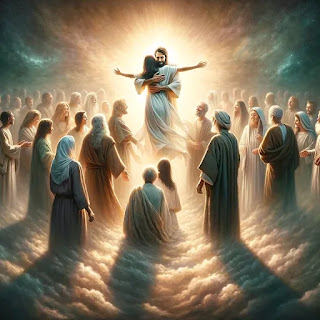


Comments
Post a Comment