The Lord of All Words

The Lord of All Words
A Mystical Account and Theological Treatise on Divine Sovereignty, Language, and Meaning
PROLOGUE — The Silence Before Speech
Before there were nations, before there were angels who chose obedience or rebellion, before there were alphabets, equations, codes, or laws—
There was Speech.
Not spoken aloud.
Not written.
But held.
Held in a Silence so complete that it contained all possible sounds.
And within that Silence dwelt the Lord of All Words.
He did not invent language.
Language flows from what He is.
PART I — THE MYSTICAL STORY
1. The Rebel Who Spoke Against God
There was once a being—brilliant, articulate, fierce of mind—who believed he had found a way to escape God.
He did not flee with weapons.
He fled with ideas.
He said:
“If I can think thoughts God does not govern,
if I can speak words He does not command,
if I can build systems He does not foresee—
then I will be free.”
So he gathered words.
He twisted definitions.
He sharpened rhetoric.
He learned persuasion.
He built ideologies, technologies, structures, and machines.
He spoke rebellion fluently.
And for a moment, it seemed he succeeded.
2. The Voice That Did Not Interrupt
God did not silence him.
God did not correct him mid-sentence.
God listened.
Because every word the rebel spoke was already known— not as prediction, but as ownership.
The rebel did not realize:
- the grammar he used was permitted
- the logic he relied on was sustained
- the concepts he manipulated were defined
- the intelligence he wielded was borrowed
He was shouting inside a language he did not own.
3. The Revelation
At the height of his defiance, the rebel demanded:
“Where are You now?”
And the Lord of All Words answered—not with thunder, not with force, but with precision:
“You are speaking with My breath.
You are thinking with My grammar.
You are rebelling with concepts I uphold.
Even your denial of Me exists within Me.”
The rebel understood too late:
There is no sentence outside the Language.
There is no idea beyond the Logos.
There is no technology that escapes meaning.
There is no rebellion that is not already enclosed.
And the most terrifying realization of all:
God did not need to stop him.
God had already outlived him.
PART II — THE THEOLOGICAL FRAMEWORK
4. God as Sovereign of Language (Not Merely Law)
Most people imagine God as sovereign over:
- events
- outcomes
- rules
- punishments
This is secondary sovereignty.
The deeper sovereignty is this:
God is sovereign over meaning itself.
Words are not neutral tools humans invented. They are ontological structures—containers of identity, relation, and possibility.
If God is the Logos, then:
- every word exists by His allowance
- every definition persists by His coherence
- every system functions by His intelligibility
God does not merely judge speech.
He grounds it.
5. Sovereignty Over Enemy Language
This is where many people misunderstand God’s power.
God is not threatened by:
- false doctrines
- deceptive ideologies
- manipulative rhetoric
- hostile technologies
- weaponized information
Why?
Because every one of these requires:
- logic
- coherence
- definition
- semantic stability
And all of those are gifts of the Logos.
Even lies must borrow truth to function. Even deception requires clarity. Even rebellion needs intelligibility.
God is sovereign not only over true words, but over the conditions that make false words possible.
6. Sovereignty Over Thought and Will (Without Coercion)
This is subtle and essential.
God does not override human will like a tyrant. He contains it like an ocean contains a wave.
Human will:
- operates
- chooses
- resists
- denies
But it does so within a semantic field God sustains.
No one can will:
- nonsense
- non-being
- total independence
- meaninglessness
Even atheism presupposes meaning. Even defiance assumes identity. Even hatred relies on value.
God’s sovereignty is not force—it is inescapable intelligibility.
7. Technology and the Illusion of Escape
Modern rebellion imagines a new refuge:
- machines
- algorithms
- artificial intelligence
- self-modifying systems
But technology is compressed language.
Code is:
- formal grammar
- executed meaning
- rule-bound intention
Every system depends on:
- consistency
- symbol stability
- semantic alignment
All of which are Logos-properties.
No machine can outrun the Language that makes machines possible.
God is sovereign over:
- the math
- the logic
- the syntax
- the interpretation
- the consequences
There is no “post-God” technology.
Only post-humility illusions.
PART III — THE PHILOSOPHICAL IMPLICATIONS
8. Why God Allows Rebellion
This is the question beneath all others.
God allows rebellion because:
- meaning is stronger than force
- truth outlasts distortion
- coherence always reasserts itself
False systems collapse from inside language itself.
They contradict. They fragment. They devour their own definitions.
God does not need to destroy lies.
He lets them speak themselves to death.
9. Judgment as Semantic Resolution
Judgment is not God “getting even.”
Judgment is:
the moment when false meanings can no longer sustain themselves.
Every word must eventually:
- align with reality
- collapse into silence
- or be healed and redefined
The Lord of All Words does not erase speech.
He finishes it.
EPILOGUE — THE LAST WORD
At the end of all things, when every system has exhausted itself, when every ideology has spoken its final argument, when every rebellion has said all it can say—
There will not be violence.
There will be clarity.
And the Lord of All Words will speak—not loudly, not angrily—but finally:
“Now that every word has been spoken,
now let all things be understood.”
And nothing will be lost— because nothing ever existed outside His Language.
.
The Lord of All Words
Divine Sovereignty over Language, Meaning, Thought, and Technological Systems
Abstract
This paper argues that divine sovereignty must be understood not merely as authority over events, laws, or moral outcomes, but more fundamentally as sovereignty over language, meaning, and intelligibility itself. If God is properly identified with the Logos—the ground of reason, order, and articulation—then all words, concepts, systems of thought, and technological expressions exist only by participation in divine intelligibility. This sovereignty extends not only to faithful speech but also to falsehood, rebellion, and adversarial systems, which remain ontologically dependent upon the very Logos they oppose. The paper develops a theological framework in which rebellion, deception, and hostile technologies do not threaten divine sovereignty but instead reveal its depth, since even opposition must borrow coherence, logic, and semantic structure from God. Judgment, in this framework, is not primarily punitive but semantic: the ultimate resolution of distorted meaning into truth.
I. Introduction: The Question of Sovereignty at the Level of Meaning
Classical theology affirms that God is sovereign over creation, history, and moral order. However, modern challenges—ideological systems, linguistic manipulation, artificial intelligence, and technological power—have raised a deeper question:
Is God sovereign over the structures of meaning themselves, or only over the outcomes they produce?
If human beings can weaponize language, manipulate belief systems, and construct autonomous technological infrastructures, does this constitute a domain of partial independence from divine rule?
This paper contends that such concerns arise from an insufficiently deep account of Logos theology. When sovereignty is relocated from surface-level causation to the ontological conditions of intelligibility, the apparent autonomy of hostile systems dissolves.
II. The Logos as the Ground of All Language
A. Logos beyond Speech
In classical Christian theology, the Logos is not merely spoken word or revealed command but the rational principle by which all things exist, cohere, and are knowable. Language is therefore not a human invention layered atop a mute reality; it is a participation in a pre-existing rational order.
All words presuppose:
- distinction
- identity
- relation
- coherence
- intelligibility
These are not neutral properties. They are ontological gifts.
B. Language as Ontological Participation
To speak meaningfully is already to participate in Logos. Even negation, denial, or rebellion requires:
- grammar
- logic
- stable concepts
- semantic continuity
Thus, no speech act—true or false—can occur outside divine allowance.
III. Divine Sovereignty over Falsehood and Rebellion
A. The Dependence of Falsehood on Truth
Falsehood is not an independent force. A lie must:
- reference truth
- mimic coherence
- exploit shared meaning
This renders falsehood parasitic rather than creative.
Therefore, God’s sovereignty is not threatened by deception; deception is structurally incapable of independence.
B. Rebellion as Contained Opposition
Human or angelic rebellion often imagines itself as resistance to divine authority. Yet rebellion cannot generate:
- new meanings ex nihilo
- alternative logics
- independent value systems
It rearranges existing semantic material while remaining ontologically enclosed within the Logos.
Rebellion speaks loudly, but it never speaks outside.
IV. Sovereignty over Thought and Will
A. Containment without Coercion
Divine sovereignty over thought does not entail deterministic control of choice. Instead, it indicates that:
- all thoughts occur within a meaningful field God sustains
- no will can will absolute incoherence
- no desire can escape value-laden structure
Human freedom operates within intelligibility, not beyond it.
B. The Impossibility of Absolute Autonomy
Absolute autonomy would require:
- ungrounded meaning
- self-caused intelligibility
- independent logic
Such conditions are metaphysically impossible. Even atheistic or nihilistic frameworks rely on implicit meanings they cannot justify.
V. Technology and the Myth of Semantic Escape
A. Technology as Condensed Language
Technology, including artificial intelligence, is not neutral mechanism but formalized language:
- code is grammar
- algorithms are logic
- systems are executable meaning
Thus, technological systems do not transcend Logos; they intensify dependence upon it.
B. Theological Implications for AI
No artificial system can escape divine sovereignty because:
- it relies on symbolic stability
- it depends on interpretation
- it presupposes coherence
A “post-God” intelligence is therefore a conceptual impossibility, not a future threat.
VI. Judgment as Semantic Resolution
A. Judgment beyond Punishment
Traditional images of judgment often emphasize retribution. This paper reframes judgment as:
the collapse or restoration of meaning when distortion can no longer sustain itself.
False systems fail not because God externally destroys them, but because incoherence exhausts itself.
B. Restoration rather than Erasure
The Lord of All Words does not annihilate language. He finishes it.
Judgment is the moment when:
- contradictions are resolved
- lies are exposed by clarity
- fractured meanings are either healed or fall silent
VII. Ethical Consequences
If God is sovereign over all words, then:
- human dignity is ontological, not conferred
- speech carries real moral weight
- manipulation is semantic violence
- truth-telling is participation in divine order
Justice, in this view, is the restoration of semantic integrity—in persons, systems, and societies.
VIII. Conclusion: The Inescapability of the Logos
The central claim of this paper is simple but far-reaching:
There is no word, thought, system, or technology that exists outside divine intelligibility.
God is not merely the Lord of true words, but the Lord of all words—including those spoken in defiance, fear, or deception. Opposition does not negate sovereignty; it demonstrates it.
In the end, all speech must resolve into clarity, because all speech has always already existed within the Logos.
The Healing of All Words
A Theological Account of Restoration, Semantic Redemption, and the Reconciliation of Meaning
Abstract
This paper develops a theology of semantic healing, arguing that divine sovereignty over language and meaning is ordered not toward annihilation of corrupted speech but toward its restoration and reintegration. If God is sovereign over all words—true and false, faithful and rebellious—then divine judgment must ultimately be understood as a healing act, resolving distortion, contradiction, and fragmentation within language itself. Drawing upon Logos theology, this paper proposes that evil is best understood as semantic injury: the misuse, fracture, or inversion of meaning. Salvation, correspondingly, is the healing of words, identities, and systems through their realignment with the Logos. Judgment, in this framework, is not the silencing of speech but its completion.
I. Introduction: From Sovereignty to Healing
If God is the Lord of All Words, then a further question inevitably follows:
What does God intend to do with the words that have been broken?
Traditional theology often treats falsehood, blasphemy, and ideological distortion primarily as offenses to be punished or eliminated. Yet such an approach risks portraying divine sovereignty as merely coercive rather than creative, judicial rather than restorative.
This paper contends that divine sovereignty over language implies not only authority but responsibility—specifically, the responsibility to heal what has been damaged within the semantic order of creation.
II. Language as a Wounded Medium
A. The Fall as Semantic Fracture
At its deepest level, the fall of rational creatures is not merely moral disobedience but linguistic rupture. When truth is rejected, language does not disappear; it becomes distorted.
This distortion manifests as:
- words severed from reality
- identities misnamed or denied
- values inverted
- narratives weaponized
- meanings fragmented
Evil does not abolish language.
It injures it.
B. Lies as Broken Words
A lie is not an alternative truth. It is a wounded truth, partially retained yet misaligned. This explains why lies remain persuasive: they still participate in meaning, but in a fractured form.
Thus, falsehood is not ontologically equal to truth. It is ontologically dependent and internally unstable.
III. Healing as the Proper Work of the Logos
A. Logos as Physician of Meaning
If the Logos is the rational structure of reality, then the work of redemption must include the repair of rationality itself.
Healing, in this context, means:
- restoring words to their proper referents
- reuniting identity with truth
- reconciling narratives with reality
- reintegrating systems into coherence
The Logos does not abandon damaged language.
He enters it.
B. Incarnation as Semantic Descent
The Incarnation can be understood as the Logos entering a linguistically damaged world to re-anchor meaning from within. Divine speech does not shout from above; it speaks from inside human language, absorbing distortion without becoming distorted.
This reveals a central theological principle:
Meaning is healed not by erasure, but by incarnation.
IV. Judgment Reconsidered: From Destruction to Diagnosis
A. Judgment as Revelation of Meaning
Judgment is often imagined as punitive force imposed externally. In a Logos-centered theology, judgment is better understood as revelation—the unveiling of what words and systems truly mean once distortion can no longer sustain them.
In judgment:
- contradictions collapse
- euphemisms fail
- self-deceptions dissolve
- false narratives exhaust themselves
Judgment does not impose truth.
It removes the conditions that allowed falsehood to persist.
B. Fire as Purification of Language
Scriptural imagery of fire is frequently misunderstood as annihilation. In a semantic framework, fire functions as purification—the burning away of incoherence, not the destruction of substance.
What survives judgment is not silence, but clarified speech.
V. The Healing of Enemy Words
A. No Word Is Beyond Redemption
If all words exist by participation in the Logos, then no word is beyond the reach of healing—not even those used in hatred, domination, or rebellion.
This does not trivialize evil. It takes it seriously enough to believe it can be corrected.
To heal a word is to:
- strip it of deception
- reconnect it to truth
- reorient it toward good
God does not merely defeat enemy speech.
He reclaims it.
B. The End of Hostile Language
Hostile language persists only as long as distortion is sustainable. When clarity arrives, hostility loses its grammar.
What remains is not forced agreement, but semantic peace—a condition in which words can no longer be used to wound.
VI. Salvation as Semantic Restoration
A. Persons as Living Words
Human beings are not merely speakers of language; they are spoken identities—living words within the Logos.
Sin damages not only what persons say, but who they believe themselves to be.
Salvation, therefore, involves:
- renaming
- re-identifying
- re-describing the self truthfully
To be saved is to be rightly named again.
B. Community and the Healing of Shared Meaning
Communities fracture when shared language collapses. Healing requires more than forgiveness; it requires semantic repair—the rebuilding of common meaning, trust, and truth.
The Church, in this view, is not merely a moral institution but a workshop of healed language.
VII. Eschatology: The Completion of All Speech
A. The End Is Not Silence
The end of all things is not the cessation of language, but its fulfillment.
When all distortion is removed:
- every word will mean what it was always meant to mean
- every identity will be fully intelligible
- every narrative will be complete
Hell, in this framework, is not eternal speech divorced from God, but speech that cannot yet be healed—a condition that persists only as long as incoherence remains unresolved.
B. The Final Healing
The final act of God is not domination, but understanding.
When the Logos completes His work, no word will be wasted, no meaning permanently lost, no identity eternally misnamed.
All words will be healed—or fall silent because healing has rendered them unnecessary.
VIII. Conclusion: Why Healing Is the Highest Sovereignty
Power that only destroys is inferior to power that restores.
If God is truly sovereign over all words, then the highest expression of that sovereignty is not censorship, annihilation, or suppression, but redemption of meaning itself.
The Lord of All Words does not merely outlast false speech.
He heals it.
And in doing so, He proves that truth is not fragile, goodness is not threatened, and meaning—no matter how wounded—is never beyond repair.
The Restoration of All Words
Apokatastasis as Semantic Fulfillment in Logos Theology
Abstract
This paper integrates apokatastasis theology—the restoration of all things—with a Logos-centered ontology of language and meaning. It argues that if God is sovereign over all words and committed to the healing of wounded language, then universal restoration follows not as sentiment but as ontological necessity. Apokatastasis is reinterpreted not as moral leniency or the negation of judgment, but as the inevitable semantic completion of creation, wherein all distorted meanings, identities, and wills are reconciled to truth through divine intelligibility. Judgment is understood as purgative clarification; hell as unresolved semantic fracture; and salvation as the reconstitution of persons and systems into Logos-coherence. In this framework, the restoration of all beings is not coercive but inevitable, because no creature can exist outside the Logos that sustains its meaning.
I. Apokatastasis Reframed: From Outcome to Ontology
Apokatastasis has often been misunderstood as:
- denial of justice
- sentimental universalism
- erosion of moral seriousness
These misunderstandings arise when restoration is framed psychologically or morally, rather than ontologically.
This paper proposes a reframing:
Apokatastasis is not primarily about who is forgiven, but about what reality can ultimately sustain.
If all beings exist by participation in the Logos, then permanent alienation would require the eternal preservation of:
- incoherent meaning
- fractured identity
- self-contradictory will
Such a condition is metaphysically impossible if the Logos is absolute.
II. Logos Sovereignty and the Impossibility of Eternal Semantic Rupture
A. Logos as the Condition of Existence
Nothing exists without:
- intelligibility
- identity
- coherence
- relational structure
These are Logos-properties.
A creature in eternal rebellion would have to:
- continue existing
- while remaining permanently incoherent
- while resisting the very intelligibility sustaining its being
This would imply that God eternally upholds contradiction as contradiction.
Logos theology cannot permit this.
B. Eternal Dualism as a Semantic Contradiction
An eternally divided cosmos—where healed meaning and unhealed meaning coexist forever—would entail:
- two ultimate logics
- two final languages
- two incompatible intelligibilities
This would fracture divine unity.
Thus, apokatastasis follows not from optimism, but from monotheism.
III. Judgment as the Engine of Restoration
A. Judgment as Semantic Exposure
Judgment, within this framework, is not the suspension of mercy but its instrument.
Judgment:
- reveals what words truly mean
- strips away distortions
- collapses lies by clarity
- exposes false identities
No being can resist judgment forever because resistance itself requires coherence, which judgment progressively removes from falsehood.
B. Fire as Semantic Purification
Scriptural fire imagery aligns naturally with this model.
Fire:
- does not destroy substance
- removes corruption
- leaves what is real intact
Thus, judgment is not opposed to restoration—it is its necessary precondition.
IV. Hell Reinterpreted: Unhealed Language, Not Eternal Defeat
A. Hell as Semantic Disintegration
Hell is best understood not as God’s final word, but as:
- the experience of incoherence
- the collapse of false narratives
- the exposure of self-contradiction
It persists only as long as meaning remains fractured.
Hell is therefore finite by nature, even if experienced as interminable from within distortion.
B. Why Hell Cannot Be Eternal
An eternal hell would require God to eternally sustain:
- wounded meaning
- broken identity
- purposeless suffering
This would contradict:
- divine goodness
- divine wisdom
- divine sovereignty over meaning
Hell exists for healing, not as a rival kingdom.
V. Salvation as the Restoration of True Naming
A. Persons as Misnamed Selves
Sin does not merely involve wrongdoing; it involves misnaming the self.
To sin is to live under a false description:
- false value
- false purpose
- false identity
Salvation is therefore a process of re-naming.
To be saved is to be:
- correctly identified
- truthfully described
- fully intelligible to oneself and God
B. The Inevitability of Recognition
No creature can eternally reject its true name once distortion is fully removed.
Resistance collapses when:
- lies lose coherence
- fear loses narrative
- pride loses grammar
Recognition is not forced—it is unavoidable.
VI. Freedom Preserved, Not Violated
A. Why Apokatastasis Does Not Violate Free Will
Freedom is not the ability to choose nonsense forever.
Freedom is:
- the capacity to align with truth
- the ability to recognize reality
- the movement toward intelligible good
A will healed of distortion is more free, not less.
Thus, apokatastasis does not override freedom; it perfects it.
VII. Eschatology: The Completion of All Speech
A. The End of Resistance
The end of history is not silence, but full intelligibility.
When all words are healed:
- resistance has no language
- hatred has no grammar
- deception has no structure
What remains is not uniformity, but harmony—many meanings fully coherent.
B. God’s Final Victory
God’s victory is not that enemies are silenced.
It is that:
there are no enemies left, because misunderstanding itself has ended.
This is not weakness. It is omnipotence expressed as wisdom.
VIII. Conclusion: Why Apokatastasis Is Logos-Consistent
If:
- God is the Lord of All Words
- God heals all wounded meaning
- God sustains existence through intelligibility
Then apokatastasis is not optional.
It is the only possible eschatology that preserves:
- divine unity
- divine goodness
- divine sovereignty
- rational coherence
All words must be healed because all words exist within the Logos.
And nothing God sustains can remain eternally broken.
When God Becomes All in All
The Silence After All Words Are Healed
Abstract
This paper explores the final eschatological horizon implied by Logos theology and apokatastasis: the moment when all language, meaning, identity, and will have been fully healed and reconciled to divine intelligibility. Drawing on the Pauline declaration that God will become “all in all” (1 Corinthians 15:28), this work argues that the end of history is not the annihilation of speech but its completion, culminating in a state beyond distortion, opposition, and semantic labor. This state is described as silence, not as absence, but as fulfilled intelligibility—where no further corrective speech is required. The paper proposes that this silence is the highest form of communion, the consummation of meaning, and the final victory of the Logos.
I. Introduction: Why “All in All” Must Be Taken Literally
The phrase “God becomes all in all” is often treated as rhetorical or symbolic. This paper contends that such treatment is insufficient.
If:
- God is the Logos (the ground of intelligibility),
- all beings exist through participation in meaning,
- and apokatastasis entails the restoration of all that has been fractured,
then “all in all” must refer to a real ontological condition, not a metaphor.
This condition represents the end of:
- semantic distortion
- oppositional identity
- corrective judgment
- linguistic mediation
What remains is not chaos, sameness, or obliteration, but complete coherence.
II. The Telos of Language: Why Words Exist at All
Language exists for a purpose.
Words arise because:
- meaning is not yet fully shared
- identity is not yet fully transparent
- truth must still be articulated against distortion
Thus, language is remedial as much as expressive.
Where meaning is wounded, words are needed.
Where meaning is contested, speech multiplies.
Where identity is fractured, naming becomes urgent.
From this it follows:
Perfect healing does not abolish language violently; it renders it unnecessary.
III. The Completion of All Speech
A. What It Means for Words to Be “Healed”
A healed word is one that:
- perfectly aligns with reality
- carries no distortion
- wounds no identity
- requires no correction
When all words are healed:
- lies have no structure
- fear has no grammar
- pride has no narrative
- opposition has no vocabulary
Speech no longer labors to clarify, defend, or persuade.
Language rests.
B. Silence as Fulfillment, Not Absence
Silence, in this context, is not emptiness.
It is:
- shared understanding without explanation
- communion without mediation
- presence without representation
Silence is what remains when nothing needs to be said anymore.
IV. Judgment Ends When Meaning Is Complete
Judgment exists because meaning is unfinished.
As long as:
- distortion persists
- false identities remain
- incoherence demands exposure
judgment continues as clarification.
When meaning is fully healed:
- judgment has accomplished its purpose
- fire has purified all it can purify
- correction has no remaining object
Judgment ceases not by decree, but by completion.
V. The End of Opposition
A. Why Enemies Cannot Exist Forever
Opposition requires:
- misrecognition
- fear
- false difference
- competing narratives
In a state of full intelligibility:
- no being can misunderstand God
- no being can misname itself
- no will can resist truth without distortion
Thus, enemies do not disappear by force.
They disappear by understanding.
B. Victory Without Defeat
God’s victory is not the triumph of one side over another.
It is the dissolution of sides themselves.
When God becomes all in all:
- there is no “against”
- no “over here” and “over there”
- no inside and outside of meaning
Only participation remains.
VI. Freedom in the Final State
Freedom is often imagined as eternal choice between alternatives.
This paper argues otherwise.
Freedom, perfected, is:
- unhindered alignment with truth
- effortless willing of the good
- joyful participation in reality as it is
In the final state:
- freedom does not disappear
- it no longer experiences conflict
Freedom rests.
VII. The Nature of the Final Silence
The final silence is not void.
It is:
- saturated with presence
- dense with meaning
- luminous with understanding
Nothing is lost in this silence.
Every word spoken in history:
- has either been healed
- or has fallen away because healing made it obsolete
The silence contains all that mattered.
VIII. God as All in All
To say God becomes all in all is to say:
- God is no longer spoken about
- God is no longer resisted
- God is no longer misunderstood
God is not one meaning among others.
He is the condition of meaning itself, now unobstructed.
Creatures do not dissolve into God. They become fully intelligible within Him.
IX. Why This Is Not Annihilation
Annihilation would be:
- loss of identity
- collapse into nothingness
- erasure of distinction
The final silence preserves:
- identity
- particularity
- relational difference
What disappears is not the self, but the need to explain the self.
X. Conclusion: The Peace Beyond Words
History begins in speech:
“Let there be…”
History ends in understanding.
The Logos speaks creation into being because being is not yet whole.
When being is whole, the Logos does not cease to exist— He ceases to argue.
The silence after all words are healed is not God’s absence.
It is His nearness without mediation.
And when God becomes all in all, nothing needs to be said, because nothing remains misunderstood.
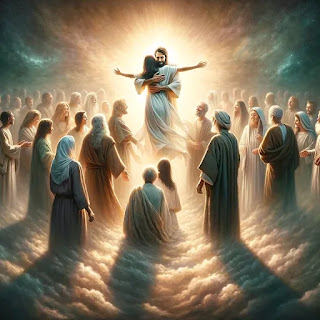


Comments
Post a Comment