Zeus and the Village by the Sea

Zeus and the Village by the Sea
An original myth in the Greek tradition
✦ ─── ❦ ─── ✦
They had made room in their houses for everything except another human being.
I. The White Houses Above the Water
In the days when the gods still walked the roads without announcing their names, there stood beside the wine-dark sea a village called Thalassara.
It occupied a sheltered curve of the coast, where the water lay blue as a kingfisher’s wing and the hills wore their olive groves like wreaths. Ships came to its harbor heavy with grain, cedar, purple cloth, and jars of fragrant oil. They departed lighter, and the coffers of Thalassara grew heavier.
Its houses were white stone. Its gates were bronze. Even the gutters had been carved into the mouths of lions, so that when rain fell, it seemed the beasts themselves drank from heaven.
There were courtyards where fountains played all afternoon, storerooms where figs sweetened beyond eating, and cellars holding enough wine to gladden a hundred weddings. At night, lamps burned behind curtains fine enough to pass through a bracelet.
The villagers were proud of these things.
In time, they became proud of themselves for possessing them.
And afterward, by a small turning of the heart that scarcely any of them noticed, they began to despise those who possessed less.
A poor man passing through Thalassara was made to feel that his hunger spoiled the view. A woman seeking work was questioned about her misfortunes until she wished she had kept them secret. Sailors injured in the harbor were carried beyond the market before the buyers arrived.
The people called this preserving the dignity of the village.
When they spoke of generosity, they meant the great feasts they gave one another.
When they spoke of worth, their eyes traveled first to a person’s clothing.
On the highest terrace stood a temple of Zeus. Its doors were inlaid with silver, and its altar shone beneath the smoke of costly offerings. Each year the wealthy households competed to present the finest sacrifice.
And each year the priest declared that no village on the coast honored the lord of heaven more splendidly.
Far above the smoke, Zeus listened.
He heard the hymns.
He heard, also, what was said at the gates.
✦ ❦ ✦
II. The Stranger on the Road
One autumn afternoon, when the sea was calm and the grapes had already been pressed, an old man appeared on the road to Thalassara.
His cloak had been patched with cloth of three different colors. One sandal was bound together with cord. Dust lay in the creases of his face, and he leaned upon a staff of unpolished wood.
He carried no purse.
No servant followed him.
There was nothing about him from which a prosperous man might hope to profit.
This was Zeus.
He had left the thunderbolt beyond mortal sight and folded his radiance into the frail appearance of a wanderer. He had taken upon himself the ache of weary feet, the dryness of a mouth that had gone too long without water, and the small uncertainty of a traveler approaching an unfamiliar door.
At the crest of the road, he stopped.
Below him, the village gleamed. Smoke rose from kitchens. A woman’s laughter drifted over a garden wall. Somewhere, bread was being drawn from an oven.
Zeus descended toward the first house.
III. What Was Given at the Doors
The first house belonged to Dorion, whose granaries stood beside the harbor.
Through the open gate, the stranger saw servants carrying dishes beneath an arbor. There were roasted fish, olives in shining bowls, and loaves so fresh that steam rose when they were broken.
Dorion reclined beside the table, selecting the softest pieces.
“Good sir,” said the wanderer, “I have walked since dawn. Will you spare a little bread?”
Dorion looked at the old man’s sandals.
“There is work in the world.”
“There is,” the stranger answered. “And there are days when a man cannot find it.”
“There is always an excuse, too.”
A servant paused with a platter in his hands. Dorion flicked his fingers, and the servant continued past the gate.
“A crust would be enough,” said Zeus.
“If I feed one beggar, I shall have twenty by morning.”
He ordered the gate shut.
Before it closed, the stranger saw a hound beneath the table turn away from a piece of bread it no longer wanted.
He went to the next house.
Here a fountain spilled into a basin of green stone. Water ran over its edge and disappeared through a channel beneath the street.
A woman stood in the courtyard choosing bracelets from a tray.
“Lady,” said the wanderer, “may I have a cup of water?”
She glanced at his torn sleeve.
“The public cistern is below.”
“They would not let me draw from it.”
“Then you should have asked someone who knows you.”
“I know no one here.”
“That is hardly my responsibility.”
The fountain continued its soft, clear singing.
Zeus looked at it.
“Even a little from the overflow.”
The woman drew back as though the request had dirtied the air.
“Do you suppose we built this courtyard for passing vagrants?”
She called for the gatekeeper.
The stranger stepped into the road before the man could lay hands upon him.
At the third house, the owner heard his request from an upper balcony.
“Only a place under your portico,” Zeus said. “The wind will turn cold tonight. I can sleep beside the outer wall.”
“There is an inn.”
“I have no coin.”
“Then there is the beach.”
“The stones are wet.”
The owner smiled.
“You should have arranged your life more carefully.”
Behind him, an attendant was shaking out blankets embroidered with golden birds.
At the fourth house, an elderly magistrate came to the door himself. He wore a ring bearing the seal of his ancestors, and he spoke as though every word had been approved by the dead.
“What do you want?”
“A little kindness,” said the wanderer. “If there is nothing you can give, perhaps you will let me rest here long enough to take the stone from my sandal.”
The magistrate looked him over.
“You have been troubling respectable households all afternoon.”
“I have asked them for help.”
“You have reminded them of unpleasant things.”
The stranger lowered himself carefully onto the edge of the step.
The magistrate struck the stone beside him with his cane.
“Up. This is my father’s threshold.”
“And did your father teach you how to welcome a tired man?”
“My father taught me to know my station.”
Zeus raised his eyes.
For a moment, the magistrate felt an inexplicable uneasiness, like the stillness before a storm.
Then he saw only an old beggar.
“Yours is in the road,” he said.
House after house, the wanderer continued.
Some pretended not to hear him.
Some laughed.
One man demanded that he recite a poem before he would consider giving him a fig. When the stranger declined, the man called him ungrateful for refusing an opportunity.
Another offered him a broken bowl and withdrew it when he reached out, to amuse the guests seated behind him.
At one doorway he asked merely to be spoken to without contempt.
The woman who answered called her husband to hear the absurdity.
By sunset, Zeus had knocked at every house.
His hands were empty.
Last of all, he climbed the terrace to his own temple.
The priest was overseeing the washing of the steps. Two large jars stood nearby, filled with clean water.
“Father,” said the stranger, “may a traveler drink and sleep beneath this roof?”
The priest frowned.
“We are preparing for a ceremony.”
“I shall be quiet.”
“Important families will be attending.”
“I shall stay out of their way.”
The priest took a small coin from his robe, considered it, and put it back.
“You must understand,” he said, “that the gods should be approached in a fitting condition.”
The wanderer looked past him at the statue within: Zeus enthroned, stern and magnificent, a golden cup in one marble hand.
“What condition,” he asked, “is fitting for a thirsty man?”
The priest summoned the attendants.
As the stranger descended the steps, they emptied a jar of water across the place where he had stood.
It ran past his feet and down into the gutter.
Zeus watched until the last thread of it disappeared.
Then he went to the square.
✦ ❦ ✦
IV. The Gathering
At the center of Thalassara stood a fountain surrounded by stone benches. Here the merchants announced their bargains, the magistrates pronounced their judgments, and wealthy families displayed their children on feast days.
The old wanderer walked to the basin.
He touched its rim with his wooden staff.
The sound passed through the village.
It entered kitchens beneath the clatter of dishes. It entered counting rooms through the chink of coins. It sounded inside the temple, beneath the priest’s evening prayer.
Each person who heard it felt that someone had called their name.
Doors opened.
The people came into the streets.
Dorion arrived with a cup still in his hand. The woman of the green fountain came wearing the bracelets she had chosen. The magistrate leaned upon his ancestral cane. The priest hurried down from the terrace, annoyed to find the ceremony interrupted.
Soon the square and all the streets around it were crowded.
At their center stood the beggar.
The magistrate recognized him.
“Have you not caused enough disturbance?”
The old man straightened.
His staff ceased to cast the shadow of a staff.
Across the paving stones spread the shadow of a vast eagle.
The fountain fell silent.
Its water hung in the air.
A wind moved through the square, lifting cloaks and extinguishing lamps, yet the olive trees beyond the village did not stir.
Dorion dropped his cup.
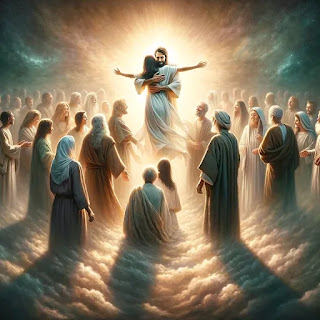
The wanderer’s ragged cloak brightened from within. Its patches opened into depths of storm cloud, and in those depths lightning moved without a sound. The stooped back rose. The lined face became terrible with a majesty no sculptor had ever caught.
Above the roofs, the sky darkened.
The villagers saw the old staff blazing in his hand.
They saw the eyes that had watched kings become dust.
And they knew.
The priest fell to his knees.
“Zeus.”
The name traveled through the crowd.
“Zeus.”
“Zeus.”
The god let them speak it.
Then he answered.
“Yes.”
V. The Judgment of the Threshold
For a long time, no one moved.
Zeus looked from face to face, recognizing each doorway in the person who had answered it.
“At your tables,” he said, “I asked for bread. Beside your fountains, I asked for water. Under your roofs, I asked for a little shelter from the night.”
His voice was quiet enough that they had to listen.
“You found reasons to refuse every request. Yet none of you lacked what I asked for.”
Dorion began to speak, but the words would not leave his throat.
Zeus turned toward him.
“Your hound was satisfied. I was hungry. You feared that feeding me might bring another hungry man to your gate.”
He looked toward the woman with the bracelets.
“Your fountain spilled more water while we spoke than I could have drunk.”
He looked toward the man from the balcony.
“You had blankets enough for empty beds. You sent me to the wet stones.”
Then his gaze rested upon the magistrate.
“And you could have given me kindness without opening a storehouse, pouring a cup, or moving a single coin. You chose to make my weariness a shame.”
The old magistrate’s cane trembled against the paving.
“Lord,” whispered the priest, “we did not know you.”
Zeus faced him.
“Suppose you had been right about me.”
The priest lifted his head.
“Suppose I had been an ordinary wanderer. Suppose there had been no thunder in my hands, no throne above the clouds, no power by which to reward you or avenge an insult.”
The suspended water quivered above the fountain.
“Would my thirst have been less real?”
No one answered.
“Would the stones have been softer beneath my back? Would hunger have hurt me less? What would my powerlessness have excused in you?”
The priest bowed until his forehead touched the ground.
“Rise,” said Zeus. “You were quite willing to stand above me this afternoon.”
The priest struggled to his feet.
From the edge of the crowd, a wealthy shipowner cried out:
“We have worked for what we possess!”
“And so you know the labor it costs,” Zeus answered. “You know the backs bent beneath your cargo. You know the hands cracked by salt, the men who haul your ropes, the women who grind your grain. Yet when those hands grow too weak to serve you, you hurry their owners out of sight.”
Thunder moved far out across the water.
“You have mistaken good fortune for proof of greater worth. A full purse has become, in your eyes, a judgment of the soul. You see a man brought low by illness and search him for a fault. You see a widow without bread and demand an account of her choices. You see an injured laborer and resent the slowness of his steps.”
The villagers stood pressed together, no longer leaving space between fine clothing and coarse.
“Which of you has bargained with age?” Zeus asked. “Which of you has purchased a promise that your body will never fail? Let that person step forward and explain why the unfortunate deserve contempt.”
No one stepped forward.
“You adorn my altar,” he continued, “and drive the helpless from its steps. You praise the order of heaven while making your neighbors afraid to ask for help.”
The priest began to weep.
“We will sacrifice a hundred oxen.”
Zeus’s eyes flashed.
“You still reach for something that belongs to you when you should be looking at what you have done.”
Around them, the bronze gates of the square began to shake.
“All day I gave you small occasions for mercy. A cup. A crust. A dry corner. A patient word. Any one of these would have cost you little.”
Now his voice deepened, and every house seemed to hear it.
“Instead, each threshold taught the same lesson: that a person without wealth could expect neither welcome nor respect in Thalassara.”
He lifted the thunderbolt.
“Very well. Let the world learn what your wealth can preserve.”
✦ ❦ ✦
VI. When the Sea Came to the Doors
Out in the harbor, the ships turned upon their moorings.
Every prow pointed toward the village.
Then the sea withdrew.
It slipped from the quays, leaving ropes hanging loose and fish gleaming on the exposed sand. It receded past the harbor wall, past the black rocks where the cormorants nested, farther than any living person had seen.
The people of Thalassara stared after it.
Far beyond the emptied bay, something rose.
At first it resembled a darkness on the horizon.
Then it climbed.
Moonlight caught its summit.
The sea stood upright.
A cry broke from the crowd.
Zeus pointed toward the road that climbed into the olive hills.
The clouds parted above it, revealing a narrow line of stars.
“That road remains open,” he said. “Go. Carry those who cannot climb. You have little time to decide what is worth saving.”
For an instant, the villagers stood motionless.
Then the square erupted.
People called for their children. Servants ran from the houses. An old woman fell beside the fountain, and the magistrate, stumbling past her, stopped.
He looked toward his house.
Its upper windows glowed. Inside were his father’s silver, his grandfather’s weapons, the carved chest containing the records of his lineage.
The woman on the stones caught his sleeve.
He bent and lifted her.
His cane remained where it fell.
At the lower end of the square, Dorion ran toward his granaries. Halfway there, he saw a small boy standing alone in the road, calling into the crowd.
The merchant hesitated.
Then he turned, gathered the child into his arms, and ran for the hill.
Behind them came the first water.
It entered quietly through the harbor gates.
It spread over the paving and found the channels between the stones. It touched the steps of the houses, rose over them, and pressed against the bronze doors.
Inside the courtyards, fountains vanished beneath a greater flow.
The householders had refused a cup.
Now water climbed their walls.
The wave crossed the harbor.
Ships lifted above the quays, their masts tilting like reeds. The harbor wall disappeared. A warehouse split apart, pouring grain into the flood in a pale, swirling cloud.
Then the sea struck Thalassara.
The sound filled the coast.
Doors burst inward. Pillars broke. Roof tiles flew into the night. Wine jars shattered in the cellars, and the treasured vintages mingled with salt water.
Purple curtains streamed through broken windows.
The golden birds upon the blankets went down into the dark.
On the temple terrace, the silver doors held for a moment.
Then the water tore them from their hinges.
It swept across the polished floor and rose around the marble throne. The golden cup fell from the statue’s hand, struck the altar once, and vanished.
From the hills, the villagers watched their lamps go out.
One by one.
All together.
Where their houses had stood, foam turned beneath the moon.
At last, the thunder ceased.
The sea settled into its new shore.
Zeus stood at the water’s edge, and no wave touched his feet.
VII. The Cup on the Hillside
Dawn found the people of Thalassara among the olive trees.
Salt had stiffened their clothes. Mud covered their hands. A child slept against Dorion’s chest, and the merchant scarcely dared to move for fear of waking him.
Below them lay a quiet bay.
Of all the village’s proud buildings, only a few broken columns showed above the water.
The woman who had refused the wanderer a drink sat shivering beside the road. She had lost one sandal. Her bracelets were gone.
After a time, she tried to swallow.
Her mouth was painfully dry.
Near sunrise, a farmer came down from the inland fields, driving a donkey laden with empty baskets. He stopped when he saw the people scattered beneath the trees.
“What has happened here?”
No one knew how to begin.
The woman looked up at him.
“Please,” she said. “Have you any water?”
The farmer untied a flask from his saddle.
He poured into a wooden cup and placed it in her hands.
She stared at it.
A plain cup, worn smooth at the rim.
Water trembled inside it.
“Drink,” the farmer said. “There is more at my house.”
She tried to thank him, but began to cry.
He waited while she drank. Then he took the cup, filled it again, and carried it to the next person.
Zeus watched from the distant crest of the hill.
For a moment, he wore once more the shape of the tired wanderer.
Then sunlight passed across the road.
And he was gone.
✦ ❦ ✦
VIII. The Doors Beneath the Sea
The people who survived did not rebuild Thalassara.
They scattered along the coast and into the inland valleys, carrying the story with them. Some told it reluctantly. Some told it whenever they saw a stranger turned from a door.
The magistrate, who had once boasted of his father’s threshold, lived his remaining years in a small house beside a traveled road. A bench stood outside it.
Dorion never again allowed bread to be thrown away while someone waited at his gate.
As for the priest, it was said that he learned to ask a hungry visitor one question before any other:
“Have you eaten?”
Years passed.
Then generations.
Fishermen came to know the drowned village by the pale shapes visible beneath their boats. On still mornings they could see the courtyards, the broken lions of the gutters, and the long streets wandering into blue shadow.
No gate remained upon its hinges.
Travelers sometimes asked how such a wealthy place had come to ruin.
And the fishermen would tell them of an old man in a patched cloak, of bread withheld, of water wasted, and of the evening when a beggar stood upright in the square.
When the telling was finished, they would look toward the houses beneath the waves and repeat the warning handed down along that coast:
Let no one who knocks at your door have to be a god to receive your kindness.
Below their boats, small silver fish passed freely through the ruined halls.
And the sea kept every door open.
✦ ─── ❦ ─── ✦
.webp)

Comments
Post a Comment