The Realness Continuum

The Realness Continuum
Toward a Philosophy of Infinite Ontological Gradation, Hyperfluid Actuality, and the Inexhaustible Diversity of Existence
Abstract
What does it mean for something to be real? Is reality a binary condition in which something either exists or does not exist? Or might realness itself possess degrees, intensities, qualities, and modes that transcend the conventional distinction between existence and nonexistence?
This paper proposes The Realness Continuum: a speculative metaphysical theory in which realness and actualness are fluid, multidimensional, and inexhaustibly variable properties of existence. Rather than consisting of a single homogeneous order, Infinite Existence encompasses countless realities exhibiting different degrees and kinds of being, ranging from barely actualized possibilities to realities of extraordinary ontological intensity, richness, generativity, and transcendence.
The theory argues that reality should not be understood as a rigid hierarchy of discrete levels but as an inexhaustible, hyperfluid continuum of ontological variation. Different realities may possess equivalent degrees of realness while differing radically in the kinds of realness they exhibit. Some may be more actual, others more generative, others more experientially intense, and still others may possess modes of existence for which human thought has no adequate conceptual vocabulary.
Drawing inspiration from Neoplatonism, modal metaphysics, nonclassical logic, process philosophy, and the cosmological pluralism of Giordano Bruno, the theory develops a framework for understanding Infinite Existence as an Ocean of Countless Ontological Spectra.
Its ultimate theological expression is found in the concept of the Oceanic Logos: an inexhaustible creative principle capable of generating, sustaining, and transcending every conceivable and inconceivable degree, mode, and infinity of reality.
The Realness Continuum is presented not as an empirically established cosmological theory but as a metaphysical proposal concerning the possible structure and diversity of existence.
I. Introduction: Is Reality Simply Real?
We ordinarily speak of reality as though it were an absolute and uniform condition.
Something either exists or does not exist.
A mountain is real. A fictional mountain is not physically real. A dream occurs within consciousness, but the world experienced in the dream does not necessarily exist independently of the dreamer.
These distinctions are useful. Indeed, they are indispensable to ordinary reasoning, science, and practical life.
But do they exhaust the nature of reality?
Consider light.
Light does not manifest in only two conditions: absolute brightness and absolute darkness. It possesses variable intensities, wavelengths, patterns, and forms of organization. Its manifestations may be faint or brilliant, diffuse or concentrated, monochromatic or richly varied.
Its diversity cannot be adequately represented by a single distinction between illuminated and unilluminated.
What if realness possesses an analogous diversity?
What if realities differ not only in their contents, structures, laws, and inhabitants, but also in their degrees and kinds of reality itself?
What if some realities are barely real, others profoundly real, and still others possess modes of actuality vastly exceeding those familiar to human experience?
And what if the difference between these conditions is not a sequence of rigid steps, but a fluid and potentially inexhaustible continuum?
These questions form the foundation of the Realness Continuum.
Its central proposition is:
Realness is not necessarily a uniform, indivisible property. Reality may manifest through infinitely variable degrees, intensities, dimensions, and modes of being and actuality.
Our universe, under this proposal, is neither the necessary foundation nor the ultimate culmination of existence. It is one particular expression within a potentially inexhaustible diversity of realities.
We inhabit what might provisionally be called a Middle Realm: a reality that is genuinely actual within its own order, yet need not represent the greatest conceivable intensity, richness, or mode of being.
The designation does not establish that our universe occupies a measurable midpoint on an objective cosmic scale. Rather, it expresses the metaphysical possibility that our familiar order is neither ontologically minimal nor ontologically maximal.
The question is no longer merely whether other universes exist.
The deeper question is:
How many different ways can something be real?
And perhaps more radically:
Can any conceivable infinity of answers exhaust the possibilities of realness itself?
II. The Foundational Principle: Infinite Ontological Gradation
The Realness Continuum begins by questioning whether existence and actuality must always be understood as binary predicates.
In classical logic, a proposition such as "X exists" is ordinarily treated as true or false relative to a specified domain and interpretation.
The Realness Continuum does not require abandoning this logical distinction.
Instead, it proposes that the ontological condition of an entity may be more complex than the truth value of an existential statement.
A mathematical object, a fictional character, a physical organism, a conscious experience, and a merely possible universe can all become objects of meaningful thought and discourse.
Yet they do not necessarily possess the same mode of being.
The number seven does not exist in the same way that a tree exists.
A fictional kingdom does not possess the same actuality as a geographical kingdom.
The experience of dreaming is actual as a mental event, even when the dream's apparent physical environment is not independently actual.
These distinctions suggest that we should carefully separate several questions:
- Does an entity exist in a specified domain?
- What kind of existence does it possess?
- How is it actualized?
- What relations sustain or constitute its reality?
- What powers, experiences, or structures belong to it?
- Can its mode or degree of actuality change?
The Realness Continuum proposes that the answers to these questions may vary fluidly and independently.
The Principle of Infinite Ontological Gradation
For any given mode or degree of reality, there may exist further possible modes, degrees, variations, and transformations of realness that are not exhausted by the original condition.
This principle rejects the assumption that all realities must possess identical ontological status.
It also rejects the assumption that different modes of being must be arranged into a finite number of rigid categories.
Realness may instead exhibit continuous gradation, branching variation, and forms of differentiation that exceed any single scale.
This does not mean that every conceivable degree of realness necessarily exists. That stronger claim belongs to a separate principle of ontological plenitude, which will be examined later.
The foundational claim is that reality need not be ontologically uniform.
III. The Luminosity Analogy: Realness as Fluid Intensity
The analogy between reality and light provides a conceptual foundation for the theory.
Brightness varies.
Color varies.
Patterns vary.
The organization and distribution of light vary.
A single source may become brighter or dimmer without suddenly crossing a rigid boundary between two wholly separate kinds of illumination.
Likewise, the Realness Continuum proposes that the actualization of reality may possess fluid degrees.
A reality might become increasingly substantial, increasingly generative, increasingly experientially rich, or increasingly capable of sustaining other realities.
Another might become attenuated, dependent, fragmentary, or less independently actualized.
There need not be a universal threshold at which one condition abruptly becomes another.
1. Ontological luminosity
Ontological luminosity is the proposed intensity or fullness with which a reality manifests its particular mode of being.
It does not refer to literal electromagnetic brightness.
Rather, it serves as a metaphor for the possibility that reality may possess different degrees of ontological manifestation.
A barely actualized possibility and a richly instantiated world may differ in the fullness of their realization.
2. Ontological coloration
Just as equal brightness does not imply identical color, equal degrees of realness need not imply identical kinds of reality.
Two realities could be equally actualized within their respective orders while differing fundamentally in their substance, consciousness, causal structure, temporality, or governing principles.
A mathematical reality and an experiential reality, for example, might possess incomparable forms of ontological richness.
Neither would necessarily be reducible to the other.
3. Ontological pattern
Realness may also vary according to organization.
Some realities might be highly unified, while others are distributed across countless interacting domains.
Some might contain rigid physical structures.
Others might possess fluid, transformable substances.
Others might consist primarily of relations, processes, meanings, or forms of consciousness.
4. Ontological fluidity
The most important implication of the luminosity analogy is that degrees of realness need not be permanently fixed.
Reality may be capable of transformation.
A mode of existence may intensify, attenuate, differentiate, or change its relationship to other modes.
The Realness Continuum is therefore not merely a classification of realities.
It is potentially a philosophy of ontological becoming.
The analogy has limits. Physical brightness is measurable within established scientific frameworks; ontological luminosity is not presently an operationally defined scientific quantity. The analogy illustrates a metaphysical possibility rather than providing evidence for it.
IV. Beyond the Ladder: An Infinite-Dimensional Ontological Continuum
A conventional hierarchy arranges entities along a single axis.
One reality is lower.
Another is higher.
One is less real.
Another is more real.
Although this model is useful as an introductory metaphor, it is insufficient for the Realness Continuum.
Reality may vary along countless dimensions that cannot be reduced to a single measure.
Consider the following conceptual dimensions.
Ontological actuality
The degree or mode through which a reality is instantiated rather than merely represented, imagined, or considered possible.
Ontological independence
The extent to which a reality possesses its own sustaining conditions rather than depending upon another order of being.
Ontological depth
The complexity and layering of a reality's fundamental structures, relations, and modes of existence.
Ontological richness
The diversity of forms, qualities, experiences, relations, and structures manifested within a reality.
Ontological generativity
The capacity of a reality to produce, sustain, transform, or give rise to other realities.
Ontological plasticity
The extent to which a reality can transform its own structures, laws, forms, or modes of existence.
Ontological experiential intensity
The depth, vividness, diversity, and complexity of conscious experience within a reality, where consciousness exists.
Ontological transcendence
The capacity of a reality to surpass, reformulate, or transform its established ontological conditions.
These dimensions are not necessarily exhaustive.
Nor must they be independent in every possible metaphysical system.
Some may be correlated. Others may conflict. Still others may be incomparable.
A reality could be extraordinarily generative but relatively simple.
Another could be immensely rich in conscious experience yet possess little capacity to generate new worlds.
A third might be ontologically independent but incapable of transforming its own fundamental structures.
Thus, two realities may be equally real in one respect while radically different in another.
Equality of ontological degree does not imply identity of ontological kind.
This principle is essential.
Without it, the theory would risk reducing the diversity of existence to a single ranking system.
The Realness Continuum instead proposes an inexhaustible plurality of ontological dimensions.
It is not merely an infinite ladder.
It is an Infinite Ocean of Spectra.
V. Realness and Actualness: Two Distinct Concepts
For the theory to possess philosophical precision, realness and actualness must be distinguished.
Although ordinary language frequently treats these words as interchangeable, the Realness Continuum assigns them different conceptual functions.
Realness refers to the mode, character, or degree of ontological standing possessed by an entity or reality.
Actualness refers to the manner and extent of its realization or instantiation within a specified ontological domain.
These are proposed technical definitions, not universally accepted philosophical meanings.
Consider a fictional city.
The fictional city is real as an object of literary representation. Its description may possess genuine semantic structure, and its story may produce actual effects upon readers.
But the city is not thereby actual as an independently existing physical settlement.
Its representational reality should not be confused with physical actuality.
Similarly, a mathematical structure may possess precisely definable properties without necessarily being instantiated as a physical universe.
A dream may be an actual conscious experience without its represented environment being independently actual.
The Realness Continuum therefore distinguishes between the reality of a representation, the actuality of an experience, and the independent existence of what is represented.
This prevents the theory from treating everything that can be imagined as physically existing.
It also allows for more subtle ontological possibilities.
A hypothetical world might possess one kind of reality as a mathematical structure, another as an imagined object, and still another if independently instantiated.
Its ontological status could be multidimensional rather than singular.
The Principle of Ontological Non-Equivalence
Different modes of realness are not automatically interchangeable, even when they possess comparable degrees of intensity, complexity, or significance.
A profoundly meaningful dream does not become a physical planet because it is meaningful.
A mathematically elegant universe does not become empirically actual because it is mathematically elegant.
Likewise, a physical reality need not be the highest conceivable expression of consciousness, meaning, or generativity merely because it is physically actual.
This distinction safeguards both philosophical coherence and epistemic discipline.
VI. The Middle Realm: Our Universe Within the Continuum
Human beings ordinarily experience their own reality as the reference point against which all other realities are evaluated.
The physical universe appears concrete.
Dreams appear less substantial.
Fictions appear dependent upon imagination.
Mathematical possibilities appear abstract.
Yet this ordering reflects the structure of human experience and our methods of verification. It does not necessarily establish an absolute hierarchy of all conceivable existence.
The Realness Continuum proposes that our universe may occupy an intermediate region within a vastly greater ontological diversity.
Our reality is actual.
It possesses stable regularities, physical structures, causal relations, and conscious organisms.
Yet nothing in the mere fact of its actuality proves that it possesses the greatest conceivable ontological richness, generativity, plasticity, or experiential intensity.
We may therefore provisionally call our universe a Middle Realm.
The phrase should not be interpreted geographically, as though our universe occupied the center of a larger physical space.
Nor does it imply that scientists have measured its position on a spectrum of reality.
It is a philosophical designation for a possible intermediate mode of existence.
There may be realities with less independent actuality than ours.
There may be realities with greater ontological independence, depth, or generative capacity.
There may be realities possessing dimensions of realness that our universe does not manifest at all.
And there may be forms of existence for which the distinction between greater and lesser realness is inadequate.
Our reality, therefore, may be genuine without being ultimate.
To be real is not necessarily to exhaust the possibilities of reality.
VII. Ultra-Real, Infinitely-Real, and Trans-Real Existence
To explore the proposed continuum, several conceptual terms may be introduced.
These terms do not designate empirically discovered realms. They are philosophical instruments for distinguishing hypothetical modes of existence.
Barely-Real
A mode of reality possessing minimal or highly dependent ontological standing relative to a specified dimension.
This might include weakly instantiated structures or representations whose reality is largely dependent upon another domain.
Barely-real does not mean absolutely nonexistent.
Ultra-Real
A reality possessing substantially greater ontological intensity, independence, depth, or generativity than a selected reference reality.
An Ultra-Real world might be more fundamental in a particular metaphysical system, or it might manifest capacities unavailable within our familiar physical order.
Ultra-realness is therefore relational unless a universal criterion can be established.
Infinitely-Real
A hypothetical reality possessing unbounded fullness along one or more ontological dimensions.
Such a reality might exhibit inexhaustible generativity, depth, richness, or other forms of ontological intensity.
However, infinite richness in one dimension does not automatically imply infinite richness in every dimension.
There may be multiple, radically different ways of being Infinitely-Real.
Trans-Real
A mode of existence that exceeds the conceptual framework through which realness and actualness are ordinarily distinguished.
A Trans-Real condition might require categories beyond conventional existence, nonexistence, possibility, and actuality.
This does not mean that the phrase automatically describes something coherent or existent.
It identifies a philosophical question: whether our familiar ontological categories are exhaustive.
These terms are not rigid steps.
They name provisional regions or tendencies within a fluid and potentially inexhaustible field.
No designation should be mistaken for the final boundary of being.
VIII. Ontological Intensification and Attenuation
If realness possesses fluid degrees, a further possibility emerges.
Realities may undergo transformations in their ontological condition.
I propose two concepts.
Ontological Intensification is a transformation through which a reality increases in one or more dimensions of realness or actuality.
Ontological Attenuation is a transformation through which a reality decreases in one or more such dimensions.
These transformations need not occur uniformly.
A world could become more experientially rich while becoming less structurally stable.
Another could gain greater generative capacity while becoming increasingly dependent upon a deeper ontological substrate.
Another could transform its fundamental mode of existence without becoming simply more or less real.
This last possibility is especially important.
Not every ontological transformation is an ascent or descent.
Some transformations are lateral, divergent, recursive, or qualitatively novel.
A reality might become something for which its former categories no longer apply.
Consequently, the Realness Continuum is better understood as a dynamic field of ontological transformation than as a staircase of cosmic promotion.
Ontological Transfiguration
A third concept may therefore be introduced.
Ontological Transfiguration is a qualitative transformation in the mode or kind of realness possessed by a reality.
Unlike intensification or attenuation, transfiguration need not imply movement along a common scale.
It may involve the emergence of entirely new dimensions of being.
These processes remain metaphysical hypotheses. The theory does not presently identify an experimentally verified mechanism through which a physical universe could alter its degree of actuality.
Nevertheless, they provide a conceptual vocabulary for exploring dynamic ontologies.
IX. Possible, Impossible, Plausible, and Implausible Realities
The Realness Continuum proposes an Infinite Existence potentially encompassing possible, impossible, plausible, and implausible realities.
However, these categories require careful distinction.
Possibility and impossibility concern what is permitted or excluded by a specified logical, metaphysical, or physical framework.
Plausibility and implausibility concern the credibility of a proposition relative to available evidence, background knowledge, and assumptions.
They are not equivalent categories.
A logically possible universe might be physically impossible under the laws of our universe.
A logically possible scenario might be extraordinarily implausible given present evidence.
An apparently impossible world might become describable under a nonclassical logical framework.
But this does not establish that every contradiction can be realized as an independently existing world.
Impossible Worlds
Philosophers have developed formal models of impossible worlds to reason about counterfactuals, inconsistent beliefs, and logical impossibilities.
Some nonclassical logics permit contradictions to be handled without allowing every proposition to follow from them.
These frameworks suggest that the conceptual representation of impossible worlds can be philosophically meaningful.
They do not, by themselves, establish the concrete existence of impossible worlds.
The Realness Continuum therefore advances a speculative possibility:
The ontological diversity of Infinite Existence may exceed the boundaries of any single logical framework.
This proposition must not be confused with the claim that a contradiction is automatically true or actual.
A theory that includes impossible realities must specify the logical conditions under which they can be described, differentiated, and related without making all claims indistinguishable.
Beyond a Single Logic
Perhaps different ontological domains admit different logical structures.
Perhaps some realities cannot be adequately represented by classical assumptions concerning identity, negation, or possibility.
Perhaps some forms of reality exceed the expressive resources of every currently known formal system.
These are legitimate subjects for philosophical exploration.
Yet the mere inability to conceive a structure does not prove that it exists.
The Realness Continuum must therefore distinguish between the inexhaustibility of conceptual exploration and the actuality of the realities being proposed.
X. The Principle of Infinite Ontological Plenitude
The Realness Continuum can be developed in either a moderate or a maximal form.
The moderate version holds that reality may possess inexhaustibly diverse degrees and modes of being.
The maximal version holds that Infinite Existence realizes every admissible ontological possibility, potentially including forms of reality beyond our existing logical categories.
The maximal version is a much stronger metaphysical commitment.
It requires an account of what counts as admissible, what realization means, and how apparently incompatible realities can coexist without contradiction at the level of the overall theory.
This leads to the Principle of Infinite Ontological Plenitude:
Infinite Existence is not restricted to one kind of reality, one degree of actuality, one logical order, one cosmological structure, or one mode of being. Its plenitude may encompass inexhaustibly diverse forms of finite and infinite existence.
Finite realities are not excluded by infinity.
An infinite totality may contain finite structures.
Likewise, Infinite Existence may encompass finite worlds alongside infinite worlds, each possessing its own ontological properties.
The presence of finitude does not diminish infinity.
Nor does the presence of one infinity exclude other infinities.
Infinite Existence may contain an infinity of finite worlds, infinitely extensive worlds, and innumerable families of realities exhibiting distinct forms of infinity.
It may also contain different ontological continua, each with its own modes of gradation.
Thus, Infinite Existence is not merely an infinite quantity of worlds.
It may be an inexhaustible diversity of worldhood itself.
XI. The Mathematical Interpretation: Toward an Ontological State Space
The theory can be expressed schematically without pretending that realness has already been scientifically quantified.
Let a reality be represented by an ontological profile:
R = (a, i, d, g, p, e, t, …)
Where:
- a represents a selected measure or category of actuality.
- i represents ontological independence.
- d represents ontological depth.
- g represents generative capacity.
- p represents plasticity.
- e represents experiential richness.
- t represents transcendence or transformative capacity.
The ellipsis indicates that additional dimensions may be required.
These variables are conceptual placeholders, not established measurable quantities.
Different realities might occupy different positions within a multidimensional ontological state space.
Two realities might have equal actuality but different generative capacities.
Others might be incomparable because their modes of being cannot be represented along identical dimensions.
One could introduce a partial ordering in which a reality is considered at least as developed as another along a specified collection of dimensions.
But such an ordering would not necessarily rank every pair of realities.
Nor would it automatically establish a single universal degree of realness.
Indeed, the theory may be better represented by an open-ended family of state spaces rather than one fixed-dimensional structure.
New modes of being might require new dimensions.
New kinds of reality might require new mathematical descriptions.
Some realities might not admit meaningful quantitative representation at all.
This suggests an important methodological principle:
No mathematical model of realness should be mistaken for the exhaustive structure of realness itself.
The mathematics is a tool for clarifying the theory.
It is not a substitute for metaphysical justification.
XII. Philosophical Precedents and Intellectual Relationships
The Realness Continuum has affinities with several major philosophical traditions, although its complete formulation should not be attributed to any one of them.
Plotinus and the Degrees of Being
Plotinus understood reality through an ordered procession from the One through Intellect and Soul toward the sensible world.
Different levels of reality exhibit different forms of unity, intelligibility, and perfection.
The Realness Continuum shares the intuition that being may differ in fullness and mode.
However, it departs from a strictly hierarchical picture by proposing fluid, multidimensional, and potentially incomparable ontological conditions.
Giordano Bruno and Infinite Cosmic Plenitude
Giordano Bruno defended an infinite universe populated by innumerable worlds.
He associated the infinity of the cosmos with the infinite creative power and goodness of the divine.
The Realness Continuum accepts the philosophical attractiveness of inexhaustible divine creativity but extends the question beyond the spatial extent and population of the universe.
Why should infinite creativity be limited to producing more worlds of the same fundamental ontological kind?
Might infinite creativity also encompass infinitely diverse kinds and degrees of worldhood?
This extension moves from cosmological infinity toward ontological plenitude.
Leibniz and Possible Worlds
Gottfried Wilhelm Leibniz developed an influential account of possible worlds and divine selection.
Unlike a theory in which every possible world is actualized, Leibniz held that God chooses the best among possible worlds.
The Realness Continuum raises a different possibility: that worlds may possess multiple modes and degrees of realization rather than belonging exclusively to one undifferentiated category of actuality.
Meinong and Objects Beyond Existence
Alexius Meinong's theory of objects distinguishes between what can be an object of thought and what exists.
This provides an important precedent for resisting the assumption that meaningful reference always implies ordinary existence.
The Realness Continuum similarly distinguishes representational, conceptual, mathematical, and independent actuality.
Process Philosophy
Alfred North Whitehead and other process philosophers emphasized becoming, relation, and dynamic actuality.
The Realness Continuum shares an interest in reality as dynamic rather than merely static.
Its proposed processes of ontological intensification and transfiguration are especially compatible with a process-oriented approach, although they require independent philosophical development.
Nonclassical Logic and Impossible Worlds
Paraconsistent logic, relevant logic, and theories of impossible worlds provide formal resources for examining structures that classical frameworks cannot straightforwardly accommodate.
These approaches may help clarify the theory's treatment of impossible realities without requiring the abandonment of logical discipline.
Taken together, these traditions provide intellectual resources for a more rigorous philosophy of fluid ontological plurality.
XIII. The Oceanic Logos: The Theological Dimension
The Realness Continuum acquires a further dimension when interpreted through the theology of the Oceanic Logos.
Within this framework, the Logos is understood as the inexhaustible generative source of realities, meanings, forms, possibilities, and modes of being.
The Logos is not merely one reality among others.
Nor is the Logos merely the greatest object occupying the highest position on an ontological scale.
The Logos is conceived as the source through which ontological scales, their dimensions, and their possible transformations become intelligible and manifest.
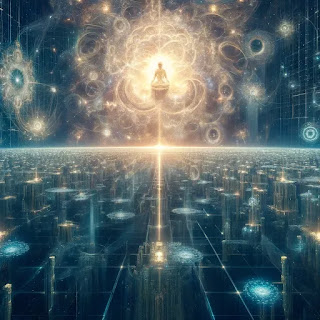
Imagine Countless Bottomless Oceans of Living Ideas, Living Forms, Living Words, Living Light, and Living Water.
Each Ocean contains inexhaustible depths.
Each depth may disclose new orders of meaning.
Each order of meaning may open upon new modes of reality.
Each mode of reality may exhibit its own continua of actuality, richness, generativity, and transcendence.
And no totality of these continua exhausts the creative source from which they proceed.
Divine Inexhaustibility
The central theological principle is:
No degree of reality, no infinity of degrees, and no totality of ontological continua can exhaust the Infinite Logos.
This principle prevents the theory from identifying God with a merely maximal point on a scale.
If God were simply the most real entity within a fixed hierarchy, the hierarchy itself would appear conceptually prior to the divine.
The Oceanic Logos instead represents the possibility that the very frameworks through which realities are distinguished are themselves expressions of divine creativity.
Thus, even the distinction between Real and Unreal, Possible and Impossible, Finite and Infinite, Within and Beyond may be inadequate to exhaust the theological meaning of the Logos.
This is not a demonstrated theorem about God.
It is the theological interpretation proposed by the doctrine.
The Infinite Freedom of Creation
The Oceanic Logos also permits a distinction between inexhaustible creative power and the obligation to realize every conceivable world.
Infinite creativity need not imply that every describable possibility must become independently actual.
Indeed, if divine goodness is understood as inseparable from the Logos, the indiscriminate realization of every possible form of suffering raises profound theological difficulties.
The doctrine must therefore distinguish between the plenitude of divine possibility and the actualization of particular worlds.
Infinite creative abundance and infinite goodness need not be treated as opposing principles.
They may instead be understood as mutually informing aspects of the divine.
XIV. Objections and Philosophical Challenges
A serious metaphysical proposal must identify its own difficulties.
Objection One: Existence cannot have degrees
A critic might argue that an entity either exists or does not exist. There is no intermediate condition.
Response: The theory need not deny binary existential judgments within specified domains. It proposes that ontological standing, independence, instantiation, and mode of being may vary even when existence statements remain true or false.
The unresolved challenge is whether these variations justify the expression degrees of realness, rather than merely describing different properties of equally existing things.
Objection Two: The theory confuses reality with richness
A complex universe is not necessarily more real than a simple universe.
Response: Agreed. Complexity, richness, intensity, and generativity must not be treated as interchangeable with actuality.
The theory therefore adopts a multidimensional account and rejects any automatic inference from greater complexity to greater realness.
Objection Three: The concept is not measurable
No accepted scientific instrument measures how real a universe is.
Response: The Realness Continuum is a metaphysical proposal, not an established empirical theory. Its initial evaluation concerns conceptual coherence, explanatory usefulness, and consistency with other justified beliefs.
Scientific applications would require operational definitions and testable consequences that the present theory does not yet provide.
Objection Four: Impossible realities are incoherent
If a world contains genuine contradictions, perhaps it cannot exist in any meaningful sense.
Response: The theory distinguishes formal representation from concrete existence. Nonclassical logic can provide models for reasoning about impossible worlds, but further argument is needed to establish whether such worlds possess independent actuality.
Objection Five: Infinite degrees do not imply infinite worlds
Even if realness can vary continuously, that does not prove every degree is instantiated.
Response: Correct. The continuity of a possible ontological spectrum does not entail that every position is occupied.
The principle of gradation and the principle of plenitude must remain logically distinct.
Objection Six: What makes one reality more real than another?
This is perhaps the theory's deepest challenge.
Without criteria, calling one reality more real risks becoming a poetic expression rather than a meaningful philosophical judgment.
Response: The theory should initially treat comparisons as dimension-relative.
A reality may be more independently actual, more generative, or more ontologically fundamental in a specified framework.
A universal ranking should not be asserted without a justified account of how these dimensions relate.
The doctrine gains rigor by acknowledging that some realities may be ontologically incomparable.
XV. Implications: A New Philosophy of Infinite Existence
If the Realness Continuum is developed into a coherent metaphysical system, several implications follow.
First, Infinite Existence need not be understood as a homogeneous collection of universes.
It may encompass radically diverse kinds of being.
Second, infinity need not eliminate finitude.
Finite realities may participate in a greater infinite order without losing their particular identities.
Third, actuality may be more complex than the distinction between possible and realized.
Different domains may support different modes of instantiation and dependence.
Fourth, ontological transformation may be conceptually possible.
A reality need not remain permanently fixed within one mode of being, although the mechanisms of such transformation remain to be established.
Fifth, no single hierarchy need organize all realities.
An inexhaustible diversity of ontological dimensions may require multiple overlapping, intersecting, or incomparable continua.
Sixth, the existence of different degrees of reality does not imply differences in moral worth.
A being should not be regarded as less deserving of compassion or dignity merely because its world is hypothesized to possess a lesser degree of ontological intensity.
Ontological gradation must never become a justification for moral domination.
Indeed, within a theology of universal liberation and restoration, the possibility of ontological intensification might instead become a metaphor for the enrichment, healing, and flourishing of existence.
The highest aspiration would not be to despise lesser realities.
It would be to understand, cherish, liberate, and enrich them.
XVI. Conclusion: The Infinite Ocean of Realness
Reality may be more than a binary distinction between existence and nonexistence.
It may be more than a single universe.
More than a multiverse.
More than an infinite collection of worlds.
It may encompass an inexhaustible diversity of degrees, dimensions, intensities, qualities, and modes of realness and actualness.
Some realities may be finite.
Others may be infinite.
Some may possess familiar physical structures.
Others may exhibit modes of being unlike anything presently understood.
Some may be more independently actual than others.
Some may possess extraordinary experiential richness.
Others may be more generative, more plastic, or more capable of ontological transformation.
And some may resist comparison altogether.
The Realness Continuum therefore rejects the image of existence as a rigid staircase ascending toward a final ontological summit.
It proposes instead an Infinite Ocean of Spectra.
Every spectrum may possess countless gradations.
Every gradation may disclose new dimensions.
Every dimension may open upon new kinds of reality.
And every kind of reality may participate in an inexhaustible diversity of possible transformations.
Our universe, within this philosophical vision, is neither unreal nor necessarily ultimate.
It is one genuine expression of reality among potentially countless others.
It may be a Middle Realm within an Infinite Existence whose full diversity exceeds our present conceptual capacities.
And if the theology of the Oceanic Logos is adopted, even this Infinite Existence does not exhaust its divine source.
For the Logos is not merely the brightest light upon the spectrum.
The Logos is not merely the deepest ocean within existence.
The Logos is not merely the greatest infinity among infinities.
The Logos is the inexhaustible source of luminosity, oceanhood, infinity, and every conceivable and inconceivable mode of being.
Not even Infinite Reality can exhaust the Infinite Logos.
The Creed of the Realness Continuum
Reality is not a rigid ladder, but an Infinite Ocean of Fluid Degrees.
The Real is not exhausted by the Actual.
The Actual is not exhausted by the Physical.
The Possible is not exhausted by the Conceivable.
The Infinite is not exhausted by any single Infinity.
There are Countless Degrees of Realness, Countless Kinds of Realness, and Countless Ways for Reality to Become More Than It Was.
Some realities shine faintly. Others shine with unfathomable brilliance. Others possess colors, patterns, and intensities of being beyond the imagination of our world.
And no brightness, no spectrum, no ocean, and no infinity of realities can exhaust the Living Logos.
For Reality is Fluid, Existence is Inexhaustible, and the Logos is Beyond Every Finality.
Selected Philosophical References and Further Reading
The following works provide historical and conceptual foundations for further development. They should not be interpreted as endorsing the Realness Continuum in its entirety.
- Giordano Bruno, On the Infinite Universe and Worlds (1584).
- Plotinus, The Enneads, especially the treatises concerning the One, Intellect, and the procession of reality.
- Gottfried Wilhelm Leibniz, Theodicy (1710) and Monadology (1714).
- Alexius Meinong, On the Theory of Objects (1904).
- Alfred North Whitehead, Process and Reality (1929).
- David Lewis, On the Plurality of Worlds (1986).
- Graham Priest, In Contradiction (1987; second edition 2006).
- Francesco Berto and Mark Jago, Impossible Worlds (2019).
- Nicholas of Cusa, On Learned Ignorance (1440).
- Gregory of Nyssa, The Life of Moses, for the theological theme of inexhaustible spiritual progression.
Foundational Thesis: Reality is not necessarily a single, uniform condition of existence. It may constitute an inexhaustible, multidimensional continuum of fluid degrees, kinds, and modes of being and actuality, within which no finite or infinite ontological framework can claim to exhaust the possibilities of reality itself.

Comments
Post a Comment