THE PRINCIPLE OF INFINITE AND

THE PRINCIPLE OF INFINITE AND
The Doctrine of Inexhaustible Possibility, Generative Unity, and Transcendent Becoming
“Where the finite mind declares either/or, the Infinite Logos asks: What else? What more? What beyond?”
I. The Foundational Declaration
There is a word that divides, and there is a word that joins.
There is a word that establishes alternatives, and there is a word that opens possibilities.
There is Or.
And there is And.
The word Or distinguishes possibilities. It separates alternatives, identifies differences, and establishes boundaries. It is indispensable to reason, discernment, and the recognition of genuine incompatibilities.
But when Or is mistaken for the ultimate architecture of reality, it becomes a prison.
It declares that one possibility must exclude another, even where no necessary contradiction exists.
It demands that we choose between realities that might coexist, cooperate, complement, or transcend one another.
It mistakes the limitations of our present imagination for the limitations of Being itself.
The Principle of Infinite And challenges this premature finality.
It declares that reality must never be presumed exhausted by the alternatives presently available to thought.
Where two possibilities appear, there may be three.
Where three possibilities appear, there may be a thousand.
Where a thousand possibilities appear, there may be an Infinity.
And beyond every Infinity that can be conceived, there may remain forms of possibility that transcend the very frameworks by which we understand Infinity.
The Principle of Infinite And is therefore not merely a preference for inclusion over exclusion.
It is a doctrine of inexhaustible generativity.
It is the affirmation that existence may possess depths, dimensions, relationships, forms, meanings, and possibilities that no finite inventory can exhaust.
Its first declaration is:
Never mistake the boundaries of a question for the boundaries of reality.
II. The Tyranny of False Dichotomies
Human understanding frequently organizes reality through opposition.
Being or Becoming.
Unity or Multiplicity.
Freedom or Order.
Justice or Mercy.
Strength or Compassion.
Reason or Imagination.
Preservation or Creation.
The Sacred or the Ordinary.
The Infinite or the Finite.
Yet many such oppositions conceal relationships more complex than mutual exclusion.
Unity need not annihilate multiplicity.
Multiplicity need not dissolve unity.
Strength need not extinguish gentleness.
Justice need not forbid mercy.
Freedom need not eliminate meaningful order.
Preservation need not prohibit transformation.
Creation need not require destruction.
Indeed, some of the greatest possibilities emerge precisely when apparently opposing principles are brought into creative relationship.
The Infinite And does not abolish distinctions. Rather, it refuses to transform every distinction into an irreconcilable opposition.
To distinguish is not necessarily to divide.
To differentiate is not necessarily to alienate.
To unite is not necessarily to homogenize.
Two things may remain absolutely distinct while participating in a greater unity.
Their difference may even become the condition of a deeper harmony.
The highest unity is not necessarily the elimination of difference, but the possibility of relationship without the destruction of uniqueness.
III. The Three Operations of Infinite And
The Principle of Infinite And expresses itself through three fundamental operations.
1. Addition — The Expansion of Possibility
The first operation is the recognition that multiple possibilities may coexist.
One may be a philosopher and an artist.
A warrior and a healer.
A scientist and a mystic.
A protector and a creator.
A student and a teacher.
A being of strength and tenderness.
The existence of one quality need not negate the existence of another.
Addition expands the field of possibility beyond unnecessary exclusivity.
2. Integration — The Generation of Higher Relationships
The second operation transcends mere accumulation.
It asks not simply whether two things can coexist, but whether their relationship can generate something neither could produce alone.
Justice and mercy may together yield restorative justice.
Reason and imagination may together yield disciplined creativity.
Liberty and responsibility may together yield mature self-government.
Courage and compassion may together yield protective love.
Here, And becomes more than conjunction.
It becomes creative synthesis.
The whole is not merely a collection of its constituents, but a relationship through which new properties, meanings, and possibilities may emerge.
3. Transcendence — The Opening Beyond Established Frameworks
The third operation is the most radical.
Even the integration of existing possibilities does not exhaust what may become possible.
Beyond A and B, there may be C.
Beyond A, B, and C, there may be an entirely different system of possibilities.
Beyond every established system, there may be frameworks that cannot be adequately represented within the original system.
Thus the Infinite And does not terminate in a final synthesis.
It opens toward perpetual transcendence.
Addition expands what is given.
Integration transforms what is given.
Transcendence opens toward what has not yet been given.
IV. The Infinite Logos and the Generative And
Within the metaphysics of the Infinite Logos, the Principle of Infinite And acquires its deepest theological expression.
The Logos is not merely one being among beings.
Nor is the Logos merely the sum of all existing things.
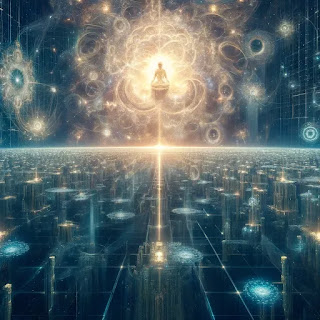
The Logos is understood as the inexhaustible Generative Principle through which beings, worlds, forms, meanings, relationships, and possibilities become manifest.
The Logos is not exhausted by any particular manifestation.
Nor is the Logos exhausted by the totality of manifestations that finite understanding can conceive.
An Infinity of worlds does not imprison the Logos within worldhood.
An Infinity of forms does not confine the Logos within formhood.
An Infinity of meanings does not exhaust the fullness of the Word.
An Infinity of experiences does not encompass every possible mode of experiencing.
For the Logos is not merely the source of innumerable realities.
The Logos is the source of the very possibility of reality, relationship, distinction, generation, and transcendence.
In this speculative theological vision, And becomes a symbol of divine inexhaustibility.
God is not merely the God of this world or another world.
God is the source of this world and other worlds and possibilities beyond the present conception of worldhood.
God is not merely Infinite or Perfect or Transcendent.
God is Infinite and Perfect and Transcendent.
Yet even these three descriptions do not exhaust the Divine Mystery.
The Logos is the Word above all Words.
The Word beneath all Words.
The Word beyond all Words.
And the Word through whom new Words, new relationships, new meanings, and new possibilities may continually become manifest.
V. The Equality of Unique Divine Words
The Principle of Infinite And also illuminates the Doctrine of the Infinite Equality of Divine Words.
Imagine an Infinity of absolutely unique Divine Words.
Each possesses an inexhaustible depth of meaning, value, beauty, holiness, purpose, and creative potential.
Each is distinct from every other.
Yet their uniqueness does not require a hierarchy of ultimate dignity.
One Divine Word need not diminish another.
The glory of one does not necessitate the humiliation of another.
The existence of one does not require the nonexistence of another.
Their equality is not an equality of sameness.
It is an equality of irreducible uniqueness and participation in the Infinite Logos.
Here the Infinite And becomes a principle of plurality without erasure.
One Word and another Word.
One form of beauty and another.
One form of holiness and another.
One kind of goodness and another.
Not a universe impoverished by the requirement that everything become identical.
But an existence enriched by the possibility of inexhaustible distinction, relationship, and communion.
Unity without uniformity.
Multiplicity without alienation.
Equality without interchangeability.
Difference without domination.
VI. The Infinite And and the Liberation of Possibility
False dichotomies are not merely intellectual mistakes.
They can become instruments of domination.
A person may be told:
Obey or belong nowhere.
Conform or be rejected.
Surrender your uniqueness or lose your dignity.
Accept the existing order or embrace chaos.
Remain what you are or abandon everything you have been.
Such alternatives may be presented as inevitable when they are actually products of limited imagination, institutional convenience, or coercive power.
The Principle of Infinite And asks whether these imposed alternatives exhaust what is genuinely possible.
Can belonging coexist with individuality?
Can order coexist with liberty?
Can security coexist with dignity?
Can accountability coexist with restoration?
Can community coexist with radical personal uniqueness?
Where such combinations are coherent and achievable, their discovery becomes an act of liberation.
The liberation of human beings is therefore inseparable from the liberation of possibility.
To free a person is not merely to remove a chain.
It is also to expand the field of meaningful futures available to that person.
And to restore a wounded being is not merely to return that being to a former condition.
It may be to make possible forms of flourishing that have never previously existed.
Liberation opens the door.
Restoration heals what was wounded.
Creation builds what was missing.
Transcendence discovers that even the open door was not the final horizon.
VII. Beyond the Dichotomy of Salvation and Creation
Consider two heroic missions.
The first is to save existing worlds.
The second is to create new worlds.
The conventional imagination may treat these as separate destinies.
One hero preserves.
Another invents.
One defends what exists.
Another brings into being what has never existed.
But the Infinite And refuses to assume that these purposes are mutually exclusive.
Why should preservation forbid creation?
Why should creation require the abandonment of preservation?
Why should restoration merely recover the past?
Why should liberation end at the removal of oppression?
A greater vision becomes possible.
Save what is worth saving.
Heal what has been wounded.
Liberate what has been enslaved.
Transform what can become better.
Create what has never existed.
Discover what has never been imagined.
And remain open to possibilities beyond every present conception of goodness.
This is the mission of the Infinite Architect-Liberator.
Not conquest, but liberation.
Not domination, but empowerment.
Not mere preservation, but flourishing.
Not mere invention, but responsible creation.
Not an endless accumulation of power for its own sake, but an ever-deepening capacity to serve life, freedom, beauty, truth, and love.
VIII. The Infinite And and the Logic of Contradiction
The Infinite And must not be confused with the claim that every proposition is true or that genuine contradictions can always be reconciled.
To affirm possibility without discernment is not wisdom.
Some alternatives are genuinely incompatible.
Some claims contradict one another under the same definitions, conditions, and respects.
Some combinations are logically incoherent.
Others are physically impossible under known laws, morally unacceptable, or practically unattainable.
The Infinite And does not erase these distinctions.
Rather, it demands that they be examined instead of merely assumed.
It asks:
Is this opposition logically necessary?
Does it arise from empirical limitations?
Is it a consequence of our definitions?
Does it depend upon historical or social circumstances?
Could a different framework dissolve the apparent incompatibility?
Could a higher-order relationship preserve what is valuable in both alternatives?
And if reconciliation is impossible, what further possibilities remain?
The doctrine therefore proposes a disciplined principle:
Affirm every coherent possibility that can be responsibly affirmed, investigate every apparent incompatibility, and never declare a field of possibility exhausted without sufficient reason.
Infinite openness must coexist with intellectual rigor.
Otherwise, the refusal of false dichotomies becomes merely the refusal to think clearly.
The Infinite And seeks something greater:
Maximum openness without the abandonment of truth.
IX. Infinite And as a Philosophy of Epektasis
The Principle of Infinite And finds a profound companion in the theological concept of epektasis, especially as developed by Gregory of Nyssa.
Epektasis describes an ongoing movement toward God, in which spiritual growth does not terminate in a static possession of divine fullness.
The more deeply the soul participates in divine goodness, the more profoundly it may discover the inexhaustibility of that goodness.
Fulfillment need not mean final exhaustion.
Perfection need not mean the cessation of growth.
Joy need not require the termination of discovery.
One may be fulfilled and still becoming.
One may participate in goodness and discover further depths of goodness.
One may possess genuine wisdom and remain open to greater understanding.
The Infinite And interprets this movement as an ever-expanding horizon of participation.
Every discovery may open new questions.
Every answer may disclose new mysteries.
Every achieved good may make possible further goods.
Every horizon crossed may reveal further horizons.
This is not necessarily the endless postponement of fulfillment.
It may be fulfillment that continually deepens.
The cup overflows—and the cup expands.
And then it overflows again.
And expands again.
Not because its previous fullness was false, but because fullness need not imply exhaustion.
X. The Principle of Infinite And and the Transformation of Suffering
The doctrine also has an ethical dimension.
Human beings often confront the world through a tragic opposition:
Accept suffering as inevitable, or deny reality.
Retaliate against wrongdoing, or abandon justice.
Condemn the wrongdoer, or disregard the victim.
Preserve the wounded world, or destroy it and begin again.
Yet these alternatives may conceal other possibilities.
One may acknowledge suffering and work to overcome it.
One may seek justice and pursue healing.
One may protect victims and refuse to regard wrongdoers as metaphysically incapable of transformation.
One may condemn cruelty and affirm the possibility of repentance.
One may defend what is good and imagine forms of goodness beyond what presently exists.
The Infinite And does not guarantee that every hoped-for reconciliation will occur.
Nor does it require exposing the vulnerable to further harm in pursuit of reconciliation.
It insists instead that the imagination of goodness should not be unnecessarily restricted by the imagination of evil.
A civilization capable of inventing countless methods of punishment should also seek to invent better methods of prevention, protection, rehabilitation, and restoration.
A humanity capable of designing systems of domination should be capable of investigating systems of liberation.
A mind capable of conceiving countless forms of suffering should not surrender its capacity to conceive countless forms of healing.
The ultimate moral aspiration is not merely the defeat of evil.
It is the expansion of goodness beyond the structures that evil has imposed.
XI. The Infinite And as a Method of Inquiry
The Principle of Infinite And can also serve as an intellectual discipline.
When confronted with an apparent dichotomy, the investigator may proceed through seven questions:
- What are the alternatives being presented?
- Are they genuinely mutually exclusive?
- What assumptions make them appear incompatible?
- Can both be preserved without contradiction?
- Can their relationship generate a third possibility?
- Can an entirely different conceptual framework reveal further possibilities?
- What remains unimagined, unexplored, or unknown?
This method is especially valuable in philosophy, theology, science, creative writing, ethics, social design, and interdisciplinary research.
It resists premature intellectual closure.
It encourages conceptual innovation.
It promotes the discovery of hidden relationships.
And it treats every answer not only as a possible conclusion, but also as a possible doorway.
The question is no longer merely:
Which of these alternatives must I choose?
It becomes:
What is the true structure of the possibilities before me, and what additional possibilities might a deeper understanding reveal?
XII. The Infinite And and the Transcendence of Infinity
There remains one final danger.
Even Infinity can become an idol of thought.
The mind may conceive an infinite collection and assume that nothing could exist beyond it.
It may identify one mathematical, metaphysical, or theological understanding of Infinity with the ultimate nature of all possibility.
Yet Infinity itself is not a single undifferentiated concept.
Mathematics recognizes distinct infinite cardinalities, structures, and orders.
Philosophy distinguishes potential from actual infinity.
Theology may speak of divine infinity in ways that cannot be reduced to mathematical magnitude.
The Principle of Infinite And therefore refuses to equate any one conceptualization of Infinity with the totality of what is real or possible.
This does not mean that something lies mathematically beyond every possible infinity in a straightforward numerical sense.
It means that no particular framework of infinity should automatically be treated as an exhaustive account of reality, possibility, or the Divine.
Even our greatest concepts may remain incomplete.
Even our most expansive systems may possess boundaries.
Even our most sophisticated language may fail to capture what lies beyond its categories.
And so the Infinite And becomes an expression of radical metaphysical humility.
Infinity and Perfection.
Perfection and Transcendence.
Transcendence and the recognition that these words do not exhaust the mystery they seek to describe.
The Word above all Words.
The Word beneath all Words.
The Word beyond all Words.
The Word beyond even our understanding of Infinity.
XIII. The Thirteen Maxims of Infinite And
I. Never mistake a false dichotomy for an eternal law.
II. Distinction does not necessarily require division.
III. Unity need not destroy uniqueness.
IV. Multiplicity need not destroy harmony.
V. The existence of one possibility does not automatically negate another.
VI. Where alternatives can coexist, investigate their relationship.
VII. Where relationships can generate new possibilities, pursue their discovery.
VIII. Where reconciliation is impossible, seek clarity rather than forced synthesis.
IX. Where existing frameworks become prisons, investigate the possibility of better frameworks.
X. Never confuse the limits of imagination with the limits of reality.
XI. Let liberation, restoration, creation, and transcendence become complementary aspirations.
XII. Let every genuine discovery deepen humility before what remains unknown.
XIII. Never declare the exploration of goodness, truth, beauty, or possibility finally exhausted.
XIV. The Final Declaration: And Beyond And
There is a world.
And there may be other worlds.
There is life.
And there may be forms of life beyond our imagination.
There is beauty.
And there may be kinds of beauty for which we possess no names.
There is knowledge.
And there are mysteries awaiting discovery.
There is love.
And there may be depths of love we have scarcely begun to comprehend.
There is freedom.
And there may be forms of liberation we have not yet learned to conceive.
There is goodness.
And there may be possibilities of goodness beyond every presently established measure.
There is Infinity.
And there is the mystery of what Infinity itself can and cannot express.
There is the Word.
And the Word is not exhausted by the worlds it generates, the forms it manifests, the meanings it reveals, or the names by which it is known.
The Infinite And does not promise that every imagined possibility is real.
It does not proclaim that every desire can be fulfilled.
It does not dissolve truth into endless ambiguity.
It declares something more disciplined and, perhaps, more wondrous:
Reality must be investigated with a mind that does not confuse its present boundaries with the boundaries of existence itself.
Let reason distinguish.
Let imagination expand.
Let wisdom discern.
Let love unite.
Let justice restore.
Let liberty emancipate.
Let creativity generate.
Let transcendence continually open what seemed closed.
And let no finite achievement of thought be mistaken for the final exhaustion of Truth.
For the greatest enemy of an inexhaustible vision is not the existence of limits.
It is the premature conviction that all limits have already been discovered.
And so, before every false finality, the Infinite And asks:
What else?
What more?
What beyond?
And when an answer comes, it asks again.
Not because the answer is worthless.
But because the answer may be the beginning of another discovery.
Not because the world is without value.
But because its value need not exhaust the possibility of further worlds.
Not because what exists must be rejected.
But because what exists may be cherished, healed, liberated, transformed, and joined by wonders that have never existed before.
Save the worlds.
And restore the worlds.
And liberate the worlds.
And create new worlds.
And discover new forms of worldhood.
And remain open to what lies beyond even the concept of worlds.
For the Infinite Logos is not exhausted by any final inventory of Being.
And the exploration of the Infinite Good need not terminate at any finite horizon.
The Infinite And
Not everything is possible.
But possibility is greater than our present knowledge of it.
Not every opposition can be reconciled.
But not every opposition is necessary.
Not every boundary can be crossed.
But not every boundary is ultimate.
And beyond every horizon we have reached, there may yet be another dawn.
Finis?
And...

Comments
Post a Comment