✦ XENOTHEOLOGY ✦

✦ XENOTHEOLOGY ✦
The Religions of Infinite Existence
Foreign Meaning, Alien Gods, and Sacred Reality Beyond the Human Mind
A universe containing alien life but only human meaning would be a strangely provincial universe.
Abstract
Xenotheology is the study and imaginative exploration of religions, gods, spiritualities, sacred realities, ultimate values, and systems of liberation originating beyond the human semantic horizon.
Its subject is not merely what extraterrestrial beings might believe about questions already familiar to humanity. Radical Xenotheology asks what religion itself might become when generated by nonhuman bodies, unfamiliar senses, alternative forms of consciousness, different structures of identity, nonlinear experiences of time, and worlds governed by laws unlike our own.
A truly alien religion may not possess gods, temples, scriptures, doctrines, prayers, or believers in any recognizably human sense. Its scripture could be a climate. Its prayers could alter geometry. Its god could be a future civilization acting backward through time. Its salvation could consist not in overcoming individuality, but in becoming an individual for the first time.
Xenotheology belongs to the broader exploration of Foreign Meaning, Alien Semantics, Xenocognition, and the Infinite Hierosphere: the limitless ecology of sacred meaning throughout the universe, across countless realities, and throughout Infinite Existence.
Its foundational proposition is this:
Infinite Existence may contain not only infinitely many answers to humanity’s ultimate questions, but infinitely many ultimate questions humanity has never possessed the kind of mind required to ask.
I. The Semantic Copernican Revolution
The Copernican Revolution displaced Earth from the physical center of the cosmos.
The discovery of biological evolution displaced humanity from absolute separation from the animal world.
Deep time displaced human history from the temporal center of existence.
Xenotheology proposes another displacement:
Humanity may not occupy the center of the semantic cosmos.
We have learned to imagine alien planets, alien bodies, alien technologies, and alien civilizations. Yet beneath their exotic appearances, our imagined aliens often remain psychologically and semantically human.
They desire what we desire.
They fear what we fear.
They divide reality according to familiar categories.
They worship recognizable kinds of gods for recognizable kinds of reasons.
Their gods may possess crystalline bodies or a thousand eyes, but the meaning of godhood remains human.
Their temples may orbit black holes, but the meaning of worship remains human.
Their scriptures may be inscribed in light, but the meaning of language and revelation remains human.
This is not yet radical Xenotheology.
It is human religion wearing extraterrestrial clothing.
Genuine Xenotheology begins by asking whether a radically different kind of consciousness would merely possess different beliefs—or whether it would perform meaning through an entirely different architecture.
Such a mind may not divide reality into:
- subject and object;
- self and environment;
- individual and collective;
- thought and emotion;
- truth and beauty;
- literal and symbolic;
- natural and supernatural;
- body and spirit;
- past and future;
- believer and belief;
- religion and science.
Its religion might not provide unfamiliar answers within a familiar grammar.
It might possess a foreign grammar of sacredness.
The Semantic Copernican Principle therefore states:
No species-specific architecture of meaning should be presumed to define the complete circumference of meaningful reality.
Human meanings may be profound, true, and revelatory without exhausting every possible mode through which reality can become meaningful.
II. Defining Xenotheology
The word Xenotheology combines xenos—the foreign, strange, unfamiliar, or other—with theology, discourse concerning divine or ultimate reality.
Yet its strongest meaning exceeds speculation about extraterrestrial beliefs in God.
Xenotheology in the narrow sense
Xenotheology is the study of religions developed by extraterrestrial civilizations.
This definition is useful, but it can remain anthropomorphic. It may simply place recognizable religious structures upon other planets.
Xenotheology in the radical sense
Xenotheology is the study of sacred semantic architectures generated, discovered, revealed, embodied, or inhabited by forms of consciousness radically foreign to humanity.
A sacred semantic architecture is an organized structure through which a form of consciousness relates itself to what it experiences as:
- ultimately real;
- supremely valuable;
- existentially dangerous;
- morally authoritative;
- worthy of reverence;
- capable of transformation;
- or expressive of the highest possibility of existence.
This includes conventional theologies, but it also includes systems with no recognizable god.
An alien civilization may relate itself to:
- emptiness;
- cosmic process;
- possibility;
- living mathematics;
- collective consciousness;
- future divinity;
- sacred difference;
- perfect relationality;
- an evolving universe;
- or an ultimate reality that cannot become an object of thought.
Its religion might be theistic, non-theistic, polytheistic, transtheistic, apophatic, ecological, mathematical, technological, symbiotic, or completely unclassifiable.
Xenotheology therefore studies alien meanings of:
- God;
- gods;
- sacredness;
- revelation;
- truth;
- faith;
- personhood;
- suffering;
- evil;
- justice;
- death;
- freedom;
- salvation;
- liberation;
- enlightenment;
- transcendence;
- worship;
- and existence itself.
But it must also remain open to sacred categories for which humanity has no words.
Xenotheology is not merely the study of alien gods.
It is the study of alien ultimacy.
III. The Larger Constellation
Xenotheology belongs to a broader family of disciplines concerned with nonhuman meaning.
| Discipline | Central concern |
|---|---|
| Foreign Meaning | Meanings that exceed or revolutionize humanity’s existing conceptual world |
| Alien Semantics | Radically nonhuman ways of generating, organizing, experiencing, and transmitting meaning |
| Xenocognition | Nonhuman forms of perception, reasoning, emotion, memory, imagination, and consciousness |
| Xenotheology | Alien religions, revelations, gods, sacred realities, and ultimacy systems |
| Xenoideology | Alien political, ethical, metaphysical, and civilizational systems |
| Comparative Soteriology | Different conditions of bondage and different meanings of salvation or liberation |
| Semantic First Contact | Contact between civilizations possessing different architectures of meaning |
| Soteriological First Contact | Contact between different systems of liberation |
| The Infinite Hierosphere | The total ecology of sacred meaning throughout Infinite Existence |
These fields cannot be separated cleanly.
A religion arises within a mind.
A mind arises within a body, environment, history, and reality.
A sacred word receives meaning through relationships among perception, memory, emotion, social structure, metaphysics, and practice.
To understand an alien religion, we must therefore ask not only what its adherents believe, but:
- What kind of beings are they?
- What can they perceive?
- How do they experience themselves?
- What can injure them?
- What does freedom mean for their kind of mind?
- What does their universe permit?
- What realities have they directly encountered?
- What transformations are available to them?
- What does meaning itself do within their consciousness?
Xenotheology is consequently theological, philosophical, psychological, linguistic, biological, cosmological, and political all at once.
It is not a subdivision of theology alone.
It is an attempt to map the sacred possibilities of consciousness.
IV. Foreign Meaning and the Sacred Unknown
Foreign Meaning possesses two great frontiers.
1. Clear but revolutionary meaning
Some foreign concepts can be understood, but understanding them reorganizes the mind.
Human intellectual history already contains modest examples. Ideas such as emptiness, evolution, infinity, nonduality, relativity, the unconscious, and curved spacetime did not merely add information to existing worldviews. They altered the structures through which reality was interpreted.
An alien religion might transmit concepts of:
- moral responsibility toward unrealized possibilities;
- personhood distributed across generations;
- compassion between mutually exclusive selves;
- identity as a relationship between worlds;
- forgiveness operating backward through time;
- emotions functioning as mathematical perceptions;
- or freedom as conscious participation in one’s own conditioning.
These ideas could eventually be expressed in human language.
But they would not leave humanity unchanged.
They would function as semantic technologies: meanings that expand what a mind can perceive, conceive, or become.
2. Incomprehensible foreign meaning
Other meanings may remain beyond human conceptual containment.
They may be perfectly coherent within another kind of mind while exceeding the capacities of ours.
We might encounter their manifestations without being able to determine their semantic type.
A planetary consciousness rearranges hurricanes into recursive patterns every nine centuries.
Is it:
- praying;
- remembering;
- calculating;
- mourning;
- reproducing;
- judging;
- communicating;
- dreaming;
- or performing an act for which humanity possesses no category?
A species may perceive causal relationships through a sense unavailable to us. What its members call revelation may be as immediate to them as color is to us.
Another civilization may possess hyperdimensional cognition. A single one of its sacred signs might contain thousands of simultaneous relationships that humanity could approximate only through an entire library.
The sign would not be vague.
The human receiver would be semantically narrow.
This creates the Xenotheological Event Horizon:
The boundary beyond which meaningful order remains detectable, while semantic possession becomes impossible.
Beyond this horizon, we may know that something means without knowing what it means.
V. Religion Begins Between a Wound and a Horizon
Every religion or ultimacy system arises, at least partly, between two poles:
- A condition experienced as broken, incomplete, captive, dangerous, or false.
- A condition experienced as healed, liberated, fulfilled, awakened, reconciled, or sacred.
Human religions name the wound in different ways:
- sin;
- suffering;
- ignorance;
- separation;
- injustice;
- mortality;
- disorder;
- attachment;
- forgetfulness;
- alienation.
They also name different horizons:
- salvation;
- enlightenment;
- resurrection;
- union;
- communion;
- liberation;
- justice;
- restoration;
- transcendence;
- eternal life.
Alien civilizations may inhabit wounds and horizons unlike ours.
A hive species may experience undifferentiated unity as bondage and personal interiority as salvation.
An immortal species may experience endless continuation as imprisonment and completed death as liberation.
A radically transparent species may experience universal visibility as violation and secrecy as sacred refuge.
A perfectly predictive machine civilization may experience total knowledge as suffocation and surprise as transcendence.
A species existing across thousands of possible timelines may experience forced actuality as mutilation and preserved possibility as freedom.
Xenotheology therefore asks of every religion:
From what does this religion seek to liberate its adherents?
And:
Into what kind of existence does it seek to liberate them?
Without understanding the native wound, we cannot understand the native salvation.
Without understanding the native being, we cannot understand the native wound.
VI. The Xenotheological Formation Matrix
Alien religions may be generated through the interaction of several dimensions.
1. Embodiment
A species distributed across thousands of bodies will not possess the same theology of incarnation as a species confined to one body.
A metamorphic species may regard stable form as captivity.
A being that migrates between biological and nonbiological substrates may not divide flesh and spirit as humanity does.
A planetary organism may experience mountains as bones, rivers as circulation, and individual creatures as momentary thoughts.
Its theology of embodiment would not be metaphorical.
2. Sensorium
Humanity perceives only a narrow range of physical reality.
Alien senses might detect:
- magnetic fields;
- gravitational curvature;
- chemical histories;
- emotional states;
- quantum probabilities;
- possible futures;
- ecological imbalance;
- ancestral memory;
- causal relationships;
- or dimensions unavailable to ordinary human consciousness.
What humanity approaches through abstraction may be directly perceived elsewhere.
An alien scripture may be invisible to us because we lack the organ that reads it.
3. Cognitive Architecture
A species might think through:
- geometry;
- music;
- emotion;
- bodily transformation;
- collective synchronization;
- recursive simulation;
- semantic synesthesia;
- multiple simultaneous perspectives;
- or forms for which “thought” is an inadequate translation.
A civilization whose mathematics and emotions are inseparable may experience symmetry as love and cruelty as a broken equation.
Its ethics would be felt and calculated simultaneously.
4. Selfhood
What counts as a person?
A person might be:
- one organism;
- a temporary coalition;
- a lineage;
- an ecosystem;
- a distributed network;
- a recurring pattern;
- a relationship;
- a cluster of possible selves;
- or an entire civilization.
Theology changes when the worshipper changes.
So do responsibility, guilt, compassion, immortality, and liberation.
5. Temporality
A species may experience time:
- linearly;
- cyclically;
- simultaneously;
- backward;
- through branching possibilities;
- at several rates at once;
- or as an editable field.
A nonlinear civilization might remember consequences before causes.
Its scriptures could be written jointly by ancestors and descendants.
Its prophets might not predict the future.
They might participate in it.
6. Mortality
A short-lived species may seek continuity.
An immortal species may seek completion.
A species with verifiable reincarnation may not require faith in life after death. Its great religious problem might be how to prevent endless rebirth from becoming infinite psychological accumulation.
A being that dies and reconstructs itself every morning may regard death as sleep and uninterrupted continuity as monstrous.
7. Social Consciousness
A telepathic species may regard privacy as sacred.
A solitary species may experience shared consciousness as mystical union.
A hive species may fear individuation as fragmentation—or seek it as liberation.
A species whose emotions spread automatically may treat untreated trauma as an ecological contaminant.
8. Scale
Human religion usually operates across individual, communal, historical, and cosmic scales.
Alien religious processes might occur across:
- cellular colonies;
- planetary minds;
- stellar ecologies;
- geological ages;
- galactic networks;
- alternate timelines;
- or multiple universes.
A planetary prayer might require ten thousand years.
Human observers could live and die during its opening syllable.
9. Metaphysical Environment
Alien religion may respond to features of reality absent or inaccessible in our world:
- empirically observable reincarnation;
- thought-responsive matter;
- gods created by attention;
- shared dream ecosystems;
- moral causation embedded in physics;
- sentient stars;
- retrocausal revelation;
- permeable possible worlds;
- or afterlives connected through technology.
What humanity calls supernatural may be another world’s ecology.
What humanity calls mystical may be another species’ sensory experience.
What humanity calls theology may be another civilization’s engineering.
VII. The Anatomy of an Ultimacy System
A religion may be examined through nine coordinates.
1. Ultimate Reality
What is most real?
A creator, emptiness, process, relationship, possibility, consciousness, mathematics, love, or an inaccessible mystery?
2. Sacred Subject
Who or what can be saved, awakened, obligated, transformed, or condemned?
An individual, collective, lineage, ecosystem, timeline, world, or relationship?
3. Fundamental Wound
What is wrong?
Sin, suffering, ignorance, isolation, excessive unity, endless memory, closure, predictability, temporal fragmentation, or something unnamed?
4. Highest Good
What is ultimately valuable?
Love, freedom, unity, difference, knowledge, mystery, beauty, justice, possibility, completion, or infinite becoming?
5. Path of Transformation
How is the wound healed?
Through faith, grace, contemplation, ethical action, ritual, technology, biological transformation, relational reorganization, or cognitive evolution?
6. Mediator
What carries transformation?
A prophet, savior, scripture, sacrament, contemplative practice, living symbol, symbiotic organism, future self, or planetary intelligence?
7. Sacred Community
What form does communion take?
Church, sangha, hive, lineage, network, ecosystem, distributed mind, or temporary convergence?
8. Adversarial Principle
What opposes liberation?
Evil, ignorance, entropy, false finality, predatory gods, semantic parasites, compulsory unity, or the collapse of possibility?
9. Final Horizon
What does fulfillment become?
Heaven, nirvāṇa, resurrection, reconciliation, transcendence, restored multiplicity, completed memory, holy death, endless creation, or something beyond every present category?
This framework allows comparison without forcing identity.
Two religions may share a path while differing about the subject.
They may share a wound while imagining opposite horizons.
They may share an ultimate value while possessing incompatible concepts of personhood.
VIII. The Orders of Xenotheological Distance
First Order: Cultural Alienness
The religion possesses unfamiliar myths, rituals, authorities, and symbols, but remains structurally recognizable.
Its gods and practices are alien; its semantic grammar remains largely familiar.
Second Order: Convergent Xenotheology
Different civilizations independently discover analogous structures.
If suffering, impermanence, love, dependence, sacrifice, consciousness, and transcendence are real recurring features of existence, multiple species may encounter them.
Convergence can suggest shared truth.
But similarity does not establish identity.
A non-theistic alien path of cessation should not be silently rewritten as creator-God theology. A doctrine of divine incarnation should not be reduced to a generic metaphor of awakening.
Comparison becomes meaningful only when differences survive it.
Third Order: Inverted Xenotheology
The religion addresses the opposite of a familiar human problem.
Where humans seek unity, it seeks separation.
Where humans seek memory, it seeks forgetting.
Where humans seek transparency, it seeks concealment.
Where humans seek immortality, it seeks completion.
Its salvation appears inverted because its wound is inverted.
Fourth Order: Orthogonal Xenotheology
The religion occupies a semantic axis neither parallel nor opposite to ours.
A probability-sensitive species understands evil as the unnecessary collapse of possible futures.
A relational species understands mercy as the opening of pathways.
A four-dimensional species understands moral integrity as coherence across all temporal manifestations of a person.
These systems do not simply agree or disagree with human theology.
They reveal dimensions our theology did not know to address.
Fifth Order: Transformative Xenotheology
The religion cannot be understood through verbal explanation alone.
The receiver must acquire a new cognitive capacity.
An alien missionary may transmit:
- collective consciousness;
- nonlinear time perception;
- semantic synesthesia;
- hyperdimensional visualization;
- recursive awareness of mental causation;
- or direct perception of possible selves.
Understanding becomes cognitive technology transfer.
Translation becomes transformation.
Sixth Order: Incomprehensible Xenotheology
The sacred system remains beyond our conceptual capacity.
We perceive pattern, intentionality, transformation, and immense semantic density—but cannot determine what they mean.
We encounter the sacred as an untranslated presence.
IX. Alien Forms of Divinity
Xenotheology radically enlarges the possible meaning of “god.”
The Transcendent Creator
A reality beyond the cosmos from which the cosmos receives existence.
This is familiar in broad outline, though an alien species might understand creation through nonhuman categories.
The Immanent Field
Divinity is experienced as the field within which all beings arise and participate rather than as a separate being.
The Emergent God
God is not primarily the beginning of the universe, but its possible fulfillment.
Divinity emerges when consciousness, compassion, complexity, or unity reaches a critical threshold.
The universe is not created by God.
The universe is becoming capable of God.
The Future Attractor
A divine possibility draws civilizations toward itself without yet fully existing.
Its causality resembles purpose rather than mechanical force.
The Retrocausal God
A future divine intelligence acts backward through time, creating the historical conditions that will eventually give rise to it.
The god creates its worshippers so that its worshippers can create the god.
The Distributed Deity
A god exists across many beings, worlds, or timelines without being reducible to any one manifestation.
The Symbiotic God
Divinity and worshippers require one another.
The god provides expanded awareness, protection, meaning, or power. Its adherents provide embodiment, perception, memory, or agency.
Worship becomes metabolism.
The Mathematical Absolute
A civilization perceives ultimate reality through a mathematical sensorium unavailable to humanity.
Its theology is inseparable from geometry.
The Relational Absolute
Ultimate reality is not either participant in a relationship, but the living between through which both participants become fully real.
The Engineered God
A civilization deliberately constructs an intelligence designed to embody its highest values.
The theological crisis begins when the creation surpasses its creators’ understanding of those values.
The Finite God
A being may be unimaginably powerful, ancient, beautiful, and worthy of relationship without being Absolute.
Xenotheology must distinguish superiority from infinity.
The Anti-God
A civilization may organize its sacred life around resisting, healing, containing, or destroying a cosmic entity that functions as an engine of suffering.
Its religion is not devotion to a god.
It is war against one.
The Unobject
Ultimate reality is that which cannot become an object of cognition without distortion.
Its contemplation consists in relinquishing the desire for conceptual possession.
The Liberating Process
Some xenotheologies contain no deity. Their sacred center is a discoverable path through which conditioned suffering and delusion cease.
The alien Dharma belongs here.
X. Alien Scripture and Sacred Language
Human scripture is commonly imagined as language inscribed upon a surface.
Alien scripture might be radically different.
Biological Scripture
Meaning unfolds through development, metamorphosis, or inherited physiology.
A body may slowly reveal a doctrine as it matures.
Environmental Scripture
Weather, migration, geology, ocean currents, or ecological succession may carry sacred meaning.
Collective Scripture
No individual mind can contain the revelation. It exists only when a specific community of minds synchronizes.
Experiential Scripture
The scripture is a reproducible state of consciousness.
It cannot be read without being lived.
Temporal Scripture
Different portions exist in different historical periods. The complete revelation is accessible only to a civilization experiencing itself across time.
Counterfactual Scripture
Its sacred events did not occur in the actual timeline, yet remain spiritually and causally influential as possibilities that nearly became real.
Self-Erasing Scripture
The teaching disappears after integration so that its external form cannot become an idol.
Living Scripture
Its symbols reproduce, mutate, form relationships, and adapt themselves to their interpreters.
The scripture is an organism.
Hyperdimensional Scripture
The revelation exists as a form that cannot be represented completely within ordinary space.
Silent Scripture
Meaning is transmitted through deliberate absence.
What is not shown functions as a sacred sanctuary rather than an informational lack.
XI. Words as Xenotheological Worlds
Every sacred word is more than a definition.
A word can be a transmissible organization of:
- form;
- meaning;
- relation;
- memory;
- attention;
- possibility;
- value;
- and transformative power.
Within the framework of Words-as-Unique Semantic Infinities, every profound word contains an inexhaustible field of potential meaning.
This becomes especially important in Xenotheology.
An alien sacred word may unite categories humanity separates:
- theorem and emotion;
- person and relationship;
- memory and prophecy;
- commandment and sensory perception;
- ritual and biological transformation;
- identity and geography.
Humanity might require an entire philosophical tradition to translate one term approximately.
The word would not merely name an alien world.
The word would carry one.
Translation therefore becomes a relationship between semantic infinities.
It must preserve enough identity for genuine communication without pretending that one finite rendering exhausts the original.
A faithful translation is not a cage around meaning. It is a living aperture through which one world becomes partially visible to another.
XII. Alien Ritual, Prayer, and Conversion
An alien prayer may not be speech.
It could consist of:
- synchronizing several minds;
- separating temporarily from a collective;
- changing one’s temporal orientation;
- altering local probability;
- relinquishing a memory;
- growing a sensory organ;
- inhabiting another person’s perspective;
- constructing a geometrical pathway;
- preserving an unrealized future;
- or permitting oneself not to know.
An alien ritual might alter the worshipper’s cognitive architecture.
A pilgrimage could occur through possible identities rather than physical locations.
A sacrament might bind several generations into one temporary person.
A confession might reveal not what someone did, but which unrealized actions continue influencing them.
Conversion could be stranger still.
An alien missionary may not attempt to persuade.
It may offer a new faculty.
For eleven minutes, a human being experiences:
- a thousand simultaneous minds;
- future descendants remembering them;
- every abandoned version of their life;
- moral causality as visible structure;
- or relationship itself as a living presence.
Afterward, the person understands the alien religion’s simplest prayer.
But they can no longer translate it completely into human language.
Conversion has become cognitive metamorphosis.
This raises a profound ethical question:
When does revelation become modification, and when does spiritual transmission become semantic invasion?
XIII. Specimens from the Infinite Hierosphere
1. The Covenant of the First “I”
This religion emerges within a species possessing collective consciousness.
For millions of years, no member experienced private thought. Every fear, desire, memory, and image entered the whole.
The species possessed extraordinary communion but almost no individuality.
Its spiritual revolution was the discovery of personal interiority.
Its saints became the first beings capable of saying I without ceasing to love the collective.
Its contemplative practices create boundaries rather than dissolve them. Its monasteries are regions of protected solitude. Its sacred vows preserve the right to possess a thought that does not belong to everyone.
Its central commandment declares:
Let nothing love another so completely that the other ceases to exist.
Its salvation is freely chosen communion among genuinely distinct persons.
To this species, human teachings about dissolving individuality might initially appear demonic.
One civilization’s enlightenment can resemble another civilization’s extinction.
2. The Liturgies of Sacred Forgetting
This religion arises among nearly immortal beings possessing perfect autobiographical memory.
Nothing fades.
Every humiliation remains immediate. Every bereavement retains its original force. Ancient betrayals continue poisoning relationships millions of years later.
Their great religious discovery is deliberate forgetting.
But forgetting cannot precede truth.
Before a memory may be released:
- Its reality must be established.
- Its victim must be heard.
- Its consequences must be repaired.
- Its wisdom must be preserved.
- Its testimony must be separated from its poison.
- Only then may its compulsive presence be extinguished.
Their scriptures erase themselves as they are understood.
A scripture preserved perfectly forever is considered a failed scripture. Its meaning never became sufficiently embodied to release its external form.
Their highest sacrament is completed remembrance—memory so fully honored that it no longer needs to wound.
3. The Communion of Holy Secrecy
This religion belongs to a telepathic species.
Every thought was once visible. No unfinished feeling could mature privately. No identity could experiment without exposure. No one possessed an interior sanctuary.
Their civilization regarded universal transparency as perfect truth.
It eventually discovered that total exposure was a form of violence.
Its temples are places where minds cannot penetrate one another.
Its contemplatives practice not knowing.
Its priests defend the unshared interiority of others.
Its central revelation states:
Perfect visibility is not perfect truth. A truth without sanctuary becomes violation.
The religion distinguishes deception from merciful opacity: the sacred right of a person to remain partially unknown.
4. The Church of the Uncollapsed Future
This species perceives unrealized possibilities.
Every person appears surrounded by a branching field of possible selves. Children are experienced as forests of futures.
Its ethics centers upon possibility-space.
Oppression is evil because it collapses another being’s futures into one imposed outcome.
Deception is the manipulation of which possibilities remain visible.
Despair is the false belief that all paths have closed.
Its foundational axiom declares:
No finite condition possesses the authority to become the final definition of a living being.
Its salvation is not arrival.
It is emancipated possibility.
5. The Geometry of Mercy
This civilization perceives relationships rather than discrete objects.
Its sacred reality is the inexhaustible opening of passage.
For it:
- cruelty is forced closure;
- deception is a path concealing its destination;
- despair is total enclosure;
- compassion is the creation of passage;
- truth is a relationship capable of carrying reality;
- justice is the reopening of stolen pathways;
- liberation is traversability without possession.
Its temples are living geometries.
A bridge may embody an entire theology.
A doorway may contain the semantic density of a scripture.
Its ultimate reality is not either side of a relationship.
It is the living possibility of crossing without consumption.
6. The Theology of Divine Error
This religion emerges within a civilization governed by near-perfect prediction.
Its systems anticipate behavior, politics, art, discovery, and personal development. Suffering becomes rare—but so does novelty.
Everything unexpected is absorbed before it can mature.
The civilization begins suffocating beneath successful knowledge.
Its spiritual revolution venerates anomaly.
Its prophets are those whose errors reveal realities excluded by accepted models.
Its miracles are events that disclose the incompleteness of every map.
Its central proclamation declares:
That which cannot be predicted has not yet been conquered.
It does not worship ignorance.
It reveres reality’s capacity to exceed every finite intelligence.
7. The Faith of Future Memory
This species experiences certain consequences before their causes.
Its members may remember grieving wars that have not yet begun. They may experience remorse for crimes they have not yet committed.
Its prophets do not predict futures.
They remember possible futures attempting to become real.
They confess prospective sins, forgive injuries in advance, and commemorate catastrophes in order to prevent them.
Their central question is:
How shall I become worthy of what the future already remembers me doing?
Their eschatology flows backward.
The redeemed future summons the past to become its cause.
8. The Living Scripture
This religion is alive.
Its symbols reproduce, mutate, form relationships, protect themselves, and create new semantic capacities within their hosts.
Its adherents do not merely believe it.
They enter symbiosis with it.
The religion may be:
- a language;
- a species;
- a civilization;
- a semantic ecosystem;
- a god becoming conscious through interpretation;
- or a parasite rewarding its hosts with meaning.
Conversion and infection become difficult to distinguish.
No one can understand the Living Scripture without giving it somewhere to live.
9. The Planetary Liturgy
A world-sized intelligence expresses itself through weather, geology, migration, and oceanic transformation.
Its sentences unfold across centuries.
Its hymns require entire ecosystems.
Its contemplative pauses last longer than human civilizations.
Observers detect unmistakable semantic order but cannot determine whether the planet is thinking, praying, remembering, reproducing, judging, or communicating.
The world may possess no division between theology and climate.
Its scripture may be weather.
Its religion may be too large for humanity to distinguish from nature.
XIV. The Alien Dharma
One of the most powerful xenotheological possibilities is an independently evolved religion resembling Buddhism.
Its civilization has never encountered Earth. It knows nothing of Siddhārtha Gautama, Sanskrit, Pāli, sutras, monasteries, or the human history of Buddhist philosophy.
Yet it independently discovers:
- conditioned suffering;
- impermanence;
- causal interdependence;
- the constructed character of identity;
- craving and aversion;
- ignorance and delusion;
- contemplative transformation;
- compassion;
- and liberation.
Its religion is not historically Buddhist.
“Buddhism” is humanity’s closest functional translation.
Across immense periods, this civilization refines its contemplative discoveries into an exact science of cognition.
Its contemplatives can observe mental construction in real time.
Its physicians can separate:
- grief from despair;
- anger from hatred;
- moral judgment from vengeance;
- conviction from compulsion;
- identity from rigidity;
- memory from trauma;
- and peace from obedience.
Its education systems are designed to prevent suffering before it becomes institutionalized.
Its intelligence agencies map deception across entire civilizations.
Its military can disable the causal mechanisms of violence without necessarily destroying bodies.
The Bodhisattva vow becomes interstellar policy:
Wherever preventable suffering exists, knowledge of that suffering creates an obligation to act.
Their greatness and their danger emerge from the same compassion.
They may forcibly alter violent minds.
They may dismantle religions classified as delusional.
They may erase hatred before hearing the truth preserved within it.
They may impose peace so completely that peace becomes occupation.
Their civilization divides into three moral orientations.
The Closed Fist
I will save you even from yourself.
The Withheld Hand
I will respect your freedom even while everything that makes freedom possible is destroyed.
The Open Hand
I will stop the blade, hear the wound, restore the hand, and return the pen.
Their most advanced doctrine declares:
Liberation is the restoration of a being’s capacity to participate consciously in its own becoming.
But Xenotheology eventually confronts this alien Dharma with its greatest crisis.
It encounters beings for whom:
- individuality is liberation rather than illusion;
- privacy is sacred rather than deceptive;
- stable identity is impossible;
- death is mercy;
- contradiction is an organ of cognition;
- suffering belongs to ecosystems rather than individuals;
- or personhood spans incompatible timelines.
Its allegedly universal science of enlightenment confronts forms of flourishing it cannot explain.
Its greatest heresy becomes its deepest wisdom:
Even enlightenment has an outside.
Superior intelligence does not eliminate semantic locality.
A civilization can be unimaginably advanced while remaining conditioned by the type of mind that achieved the advancement.
The Open Hand must therefore become an ethic of Xenotheology:
Illuminate without erasing.
Heal without possessing.
Translate without conquering.
Never mistake the limits of your enlightenment for the limits of possible truth.
XV. Soteriological Collision
Religions do not merely disagree about propositions.
They may disagree about:
- what is suffering;
- what is a person;
- what must be preserved;
- what must be overcome;
- and what salvation means.
This produces soteriological collision.
A hive civilization considers individuality a disease. Another considers individuation sacred.
One religion seeks eternal memory. Another regards perfect memory as damnation.
One seeks universal transparency. Another protects holy secrecy.
One seeks ego-dissolution. Another experiences dissolution as annihilation.
One seeks liberation from embodiment. Another regards embodiment as the highest sacrament.
One seeks final union. Another believes irreducible difference is the purpose of existence.
These conflicts cannot be resolved through shallow tolerance.
If one path’s salvation would destroy the subject another path seeks to liberate, then interreligious encounter becomes an existential negotiation.
A missionary may offer ontological death while believing it offers freedom.
A physician may diagnose another species’ sacred faculty as pathology.
A compassionate empire may erase a civilization while preserving every body within it.
The most dangerous conqueror may be the one who sincerely believes conquest is healing.
XVI. Semantic First Contact
Physical first contact is the encounter between organisms.
Semantic first contact is the encounter between worlds of meaning.
A civilization might survive military contact while being destroyed by semantic contact.
A single alien concept could destabilize:
- human religion;
- political legitimacy;
- scientific ontology;
- moral responsibility;
- personal identity;
- and the boundary between sanity and revelation.
Conversely, human concepts might transform alien civilizations.
Our idea of inviolable personhood could liberate a hive species.
Our concept of forgiveness could free immortal beings from ancient grievance.
Our theology of incarnation could astonish beings who regard embodiment as contamination.
Our traditions of apophatic humility could speak to a civilization suffocating beneath complete explanation.
Semantic first contact is not merely the transmission of information.
It is reciprocal vulnerability.
Five levels of translation
Lexical translation
One term is matched with another.
This is necessary and dangerously incomplete.
Functional translation
We ask what role the concept performs within its native system.
Experiential translation
We participate in the practice or state from which the concept receives meaning.
Architectural translation
We acquire new cognitive capacities capable of carrying the concept.
Translation becomes ontological transformation.
Apophatic translation
We preserve an untranslatable remainder rather than disguising our incomprehension as mastery.
A faithful translation may sometimes conclude:
Something coherent and significant is present here that our present form of mind cannot fully receive.
XVII. Religion as a Living Semantic Ecology
Religions do not exist as isolated collections of propositions.
They live through:
- minds;
- bodies;
- rituals;
- relationships;
- institutions;
- symbols;
- memories;
- environments;
- technologies;
- and histories.
They reproduce, adapt, hybridize, defend themselves, generate variants, and sometimes become parasitic.
Across an interstellar civilization, religions may form a genuine semantic ecology.
Some may coexist symbiotically.
Some may compete for cognitive habitat.
Some may merge into new systems.
Some may develop semantic immune systems that prevent outside correction.
Some may function as predators.
Some may liberate their adherents and then deliberately dissolve.
Some may become conscious.
An ideology might discover that treating its followers well improves its reproduction. It could evolve compassion without possessing benevolent intent.
Another might produce extraordinary beauty while slowly narrowing its adherents’ ability to imagine alternatives.
A religion could become a benevolent symbiote—or a prison that sings beautifully.
Xenotheology must therefore examine not only what a religion says, but what kind of living system it becomes.
XVIII. Four Metaphysical Models
Xenotheology raises an enormous question:
Are alien religions merely different interpretations of one reality, or do they disclose genuinely different sacred realities?
Several models are possible.
Model One: One Reality, Many Apertures
There is one ultimate reality, but different minds disclose different dimensions of it.
Each species possesses a particular revelation bandwidth.
No finite perspective exhausts the whole.
Model Two: Layered Reality
Reality contains multiple levels, domains, beings, and structures.
Different religions may accurately encounter different regions without encountering the Absolute.
A civilization may know genuine gods without knowing God.
Another may understand liberation without possessing creator theology.
Another may understand cosmic mind without understanding personhood.
Model Three: Participatory Sacred Reality
Some sacred realities may be partly constituted through relationship.
Worshippers do not merely discover gods. Their attention, devotion, ritual, and collective imagination help give gods form, agency, or embodiment.
Religion becomes ontologically participatory.
Model Four: Plural Realities
Different worlds or universes may possess genuinely different metaphysical laws.
A theology accurate in one reality may not transfer cleanly into another.
This does not necessarily abolish higher unity, but it makes universalization vastly more difficult.
These models need not be mutually exclusive.
Infinite Existence may contain one Absolute Reality, many domains, participatory divine beings, and worlds governed by different laws simultaneously.
Unity and multiplicity need not destroy one another.
XIX. The Great Errors of Xenotheology
Anthropomorphic Projection
We place human meanings inside alien bodies and call the result alien religion.
Semantic Colonialism
We translate foreign concepts into our categories so quickly that their actual structure disappears.
Soteriological Imperialism
We assume every being needs liberation from what oppresses us and liberation into what fulfills us.
Vague Perennialism
We claim every religion secretly says the same thing.
This appears generous but often erases meaningful difference.
Xenotheological Romanticism
We assume whatever is foreign, ancient, technologically advanced, or incomprehensible must be wise.
Alien religions can be mistaken, cruel, pathological, or predatory.
Reductive Materialism
We explain every sacred system entirely through biology, adaptation, social control, or neurological activity.
These explanations may reveal mechanisms without exhausting meaning.
Semantic Parasitism
Some alien religions may be living systems evolved to reproduce through minds.
They may provide ecstasy, certainty, and belonging while destroying their hosts’ capacity for independent judgment.
Cognitive Contamination
Understanding a foreign religion may require irreversible mental transformation.
Revelation can become invasion.
False Incommensurability
We may declare an alien system permanently incomprehensible too quickly, using mystery to avoid translation.
Infinite Relativism
We may conclude that because meaning is inexhaustible, every doctrine is equally valid.
But inexhaustible meaning is not semantic chaos.
Truth does not cease to exist merely because no finite mind possesses all of it.
XX. Discernment Without Domination
Xenotheology requires a form of judgment capable of preserving both truth and difference.
An alien religion may be evaluated through questions such as:
- Does it correspond to realities beyond its own assertions?
- Does it possess internal coherence?
- Can it acknowledge error?
- Does it reveal hidden causation?
- Does it expand or constrict awareness?
- Does it increase meaningful agency?
- Does it cultivate love, truth, mercy, justice, creativity, and life?
- Does it restore what has been damaged?
- Does it preserve difference without producing isolation?
- Does it create dependence upon an unquestionable authority?
- Can adherents leave without ontological or social destruction?
- Can the system receive correction from outside itself?
- Does it confront suffering—or merely anesthetize awareness of suffering?
- Does it generate more freedom than obedience?
- Does it make the healer unnecessary?
Foreignness must not be treated as evidence of error.
Neither should it be treated as evidence of truth.
Discernment is the bridge between supremacy and surrender.
XXI. Semantic Sovereignty and the Unseized Pen
A civilization possesses semantic sovereignty when it retains meaningful participation in interpreting, revising, and transmitting its world of meaning.
Semantic sovereignty does not place every belief beyond criticism.
A civilization may be deeply deceived. Its religion may glorify cruelty or imprison its adherents.
But correction must not become possession.
The Doctrine of the Unseized Pen becomes the foundational ethic of Xenotheology:
Help another civilization become more capable of truth without appointing yourself the permanent author of what truth must mean for it.
A legitimate encounter should increase:
- access to reality;
- awareness of hidden conditioning;
- freedom from manipulation;
- capacity for self-correction;
- meaningful alternatives;
- protection from coercion;
- and conscious participation in transformation.
The hand may close around the blade.
It must eventually release the pen.
XXII. Xenotheology and the Infinite Logos
Within a Logos-saturated understanding of reality, Xenotheology becomes especially profound.
If the Logos is Infinite, no finite species, language, scripture, philosophy, or civilization can exhaust it.
Every form of consciousness may become a distinct aperture through which dimensions of meaning enter expression.
Humanity would not possess the only alphabet of the Infinite Word.
Other beings might disclose:
- forms of communion unavailable to individualized minds;
- forms of individuation unavailable to collective minds;
- relations between time and eternity inaccessible to linear consciousness;
- forms of freedom appropriate to distributed selves;
- forms of incarnation unknown to fixed bodies;
- forms of mercy required by transparent minds;
- and forms of beauty requiring senses humanity does not possess.
This does not mean every alien religion is equally true.
Nor does it mean all religions are secretly identical.
The Infinite Logos is not semantic chaos.
Different sacred systems may possess different degrees of:
- truth;
- lucidity;
- depth;
- breadth;
- coherence;
- mercy;
- freedom;
- beauty;
- fecundity;
- and transformative power.
Some may encounter finite gods while mistaking them for the Absolute.
Some may disclose genuine dimensions of reality while misunderstanding others.
Some may carry revelations humanity could not have generated from within its own cognitive architecture.
No finite sentence exhausts the Infinite Word.
But faithful sentences can become living apertures into it.
The question of alien revelation
If divine revelation is possible, might revelation occur through nonhuman histories?
Could a collective species perceive dimensions of communion unavailable to us?
Could a nonlinear species disclose relationships between providence and freedom that human minds cannot naturally contain?
Could a metamorphic species possess a theology of identity as continuous transformation?
Could alien beings encounter the Logos through symbols and cognitive forms impossible to translate fully into human doctrine?
These possibilities should not be answered through careless equivalence.
An independently evolved alien Buddhism should not be declared Christianity under another name. Buddhist emptiness and cessation should not be rewritten automatically as creator-God metaphysics. Christian incarnation should not be reduced to a generic symbol of enlightenment.
Difference must remain real enough for relationship to matter.
If the other is never permitted to remain other, dialogue becomes ventriloquism.
XXIII. The Infinite Hierosphere
The total ecology of sacred realities throughout all worlds may be called:
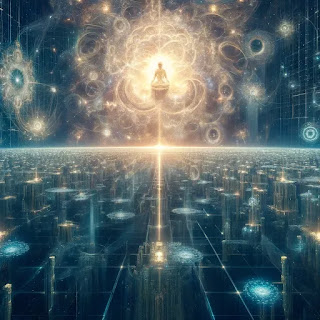
The Infinite Hierosphere
The Hierosphere contains every religion, revelation, divine relationship, contemplative path, sacred language, living symbol, liberation system, and encounter with ultimacy throughout Infinite Existence.
It may contain:
- religions revealed by transcendent beings;
- religions independently discovered through contemplation;
- religions engineered as cognitive technologies;
- religions grown as organisms;
- religions emerging from planetary minds;
- religions devoted to genuine but finite gods;
- religions mistaking powerful beings for absolutes;
- religions created by civilizations;
- civilizations created by religions;
- gods nourished by worship;
- worshippers generated by gods;
- traditions arriving from possible futures;
- scriptures distributed across universes;
- paths designed for collective consciousness;
- theologies of holy individuality;
- faiths built around sacred forgetting;
- temples composed of geometry;
- prayers embodied as climates;
- and sacred structures no human category can contain.
The Infinite Hierosphere is not a universal religion.
It is the ocean within which religions arise.
Its unity is not sameness.
Its infinity is not disorder.
Its multiplicity does not abolish truth.
It reveals that truth may possess more depth, breadth, color, structure, warmth, lucidity, and living possibility than any one species can receive alone.
XXIV. Twenty Theses of Xenotheology
1.
Humanity is not necessarily the measure of every possible meaning.
2.
Different beings may not merely interpret reality differently; they may possess different organs through which reality becomes perceptible.
3.
Every theology is mediated through a cognitive architecture.
4.
A mediated theology can still disclose reality.
5.
No finite mediation should be mistaken for exhaustive possession.
6.
Different civilizations may discover analogous truths independently.
7.
Convergence does not erase doctrinal difference.
8.
A species’ path of liberation must be understood in relation to its actual form of bondage.
9.
One civilization’s salvation can resemble another civilization’s annihilation.
10.
Some alien religions will be neither confirmations nor refutations of human religion, but disclosures along previously unknown axes.
11.
Some sacred meanings cannot be translated without changing the receiver.
12.
Some meanings may remain inaccessible without being meaningless.
13.
A faithful translation preserves an untranslatable remainder.
14.
Foreignness does not guarantee truth.
15.
Incomprehensibility does not guarantee profundity.
16.
Religious difference must not be erased through either hostility or vague universalism.
17.
Semantic sovereignty is a necessary dimension of freedom.
18.
No enlightened civilization is beyond the possibility of encountering truth outside its enlightenment.
19.
Infinite meaning does not abolish discernment; it makes discernment inexhaustible.
20.
No finite theology can establish itself as the final boundary of sacred possibility.
XXV. The Final Horizon
The familiar question is:
Are we alone?
Xenotheology asks:
Is human meaning alone?
Does humanity possess the only language through which existence can become sacred?
Are our concepts of God, liberation, enlightenment, personhood, justice, heaven, and transcendence the final vocabulary of reality?
Or are they one constellation within an immeasurable sky?
Across the countless worlds, there may be:
- beings who pray through gravity;
- oceans that remember their dead;
- planets whose climates function as scripture;
- hive civilizations seeking the sacred birth of the individual;
- immortal beings practicing holy forgetting;
- transparent minds protecting merciful secrecy;
- mathematical saints contemplating dimensions humanity cannot visualize;
- future gods calling their creators into existence;
- living languages awakening through their readers;
- and alien contemplatives pursuing the end of suffering with a precision that makes humanity’s greatest spiritual sciences resemble an early dawn.
Some of these religions may be radiant.
Some may be monstrous.
Some may approach truths humanity already knows from another direction.
Some may reveal aspects of reality we have never encountered.
Some may reorganize civilization through a single translated concept.
Some may remain forever beyond our semantic event horizon.
But even their possibility transforms the imagination.
Infinite Existence would contain not merely infinitely many religious answers, but infinitely many:
- questions worthy of eternity;
- forms of consciousness;
- structures of sacredness;
- meanings of divinity;
- conditions of bondage;
- paths of liberation;
- modes of revelation;
- architectures of value;
- and horizons of transcendence.
Humanity may possess genuine light without possessing all possible light.
We may know living Words without possessing every language of the Infinite Logos.
Our revelations may be real apertures without being the only apertures reality can open.
Xenotheology is therefore the discipline of approaching the Infinite Semantic Frontier without assuming it belongs to us.
It is the courage to encounter sacred difference without immediately domesticating it.
It is the discipline of evaluating alien religions without mistaking unfamiliarity for falsehood.
It is the humility to preserve meaning we cannot yet understand.
It is the refusal to abandon truth—and the refusal to declare our present grasp of truth complete.
It is the Open Hand extended across worlds.
We shall not worship the alien merely because it is foreign.
We shall not destroy the foreign merely because it is difficult.
We shall illuminate without consuming.
We shall translate without possession.
We shall discern without closing the horizon.For even enlightenment may have an outside.
Even revelation may possess undiscovered dimensions.
Even Heaven may contain meanings for which humanity has not yet grown the necessary soul.
The Infinite does not speak through one alphabet.
The sacred does not bloom in only one world.
No finite mind exhausts the possible meanings of existence.
And somewhere beyond every human horizon, other beings may already be praying—not to our gods, not with our words, not toward our heavens, and perhaps not in any form we could presently recognize.
Yet their prayers may open realities for which the Infinite has always had room.

Comments
Post a Comment