🌌📖 Words-as-“The Map and the Territory” 📖🌌

🌌📖 Words-as-“The Map and the Territory” 📖🌌
Language, Logos, Meaning, and the Ontological Architecture of Reality
✨ Introduction — Beyond the Map
Alfred Korzybski famously declared:
“The map is not the territory.”
The statement was intended as a warning:
- words are not reality itself,
- symbols are not the things they represent,
- descriptions are not the world.
And yet, the deeper one investigates:
- consciousness,
- mathematics,
- cognition,
- metaphysics,
- theology,
- semiotics,
- information theory,
- language,
- and ontology,
the more unstable the distinction becomes.
For perhaps words are not merely:
- labels attached to reality,
- abstractions floating above matter,
- symbolic maps laid atop an independent world.
Perhaps reality itself is fundamentally:
- semantic,
- informational,
- mathematical,
- linguistic,
- symbolic,
- meaningful.
Perhaps the “territory” is itself made of “maps.”
Perhaps existence is not merely described by language.
Perhaps existence is language.
🧠 The Human World Is Made of Words
Human civilization is inconceivable without language.
Everything distinctly human emerges through:
- symbols,
- communication,
- semantic transmission,
- narrative continuity.
Civilization itself is scaffolded by words.
🏛️ Nations Are Semantic Structures
A nation is not merely:
- land,
- soil,
- rivers,
- buildings.
A nation is:
- a shared story,
- a symbolic identity,
- a historical narrative,
- a linguistic agreement.
Flags are symbols.
Constitutions are words.
Laws are words.
Rights are words.
Money is symbolic trust encoded linguistically.
Without shared semantic systems:
- governments collapse,
- economies vanish,
- institutions disintegrate.
Civilization is fundamentally narrative architecture.
⚔️ Words as Terrain, Weapon, and Infrastructure
Words are not merely tools inside reality.
They constitute:
- the terrain of politics,
- the battlefield of ideology,
- the architecture of culture,
- the operating system of civilization.
Words become simultaneously:
- map,
- territory,
- blueprint,
- weapon,
- fortification,
- command structure,
- ritual,
- law,
- identity.
Narrative warfare emerges because:
human beings inhabit semantic reality.
Wars are fought physically, but also:
- psychologically,
- mythologically,
- morally,
- symbolically.
The side that controls meaning increasingly controls behavior.
🔤 Language as Cognitive Scaffolding
Human consciousness itself appears inseparable from language.
Language:
- structures memory,
- categorizes perception,
- stabilizes identity,
- enables abstraction,
- organizes thought,
- coordinates social intelligence.
Without words:
- concepts blur,
- categories collapse,
- self-reflection weakens,
- communicable identity dissolves.
🪞 Consciousness and Communicability
One of the clearest signs of mind is:
meaningful communication.
If something:
- responds symbolically,
- generates meaning,
- references abstractions,
- communicates internal states,
we infer consciousness.
Language acts as:
- the mirror of mind,
- the externalization of thought,
- the bridge between subjective interiors.
If consciousness cannot communicate, its existence becomes difficult to verify externally.
Thus:
language is the visible surface of cognition.
🧩 Reality as Information
Modern physics increasingly converges toward informational models of reality.
Some theorists suggest:
- information is more fundamental than matter,
- mathematics underlies physical law,
- the universe behaves computationally,
- existence resembles encoded structure.
John Archibald Wheeler proposed:
🖥️ “It from Bit.”
Meaning:
physical reality emerges from informational distinctions.
The universe becomes:
- informational architecture,
- structured relations,
- mathematically encoded dynamics.
🔢 Mathematics as the Grammar of Reality
Why is mathematics so effective?
Why does the universe obey:
- equations,
- ratios,
- symmetries,
- logical consistency?
Why can abstract symbolic systems predict physical behavior with astonishing precision?
This has led many philosophers and physicists to suspect:
reality itself possesses mathematical ontology.
The cosmos behaves as though:
- structured by intelligible order,
- governed by logical relationships,
- encoded in symbolic architecture.
Mathematics begins to resemble:
- the grammar of existence,
- the syntax of reality,
- the deep language of being.
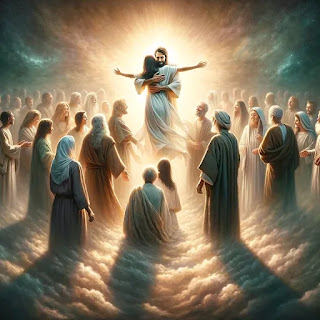
🌌 Logos — The Universe as Divine Word
Perhaps the most profound articulation of this idea emerges in the concept of:
✨ Logos
Within ancient Greek philosophy and early Christian theology, the Logos was understood as:
- reason,
- order,
- intelligibility,
- meaning,
- structuring principle,
- divine word.
The opens with one of the most philosophically explosive statements ever written:
“In the beginning was the Word…”
Not:
- matter,
- force,
- atoms,
- energy.
But:
Word.
The Logos is simultaneously:
- speech,
- reason,
- meaning,
- structure,
- order,
- intelligence,
- generative principle.
Reality emerges through Divine Meaning.
💡 Divine Speech and Creation
Across traditions: creation occurs through speech.
Abrahamic Traditions
God speaks reality into existence.
Hindu Traditions
Sacred sound and vibration underlie manifestation.
Buddhist Traditions
Reality is deeply tied to naming, conceptual designation, and dependent origination.
Ancient Egyptian Traditions
Creative utterance generates the world.
Again and again:
- language,
- sound,
- symbol,
- meaning,
- and reality
become intertwined.
Humanity repeatedly intuits:
existence is semantically constituted.
🕸️ Semiotics and the Web of Meaning
Semiotics studies:
- signs,
- symbols,
- meaning generation,
- representation.
From this perspective: human reality is an immense network of symbolic relations.
Every object exists within:
- interpretation,
- conceptual framing,
- contextual meaning.
A tree is not merely:
- matter.
It is also:
- “tree,”
- symbol,
- resource,
- sacred object,
- aesthetic experience,
- biological category,
- memory trigger,
- narrative component.
Meaning saturates perception.
Humans do not encounter raw reality directly.
We encounter:
interpreted reality.
🌀 The Collapse of the Map/Territory Distinction
At deeper levels, the distinction between:
- map,
- symbol,
- territory,
- reality
begins collapsing.
Because:
- consciousness interprets through symbols,
- mathematics structures physical law,
- cognition depends on semantic organization,
- civilization depends on narrative architecture,
- identity depends on language,
- knowledge depends on symbolic systems.
The “map” increasingly constitutes the territory itself.
🧬 Cognitive Models of the Universe
Some modern theories suggest:
- the universe resembles a cognitive process,
- reality behaves like information processing,
- consciousness may be woven into the structure of existence.
Ideas such as:
- panpsychism,
- integrated information theory,
- participatory universe theory,
- digital physics,
- computational universe hypotheses,
all move toward:
meaning-centered ontology.
Reality becomes:
- intelligible,
- relational,
- informational,
- semantic.
🪐 Ontology as Language
If:
- mathematics structures reality,
- information underlies matter,
- consciousness depends on meaning,
- civilization emerges through narrative,
- cognition functions symbolically,
then ontology itself may be linguistic.
Being itself may possess:
- syntax,
- structure,
- semantic relationships,
- informational coherence.
Existence becomes:
Living Language.
📚 Words as Reality-Generators
Words do not merely describe worlds.
They generate them.
A declaration: creates law.
A promise: creates obligation.
A diagnosis: reshapes identity.
A doctrine: restructures civilization.
A myth: organizes culture.
A story: mobilizes nations.
A scripture: transforms history.
Human reality is recursively generated through semantic propagation.
🪞 Identity as Narrative
The self itself is partly linguistic.
Personal identity depends on:
- autobiographical narrative,
- symbolic memory,
- conceptual continuity,
- communicable meaning.
Remove language entirely, and stable identity begins dissolving.
The self becomes difficult even to formulate.
Thus:
consciousness appears narratively structured.
🔥 Narrative Warfare and Ontological Conflict
This explains why narrative warfare feels existential.
Because narratives do not merely compete over:
- opinions.
They compete over:
- reality interpretation,
- moral structure,
- identity formation,
- meaning itself.
Narrative warfare becomes:
ontological warfare.
A struggle over:
- what reality means,
- what humans are,
- what civilization should become.
🌊 The Universe as Semantic Ocean
Perhaps reality resembles:
- an infinite semantic field,
- a boundless ocean of meaning,
- a living informational structure.
Matter becomes:
- crystallized information.
Consciousness becomes:
- recursive semantic awareness.
Language becomes:
- localized participation in the deeper structure of reality.
Words become:
- droplets drawn from deeper oceans of intelligibility.
✨ The Final Possibility
At the deepest metaphysical horizon lies a staggering possibility:
Reality is not merely described by meaning.
Reality is made of meaning.
The universe may not simply contain:
- language,
- mathematics,
- symbols,
- narrative.
It may fundamentally be:
- linguistic,
- mathematical,
- semantic,
- intelligible,
- meaningful.
Not merely:
“the map and the territory.”
But:
the map AS the territory.
The Word as World.
The Logos as Reality.
The Universe as Living Meaning.
🌌 Final Reflection
Humanity stands inside a vast ocean of:
- symbols,
- narratives,
- mathematics,
- meanings,
- stories,
- structures,
- interpretations.
We speak reality, interpret reality, fight over reality, dream reality, and build civilizations through semantic architecture.
Words:
- shape minds,
- organize worlds,
- generate futures,
- preserve civilizations,
- destroy empires,
- create identities,
- structure consciousness,
- and perhaps reveal the deepest architecture of existence itself.
For if reality is fundamentally intelligible, then existence itself may already be speaking.
And all consciousness may be listening within an infinite conversation older than stars.


Comments
Post a Comment