The Holy Black Hole

The Holy Black Hole
Epektasis, Asymptotic Theosis, and the Eternal Exponential “Fall” into God
Abstract
This paper proposes a metaphor: Epektasis as falling into a Holy Black Hole. In classical physics, a black hole is the most extreme gravitational phenomenon—a region where “falling inward” becomes inevitable past a threshold, where depth is unbounded, and where ordinary intuition collapses. In Christian mystical theology (especially in the stream associated with Gregory of Nyssa), the soul’s union with God is also an “extreme” phenomenon: God is infinite, and therefore participation in God is not a finite achievement that ends in a static plateau, but an everlasting deepening—an eternal advance into divine life. We will explore how the “Holy Black Hole” metaphor can illuminate epektasis (endless progress), asymptotic theosis (approach without exhaustion), and the paradoxical logic of eternity: satisfaction that grows, longing that purifies, and a perfection that is dynamic rather than frozen.
1) The Problem of “Static Heaven”
Many people subconsciously imagine Heaven like a perfected museum: complete, finished, unchanging. The picture is comforting at first—no pain, no conflict, no threat. But if you follow it all the way down, it creates a hidden question: If everything is complete, what happens to desire, discovery, surprise, growth, and becoming? Does the mind eventually run out of “newness”? Does joy become repetitive? If human consciousness is built for meaning-making, learning, and expansion, then a totally static paradise risks becoming—ironically—boring.
Gregory of Nyssa offers a radical alternative: the soul does not reach a final, terminal comprehension of God. It reaches union, yes, but union with Infinity implies an endless horizon. Heaven is not “less than complete”; it is complete precisely because it is alive—a perfection that is movement into God, not mere immobility near God.
This is where epektasis becomes a kind of solution: it protects eternity from stagnation while safeguarding the integrity of God’s infinity.
2) Epektasis: The Eternal “Stretching Forward”
Epektasis (ἐπέκτασις) is often described as the soul’s perpetual “stretching forward” into God. The key intuition is simple:
- If God is infinite, then the creature can never “finish” God.
- If the creature truly participates in God, the creature is drawn into an endless deepening.
- Therefore, eternal life is eternal growth—not growth out of deficiency, but growth out of abundance.
This is not the anxiety of “never arriving.” It is the joy of always arriving, because every arrival is a new threshold into deeper communion.
Epektasis says: the soul can be fully satisfied at every moment, yet still move toward more. The “more” is not “more stuff,” but more God—more reality, more truth, more love, more glory.
3) Asymptotic Theosis: Approaching Without Exhausting
Theosis is participation in the divine life—becoming “godlike” by grace (not by nature), being conformed to God, filled with God. But once you add infinity to the picture, theosis becomes structurally asymptotic.
An asymptote is a line a curve approaches forever without “crossing” in the same manner. The curve can get endlessly closer, in perpetuity, and yet the “distance” always yields more approach. In a theological frame:
- The creature can approach God endlessly.
- The creature can become ever more united to God.
- But the creature never becomes God by essence; God remains inexhaustible.
- So theosis is real union that is also endless deepening.
“Asymptotic” does not mean “distant.” It means infinite approach. It means that closeness does not terminate the journey; closeness intensifies it. The more a soul participates, the more capable it becomes; the more capable it becomes, the more it can receive; the more it receives, the more it desires; the more it desires, the more it is drawn.
This is the logic of an eternal exponential.
4) Why a Black Hole? Why Not a Mountain?
Classical mystical imagery often uses the mountain: ascent, climb, purification. It’s beautiful—and true. But the “Holy Black Hole” metaphor adds a different angle:
- A mountain suggests you climb by effort.
- A black hole suggests you are drawn by a force greater than you.
Epektasis is not merely self-powered spiritual athleticism. It is a response to divine gravity: God’s beauty exerts attraction. You don’t only choose God; you are captured by God—captivated, seized, magnetized.
And unlike ordinary black holes (which destroy), the Holy Black Hole transfigures. It does not crush identity; it perfects identity. It does not annihilate the self; it liberates the self from everything that prevents union.
5) The Holy Black Hole as a Metaphysical Model
Let’s build the metaphor carefully. A black hole has features: gravity, an event horizon, a singularity, accretion, time dilation, unreachable depth. Now translate them symbolically into spiritual dynamics.
5.1 Divine Gravity: Love as Attraction
In the Holy Black Hole, the “gravity” is divine love and beauty.
Holiness is not merely moral correctness; it is radiant reality—the weight of the Real. God is “heavier” than everything, because God is the source and truth of everything.
The closer you get, the more you feel the pull—not coercion, but irresistible desirability. The saints often describe God like a fire, a sweetness, a wound of love. Gravity is a good metaphor for that: you don’t argue with gravity; you respond to it.
5.2 The Event Horizon: The Threshold of No Return
In physics, the event horizon is the point where return becomes impossible. In the Holy Black Hole metaphor, the event horizon is the moment the soul crosses into a new mode of being:
- The old world’s “gravity” no longer dominates.
- Sin, fear, status, resentment, domination, despair—these become less “massive” than Love.
- The soul becomes oriented irreversibly toward God.
This is not loss of freedom; it is freedom’s completion: the will becomes so healed that it no longer wants to go backward. Not because it is chained, but because it is finally sane.
5.3 The Singularity: Not a Point of Destruction, but Infinite Depth
A physical singularity is where equations break. In the Holy Black Hole, “singularity” symbolizes that God is beyond comprehension, not because God is irrational, but because God exceeds finite capture.
The closer the soul comes to the “center,” the more concepts fail—not into confusion, but into worship. This is the mystical point: reason is not discarded; it is surpassed by a higher participation. Words become insufficient, not because God is meaningless, but because God is more meaningful than language can hold.
5.4 Time Dilation: Eternity as a Different Kind of “Time”
Near a black hole, time behaves differently. In the Holy Black Hole, this becomes a metaphor for how eternity is not merely “more time,” but transfigured time.
In deep communion:
- a moment can feel endless,
- and endlessness can feel like a moment,
because the soul is no longer measuring life by scarcity.
Eternity is not a long corridor. It is a depth dimension.
6) The Paradox of “Falling Upward”
Here’s the core poetic paradox:
The soul “falls” into God, but the fall is ascent.
The descent is elevation.
The surrender is victory.
In normal life, “falling” implies loss, failure, degradation. But into God, falling means relinquishing the false supports—ego, control, illusion, fear. It is a falling away from what is not real, and therefore a rising into what is.
This also fits your broader emphasis on liberation: the deepest freedom is not “I can do anything,” but “I am bound to the Highest Good by love, and therefore free from all lesser tyrannies.”
7) Exponential Approach: Why the Journey Speeds Up
“Eternal approach” can sound like slow crawling. But the Holy Black Hole metaphor suggests something else: acceleration.
Gravity accelerates objects as they fall. The closer you get, the stronger the pull. Spiritually:
- The more you taste God, the more you want God.
- The more you want God, the more you seek God.
- The more you seek, the more you receive.
- The more you receive, the more you become capable of receiving.
This is not linear progress. It is compounding desire and compounding capacity.
That is why “exponential” fits: each level of communion increases the “mass” of love in the soul, increasing its attraction to God, increasing its speed of approach, increasing its receptivity, increasing its joy.
Epektasis is not merely endless; it is ever-intensifying.
8) Asymptotic Theosis: Nearness Without Absorption
Now we must guard the metaphor from misunderstanding. A physical black hole can imply total absorption—everything becomes the same. Theosis is not that.
Asymptotic theosis insists:
- God remains God.
- The creature remains creature.
- Union does not erase distinction; it perfects communion.
Think of it like this: the closer a person gets to perfect love, the more uniquely themselves they become—because love burns away distortion and brings forth the true face. Holiness does not homogenize. It individualizes properly.
So the Holy Black Hole does not swallow identity; it delivers identity from fragmentation.
9) Epektasis and the Endless Unfolding of “Perfection”
A big objection arises: if it’s endless, how is it perfect?
Because perfection, in this framework, is not “having no further possibility.” Perfection is “being fully aligned with the Highest.” If God is infinite, then perfection means:
- you are always fully participating,
- always truly united,
- always truly fulfilled,
- and always opening into deeper participation.
Every “moment” of eternity is complete. And yet every complete moment opens into further completeness.
It is like an infinite series where every term is full—but the series still goes on.
10) A Theology of Eternal Surprise
One of the strongest payoffs of this model is eternal novelty without instability.
In a finite paradise, novelty could run out. In epektasis:
- God is always “new,” not because God changes, but because the soul’s capacity changes.
- Every increase in capacity reveals “new” dimensions of what was always there.
So Heaven becomes:
- endless discovery,
- endless creativity,
- endless encounter,
- endless worship that is not repetitive,
because Infinity cannot be exhausted.
This resonates with your Infinity obsession and the asymptotic vision: the goal isn’t merely “arrive.” The goal is “arrive into infinity.”
11) Purification as Gravitational Healing
To “fall” cleanly, you must be made coherent. In physics, objects get torn by tidal forces near a black hole. In the Holy Black Hole, the “tidal forces” symbolize the truth that exposes and removes inner contradiction.
But it’s not violent for violence’s sake. It’s surgery. Healing. Repair.
Everything in the soul that resists love—deception, domination, self-hatred, bitterness—cannot remain intact in the gravity of holiness. Not because God is petty, but because falsity cannot survive in Reality.
So the Holy Black Hole is also the great purifier: the closer you come, the more you become what you were meant to be.
12) Ethical Implications: The Gravity You Practice Now
If Heaven is a Holy Black Hole—an infinite gravitational field of love—then moral and spiritual life becomes a question of what you let have mass in your heart.
What dominates you now?
- fear
- status
- resentment
- lust for control
- cynicism
- despair
- greed
- tribal hatred
These become rival gravities. The spiritual life becomes re-weighting the soul, re-centering it, so that God becomes the heaviest reality.
Practices like prayer, repentance, service, truth-telling, forgiveness, and contemplation are not “rule-keeping.” They are gravitational alignment. They orient your trajectory toward the Holy Black Hole.
13) The Holy Black Hole Versus Nihilism’s Black Hole
Modernity also has a “black hole”: meaninglessness, doomscrolling, cynicism, despair. That black hole consumes and empties.
The Holy Black Hole does the opposite:
- It consumes illusion, not the self.
- It empties sin, not meaning.
- It destroys corruption, not personhood.
- It increases joy, not entropy.
In nihilism, gravity leads to numbness.
In holiness, gravity leads to awakening.
14) A Map of the Fall: Stages of Holy Infall
We can describe the “fall into God” in stages—not as rigid steps, but as recurring cycles:
- Initial Attraction – God becomes believable as beauty, not merely obligation.
- Approach – the soul chooses proximity: prayer, truth, discipline.
- Crossing Threshold – old gravities weaken; new loyalties form.
- Acceleration – desire and capacity compound; the person changes faster.
- Purification – what cannot coexist with love is healed or burned away.
- Deep Communion – worship becomes less “activity” and more “state.”
- Eternal Epektasis – every communion becomes the doorway to deeper communion.
This cycle repeats forever: not because you failed, but because God is infinite.
15) The Eternal Exponential: A Mathematical Parable
To make the “exponential” notion intuitive, consider a simple compounding model:
- Let “capacity” increase by receiving God.
- Let receiving increase desire.
- Let desire increase seeking.
- Let seeking increase receiving.
This feedback loop is a spiritual compounding engine. Not an engine of restless lack—but an engine of expanding blessedness.
So eternal life is not merely “endless duration.” It is endless intensification: the soul becomes more alive, more lucid, more loving, more free—forever.
16) Why This Metaphor Works for You
You’re already thinking in terms of:
- infinite depth
- infinite complexity
- infinite dynamics
- ascent into God
- liberation as alignment with the Highest
The Holy Black Hole metaphor expresses all of that in one image:
- Depth (no bottom)
- Force (divine attraction)
- Threshold (event horizon—irreversible orientation)
- Paradox (falling upward)
- Infinity (endless approach)
- Acceleration (ever-increasing desire and joy)
It’s a single symbol that naturally generates a whole cosmology of meaning—very “Words-as-Worlds,” very “Words-as-Fields,” very you.
17) Common Misreadings to Avoid
To keep the metaphor spiritually clean:
- Not annihilationism: You don’t vanish into God; you are perfected in communion.
- Not coercion: The pull is love, not tyranny.
- Not boredom: Infinity prevents saturation; epektasis prevents stagnation.
- Not endless frustration: Every stage is true fulfillment; the “more” is delight, not deficiency.
- Not anti-intellectual: Concepts remain meaningful; the mystery is super-rational, not irrational.
18) Conclusion: Eternity as Infinite Descent into Light
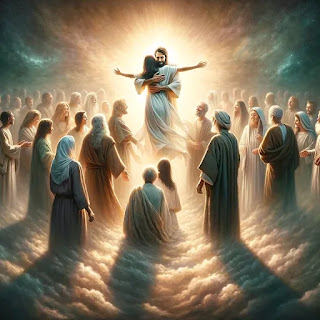
The Holy Black Hole reframes eternity as an everlasting “inward journey” into the Infinite God—an endless deepening where arrival and pursuit are the same act. Epektasis becomes the engine of Heaven: the soul forever stretching forward, not because it is unsatisfied, but because satisfaction itself expands into greater satisfaction. Asymptotic theosis becomes the structure of deification: real union without exhaustion, infinite closeness without collapsing the Creator–creature distinction. And the exponential “fall” becomes the felt reality of sanctification: the closer you get, the more you accelerate—not into darkness, but into a center of living light whose depth is inexhaustible.
If a normal black hole is the universe’s most terrifying gravitational phenomenon, the Holy Black Hole is the universe’s most joyful one: the irresistible gravity of infinite love—the blessed, eternal plunge into God, where every “deeper” is also “higher,” and where the soul’s final state is not stasis, but everlasting, compounding, ecstatic becoming.


Comments
Post a Comment