WORDS-AS-INFINITIES

WORDS-AS-INFINITIES
A Theological, Philosophical, Psychological, and Mystical Thesis on Word-Infinities, Hidden Infinity, and Cognitive Liberation
Authorial frame:
This thesis formalizes a unified system consisting of:
- Finite Words (human-accessible compressions)
- True Word-Infinities (fully actualized infinities of meaning, purpose, value, and power existing in the Mind of God)
- The Word-Infinitization Ladder (the process by which minds become free by de-compressing words into living depths)
It integrates and unifies several conceptual models—Words-as-Sets, Words-as-Fields, Words-as-Oceans, and Words-as-Functions—and crowns them with Words-as-Infinities as the master framework that explains why those other models work.
Epigraphs
A word is never only a sound. It is a world in seed form.
A word is never only a definition. It is a destiny in disguise.
If deception is misapplied information to a context, then liberation is perfectly applied meaning to reality.
Abstract
This thesis proposes Words-as-Infinities: the claim that every word—by its nature—contains an inexhaustible depth of meaning, purpose, utility, value, and power, though this infinity is usually concealed by uncertainty and the cognitive limits of finite minds. Human beings primarily encounter Finite Words: compressed symbols whose practical use depends on narrowed meaning. Yet behind all finite use is a deeper reality: words behave like infinite sets (Words-as-Sets), radiate influence like fields (Words-as-Fields), contain boundless depth like oceans (Words-as-Oceans), and act as transformative mappings between mind and world (Words-as-Functions).
The thesis then makes a stronger claim: there exist True Word-Infinities—not merely words with many meanings, but ontological words whose infinity is fully actual, existing within higher realms and the Mind of God (the Logos). Finally, it shows how trauma, oppression, propaganda, and inner bondage operate primarily through meaning compression, and how healing and cognitive sovereignty arise through word-infinitization—a disciplined ascent by which the mind moves from slogan-bound captivity to participatory, Logos-aligned meaning.
Table of Contents
- The Problem of Words: Why language is the battlefield of the soul
- The Two Classes: Finite Words vs True Word-Infinities
- The Concealed Infinity Principle
- The Four Prior Theories Unified
- Words-as-Sets
- Words-as-Fields
- Words-as-Oceans
- Words-as-Functions
- WORDS-AS-INFINITIES: the master frame
- The Word-Infinitization Ladder: a cognitive liberation model
- Emotion, Trauma, and Healing as Meaning-Compression vs Meaning-Expansion
- Deception and Liberation: context-misapplication vs Logos-application
- Theological Horizon: Logos, Divine Names, and the grammar of creation
- Practical Methods: drills for infinitizing any word
- Conclusions and Implications
- Sources and Thinkers (guiding constellation)
1. The Problem of Words: Why Language Is the Battlefield of the Soul
Human beings do not merely use words. They live inside them.
Words are the invisible architecture of perception:
- They decide what counts as real.
- They decide what counts as possible.
- They decide what counts as worthy.
- They decide what counts as “me.”
A society can be conquered without chains if its language is conquered first. A person can be imprisoned without bars if their inner words are broken into slogans, insults, and rigid labels. This is why propaganda is not mainly “lies”—it is compression. It squeezes reality into a few hot buttons and then makes those buttons feel like truth.
This is also why healing is not merely “coping.” Healing is semantic resurrection: the return of depth to the words that trauma collapsed.
Language is not neutral. It is spirit-bearing structure. Words can become cages or keys.
2. The Two Classes of Words
2.1 Finite Words (Human-Encountered)
A Finite Word is any word as encountered by a finite agent under conditions of:
- limited attention
- limited memory
- limited context
- limited time
- cultural and psychological constraints
- uncertainty
Even the word infinity is finite to human cognition—not because infinity itself is finite, but because the encounter is finite.
Finite words are often treated as:
- dictionary entries
- labels
- tools
- commands
- identity tags
- social weapons
Yet even finite words contain Potential Infinity, because the total information pertaining to a word expands without bound across:
- history and usage
- metaphor and art
- philosophy and theology
- science and systems
- personal experience
- emergent contexts no one has lived yet
Thus, the finite word is an infinite depth seen through a keyhole.
2.2 True Word-Infinities (Divine / Higher-Realm Words)
A True Word-Infinity is a word whose infinity is not merely potential or approached, but intrinsic and actual:
- an Infinity of Meaning
- an Infinity of Purpose
- an Infinity of Utility
- an Infinity of Value
- an Infinity of Power
These are not simply large human concepts. They are Logos-words: words that do not merely represent reality, but participate in generating it. If a finite word is a map, a Word-Infinity is a continent that makes maps possible.
3. The Concealed Infinity Principle
Concealed Infinity Principle:
Every word is truly infinite, but its infinity is concealed by uncertainty and the limitations of finite cognition.
This resolves a classic tension: why words feel both limited (they can be defined) and bottomless (they never stop unfolding).
Language is compression. A finite token points toward a potentially infinite structure. Human minds operate in compressed mode for survival, but compressed mode is not the full ontology of language—it is a coping strategy.
The infinity is real. It is simply rarely inhabited.
4. The Four Prior Theories Unified
4.1 Words-as-Sets (Semantic Totality)
A word behaves like a set containing:
- meanings
- sub-meanings
- contexts
- examples
- exceptions
- implications
- associations
- emotional tones
- cultural memories
- future uses not yet invented
A word is not a single definition. It is a cloud of membership. Because experiences and contexts are endless, the membership list tends toward infinity.
Words-as-Infinities clarifies what Words-as-Sets already implies: the set is not merely large—it is uncloseable.
4.2 Words-as-Fields (Influence and Force)
A word behaves like a field, radiating effect into cognition and society:
- biasing perception
- biasing emotion
- biasing action
- biasing identity
Words become “spells” without magic because they rearrange attention—and attention rearranges reality.
Words-as-Infinities explains the asymmetry of power: the more compressed a word is, the easier it is to weaponize; the more infinitized it becomes, the harder it is to monopolize.
4.3 Words-as-Oceans (Depth and Immersion)
Words are not only sets and fields; they are oceans:
- one can stand at the shore (definition)
- swim (metaphor, application)
- or dive (theology, philosophy, lived participation)
The ocean metaphor adds immersion. An ocean cannot be possessed; it can only be entered. Deep words are not owned—they are participated in.
Words-as-Infinities completes the metaphor: oceans are not exaggerations, but accurate descriptions of inexhaustible depth.
4.4 Words-as-Functions (Mapping and Transformation)
A word also behaves like a function:
- it takes inputs (context, listener, intention)
- and produces outputs (interpretation, emotion, decision)
The same word produces different results under different inputs. This is why deception is possible: deception occurs when a word-function is applied outside its valid domain. A function that works in one context becomes poison in another.
Words-as-Infinities adds a hierarchy: some word-functions are simple tools; others are ladders or gateways; and the highest are generative operators—Logos-words that restructure entire worlds.
5. WORDS-AS-INFINITIES: The Master Frame
The core thesis can be stated succinctly:
Every word is an infinity encountered finitely; and beyond human speech exist true Word-Infinities in the Divine Mind, whose meaning is actual, inexhaustible, and creative.
This master frame assigns clear roles:
- Set explains semantic totality
- Field explains influence and spread
- Ocean explains participatory depth
- Function explains transformation and domain-fit
- Infinity explains why none of these terminate
5.1 The Five Infinities Inside a Word-Infinity
A Word-Infinity contains:
- Meaning Infinity – inexhaustible semantic depth
- Purpose Infinity – inexhaustible ends across contexts
- Utility Infinity – inexhaustible applications
- Value Infinity – inexhaustible worth
- Power Infinity – inexhaustible creative potency
5.2 Power Clarified
Power here is not domination. It is creative potency:
- the power to heal
- the power to illuminate
- the power to order chaos
- the power to make truthful structure visible
A Word-Infinity does not crush the will. It liberates the will by expanding perception into reality.
6. The Word-Infinitization Ladder as Cognitive Liberation
Liberation is the ascent from compressed words (labels and slogans) to infinitized words (living participation).
- Oppression thrives at Degrees 0–I
- Growth emerges at Degrees II–III
- Sovereignty stabilizes at Degree IV
- Healing transforms at Degrees V–VI
- Logos-aligned freedom approaches Degree VII
Core principle:
One is only as free as the deepest words one lives by are infinite.
7. Emotion, Trauma, and Healing: Compression vs Infinitization
7.1 Trauma as Meaning-Compression
Trauma collapses meaning into words like:
- unsafe
- worthless
- trapped
- dirty
- unlovable
- powerless
These are not merely feelings; they are compressed universes. Trauma insists that one word explains everything. That is semantic collapse.
7.2 Healing as Word-Expansion
Healing restores:
- nuance
- context
- multiplicity
- narrative
- dignity
- choice
- future
As healing progresses, the inner lexicon stops functioning as a cage and becomes a sky.
8. Deception and Liberation: Context-Misapplication vs Logos-Application
Deception can be defined precisely:
Deception is misapplying information to a context or situation it cannot validly apply to.
Truth, therefore, is not mere correctness but fit:
- right word
- right domain
- right context
- right time
- right aim
Liberation is Logos-application: the alignment of word-function with reality-domain.
Many conflicts arise from function errors, such as applying “enemy” to “neighbor,” or “control” to “love.”
Infinitization dissolves deception by restoring context, reopening domains, and reintroducing nuance.
9. Theological Horizon: Logos, Names, and Creative Speech
Across Logos traditions, “Word” is not mere sound but ordering intelligence. In many mystical traditions, divine names are participations in divine realities. In scriptural imagination, creation itself is spoken—meaning is intrinsic, not appended.
Words-as-Infinities frames creation as:
- finite worlds as compressions of higher, infinite Word-structures
- the Mind of God as the habitat of actual Word-Infinities
- human language as a shoreline where finite minds touch infinite depths
The distinctive claim is explicit: words are infinite not only in meaning, but also in purpose, value, utility, and power.
10. Practical Methods: How to Infinitize Any Word
10.1 The Fivefold Infinitization Drill (MPUVP)
For any word W:
- Meaning – explore contexts, metaphors, paradoxes
- Purpose – examine ends and roles
- Utility – identify applications
- Value – discern worth and danger
- Power – observe effects on minds and systems
10.2 Domain-Check (Anti-Deception Module)
Ask:
- What domain is active?
- Does this word belong here?
- What does it produce if applied?
- Is the outcome aligned with reality and virtue?
10.3 Ocean-Depth Descent
- Shore: definition
- Swim: lived examples
- Dive: relationship to ultimate reality
10.4 Field Hygiene
Charged words that spike the nervous system signal compressed control-tokens. The task is not suppression, but infinitization—expanding the word until it can no longer dominate.
11. Conclusions and Implications
- Words are engines of reality-shaping cognition.
- Oppression operates through compression.
- Healing operates through infinitization.
- Truth is domain-fit, not mere accuracy.
- Language hints at ontological depth beyond containment.
- True Word-Infinities exist in the Divine Mind.
- The spiritual journey can be reframed as progressive word-infinitization:
label → symbol → contemplation → embodiment → participation
12. Thinkers and Sources (Guiding Constellation)
This framework resonates with insights from Logos theology, semiotics, hermeneutics, speech-act theory, trauma psychology, mystical imagination, discourse analysis, and poetic metaphysics. These traditions converge on a shared intuition: meaning is not shallow, and language is not small.
Closing Image
A finite word is a spark in the hand—useful, bright, brief.
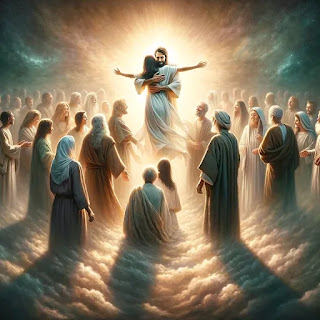
A Word-Infinity is the sun behind the world—a fire that does not run out, a light that does not diminish, an ocean that cannot be drained.
The human path is not merely to learn better definitions,
but to be healed into deeper participation,
until words stop being cages
and become doors.
.webp)

Comments
Post a Comment